
Chọn một đèn pha LED ô tô khó hơn việc so sánh công suất và giá cả. Kết quả tìm kiếm đầy rẫy các sản phẩm 150W, 200W, 220W và 300W, với những tuyên bố lumen khổng lồ, các hệ thống tản nhiệt khác nhau và hàng chục cấu hình chip. Đối với các nhà phân phối và doanh nghiệp lắp đặt chuyên nghiệp, việc chọn sai có thể dẫn đến trả hàng, khiếu nại và làm mất lòng tin của khách hàng.
This guide takes a different approach.
Instead of asking which LED looks the most powerful, we'll look at which specifications actually predict useful headlight performance and which numbers deserve more scrutiny.
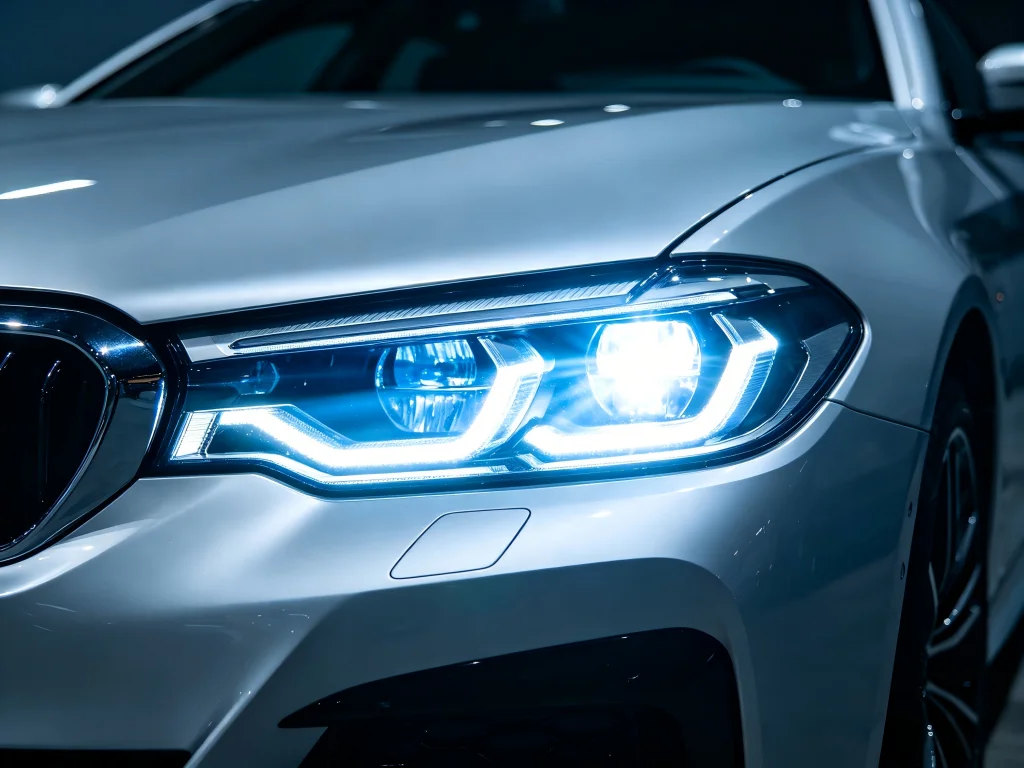
1. What Should You Look for When Buying Automotive LED Headlights?
Choose LED car headlights by evaluating beam shape, LED chip geometry, sustained power, heat dissipation design, electrical compatibility, physical installation, and supplier consistency. Wattage and lumen figures can aid comparison, but should not replace optical inspection inside the actual reflector or lens used by the vehicle.
This creates seven main purchasing criteria:
- Optical compatibility
- Beam shape
- Sustained brightness
- Quản lý nhiệt
- Control electronics
- Mechanical installation
- Supplier and manufacturing capability
Note what is not at the top of the list: advertised wattage.
2. 150W vs 200W vs 220W vs 300W LED Headlights
A 300W label does not automatically make an LED headlight better than a 150W or 200W product. Wattage only describes power consumption when measured consistently. Headlight effectiveness also depends on optical efficiency, LED placement, thermal stability, beam intensity, and the amount of light produced that reaches useful areas on the road.
| Search category | Appeal potential | Main risks | What B2B buyers should verify |
|---|---|---|---|
| 150W LED | Performance-oriented upgrade | Ratings can be misunderstood | Actual operating power per bulb |
| 200W LED light | Strong marketing position | Reduced heat and output power | Output power maintained after startup |
| 220W LED light | Premium technical specification positioning | Higher numbers may not improve optics | Beam intensity and thermal design |
| 300W LED light | Extreme performance positioning | Ratings based on pairs or inflated | Measured electrical data and test conditions |
2.1. Trap #1: Comparing Different Power Definitions
Assume Supplier A advertises 200W and Supplier B advertises 150W.
Supplier A sounds more powerful.
But Supplier A may quote combined theoretical power for a pair while Supplier B may publish a different measurement. Without knowing the test method, the comparison becomes meaningless.
Professional procurement teams should request measurable operating data and clarify whether the specification refers to one bulb or a pair.
2.2. Trap #2: Assuming More Power Means Longer Distance
A 200 watt LED headlight bulbs may consume more electrical power than another product without producing superior long-range illumination.
Why?
Because distance depends greatly on where the light is focused.
A lamp that spreads a huge amount of light over nearby areas may look brighter while producing weaker light far down the road.
3. Lumens vs. Lux: Which Number Matters?
Lumens describe luminous flux. Lux describes illuminance on a surface. Neither number should be interpreted without understanding the test setup.
For headlight buyers, this difference is critical.
Imagine two products producing similar total luminous flux. Product A focuses light effectively into useful road areas. Product B disperses more light outside those areas.
The total amount of light emitted may look similar on paper, but the driving experience can be very different.
Readers wanting basic photometric definitions can review the technical concept of lux.
4. LED chip shape: A specification most buyers overlook
This is one of the first areas our engineering team examines when evaluating replacement lamp performance.
Halogen reflectors are designed around a filament of defined size and position. When an LED replaces that filament, the LED's emitting surface must interact precisely with the existing optics.
If the light source becomes too large or moves out of the expected focal zone, beam accuracy can degrade.
Results can include:
- blurry cutoff lines;
- dark zones;
- excessive foreground brightness;
- uncontrolled upward light;
- reduced headlight focus; and
- more glare for other road users.
5. H4 LED Headlights Need Special Attention
One an LED for H4 car headlights is not just a bright LED that fits into the H4 socket.
Traditional H4 applications combine low beam and high beam functions in one bulb structure. This makes the shape of the light source particularly important.
Before purchasing H4 LED bulbs in bulk, check:
- the low beam cutoff line;
- the high beam center intensity;
- the transition between low beam and high beam;
- the installation orientation;
- compatibility with the reflector;
- the rear mounting clearance; and
- the thermal behavior during continuous operation.
A product that performs well in one housing may not perform identically in another housing. This is why application testing provides more useful information than merely evaluating the LED bulb on a test bench.
6. Fan cooling vs. passive cooling
| Yếu tố | Active fan cooling | Passive cooling |
|---|---|---|
| Heat dissipation capability | Can be high if airflow is good | Highly dependent on heatsink size |
| Compact high-power design | Usually beneficial | May require larger structure |
| Moving parts | Có | No |
| Installation considerations | Airflow should be kept clear | Heat dissipation space is very important |
| Buyer reviews | Fan quality + complete heat path | Material + area + heat path |
No architecture automatically wins.
A poorly designed fan does not become premium just because it uses active cooling. Similarly, a passive system is not automatically more reliable if it cannot dissipate enough heat for its operating power.
The right question is whether the complete thermal system keeps critical components within the appropriate operating range.
7. How to Test Thermal Stability Before Buying in Large Quantities
A useful LED headlight test should compare output at startup with output after continuous operation. If heat causes strong power reduction, initial brightness may exaggerate actual driving performance. Therefore, B2B buyers should evaluate stabilized temperature, electrical power, light output, and component behavior rather than relying on short demonstrations.
For distributors evaluating samples, a basic procurement test can follow this sequence:
- Record input voltage, current, and power immediately after startup.
- Install the light in a representative headlight configuration.
- Operate continuously under controlled conditions.
- Monitor changes in electrical power and lighting performance.
- Check the beam after the system reaches stable operating conditions.
- Repeat the test on multiple samples rather than relying on a single unit.
This final step is crucial.
B2B buyers are purchasing manufacturing consistency, not a carefully selected sample.
8. LED Automotive Headlight Price: Why the Cheapest Quote Can Cost More
When buyers search LED car headlight price, unit natural cost becomes a primary consideration.
But professional procurement should calculate a broader cost.
Consider a cheaper bulb that generates more warranty claims. Distributors may have to pay for replacements, international shipping, customer support, technician time, and damaged dealer relationships.
Those costs can exceed the initial savings.
For wholesale buyers, a more useful equation is:
Total Procurement Value = Product Performance + Consistency + Supplier Support + Market Fit – Failure and After-sales Risk
This is one reason why experienced distributors often become more demanding about quality after a few years in the market. They have learned what cheap failures cost.
9. What about 300W LED car headlights?
The phrase 300 watt LED headlight for cars attracts buyers seeking extreme performance. But such high advertised numbers deserve careful technical verification.
Ask the supplier:
- Is 300W measured or theoretical?
- Is the rating for one light or a pair?
- At what voltage is the power measured?
- What is the operating power after thermal stabilization?
- How is heat removed?
- What beam data supports the performance claim?
Apply similar questions when comparing a 220-watt automotive headlight LED hoặc 150-watt automotive headlight LED.
The number itself is not the issue. An unverifiable number is the issue.
10. Are automotive headlight LEDs legal in India?
Buyers looking for legal automotive headlight LEDs in India should separate physical compatibility from regulatory compliance.
A replacement LED may fit the socket and work electrically, but that alone does not establish the legal compliance of the resulting headlight system.
Regulatory requirements can involve vehicle type, approved lamp configurations, optical performance, installation, and other factors. Regulations can also change, so businesses should verify current requirements before importing, selling, or installing a specific lighting configuration.
For current Indian regulatory information, refer to authoritative sources such as Indian Road Transport and Highways Board and applicable automotive standards instead of relying solely on the seller's claims.
11. Searching for “LED headlight bulbs near me”?
For consumers, LED headlight bulbs near me often signals strong purchase intent.
But choosing the nearest installer should not be the only criterion.
A professional retrofitting shop should understand beam alignment, bulb orientation, electrical compatibility, projector and reflector behavior, as well as post-installation checks.
Ask the installer to demonstrate the beam rather than just showing the bulb.
12. Comparing suppliers: What should real B2B buyers score
| Purchasing factors | Low-cost goods supplier | Professional lighting manufacturer | Why It Matters |
|---|---|---|---|
| Giá | Often very competitive | Based on product positioning | Affects profit margin but not overall risk |
| Capacity announcement | May focus on prominent figures | Should support technical evaluation | Prevent misleading comparisons |
| Optical development | May be limited | Application orientation | Useful road illuminance control |
| Thermal design | Cost orientation | Performance and durability orientation | Affects maintained power |
| Batch uniformity | Must be carefully inspected | Should be managed systematically | Reduce wholesale return risk |
| Customizable | Often limited | Can support market-specific programs | Helps distributors differentiate |
| Technical support | Mainly sales-focused | Technical and application support | Useful for professional channels |
13. Why professional buyers choose GTR
GTR positioned around professional automotive lighting rather than a race for the biggest number printed on the box.
Based on our manufacturing experience, successful aftermarket lighting requires many fields to work together: optics, electronics, thermal management, mechanical engineering, production control, and practical application knowledge.
For wholesalers, distributors, importers, and tuning shop chains, this also changes what the relationship with a supplier should deliver.
You may need products tailored to local vehicle populations.
You may need different performance levels for good-better-best product positioning.
You may need packaging, branding, technical documentation, or other customization for your sales channel.
Most importantly, you need repeatable quality when an initial sample becomes a commercial order.
That is where manufacturing capability becomes more valuable than an impressive specification sheet.
14. Realistic sample evaluation checklist
Before approving your next LED headlight supplier, use this checklist:
- Measurement: Do not accept power and output claims without understanding the test conditions.
- Installation: Evaluate samples inside a realistic representative headlight.
- Illumination: Check the cut-off line, hot spot, width, dark zones, and focus of the high beam.
- Thermal: Run the product long enough to reveal thermal behavior.
- Fit: Check base dimensions, rear clearance, dust cover, and wiring system.
- Repeat: Compare multiple production samples to ensure consistency.
- Verify: Review regulations and documentation applicable to your target market.
- Calculate: Compare warranty and after-sales risks alongside purchase price.
15. FAQ: LED Car Headlight Buying Questions
15.1. Which LED headlight is best for a car?
The best choice is one that matches your vehicle's optical system while providing controlled beam distribution, stable power, efficient cooling, reliable electronics, and proper installation. There is no universal wattage that makes one LED best for every car.
15.2. Should I buy a 200W or 300W LED headlight?
First, compare verified operating wattage, sustained performance, beam quality, and thermal behavior. Larger advertised wattage does not by itself prove better road performance.
15.3. Is W enough for automotive LED headlights?
Wattage alone cannot answer this question. An efficient optical system can produce excellent useful light without chasing extreme wattage numbers.
15.4. What makes a good H4 LED bulb?
A powerful headlight an LED for H4 car headlights must provide accurate light source positioning, effective high/low beam control, stable thermal performance, appropriate dimensions, and good electrical compatibility.
15.5. Why are some LED headlights much cheaper?
Price differences can reflect LED components, driver design, heat sink materials, manufacturing consistency, quality control, packaging, supplier support, and brand positioning. Evaluate total cost of ownership rather than relying solely on price.
15.6. Can LED headlights cause glare?
Yes. Poor light source positioning, incompatible optics, improper installation, or poor headlight alignment can direct too much light into unwanted areas. Optical compatibility and proper alignment are essential.
15.7. Do LED headlights dim when hot?
Some designs may reduce output as operating temperature increases. The degree depends on thermal management and electronic control, so continuous testing is useful when comparing products.
15.8. Where can wholesalers source professional LED headlights?
B2B buyers should prioritize manufacturers that can support technical evaluation, consistent production, application fit, quality control, customization, and after-sales requirements rather than just choosing suppliers from a price list.
16. Your next headlight order should start with testing, not wattage
If you are selecting automotive LED headlights for your next product line for wholesale, distribution networks, or professional retrofit chains, don't let 150W vs 200W vs 300W become the entire purchasing decision.
Your customers don't drive by spec sheets.
They drive on dark highways, wet streets, mountain roads, and poorly lit rural routes. They will judge your product by what they actually see after the sun goes down.
Truy cập www.rhgtr.com to explore GTR automotive lighting solutions. Send us your target market, vehicle application, product positioning requirements, and expected ordering program. Instead of choosing another LED from a spreadsheet, build a lighting product line based on the performance your dealers and customers can see on the road.