
Membeli bola lampu LED pin ganda terdengar sederhana sampai Anda dihadapkan pada dinding pilihan: G4, G9, GY6.35, 12V, 120V, 2700K, 6000K, 200 lumen, 500 lumen, dapat diredupkan, tidak dapat diredupkan, silikon, kaca, gaya jagung, gaya bola. Perbedaan antara bohlam $3 dan bohlam $12 tidak selalu jelas dari kemasannya. Tetapi perbedaan dalam apa yang terjadi setelah pemasangan — apakah bohlam bertahan lima tahun atau lima bulan, apakah bohlam memancarkan cahaya yang bersih dan merata atau sinar kuning yang tidak merata — sangat besar. Panduan ini untuk pembeli yang ingin melakukannya dengan benar pada percobaan pertama.
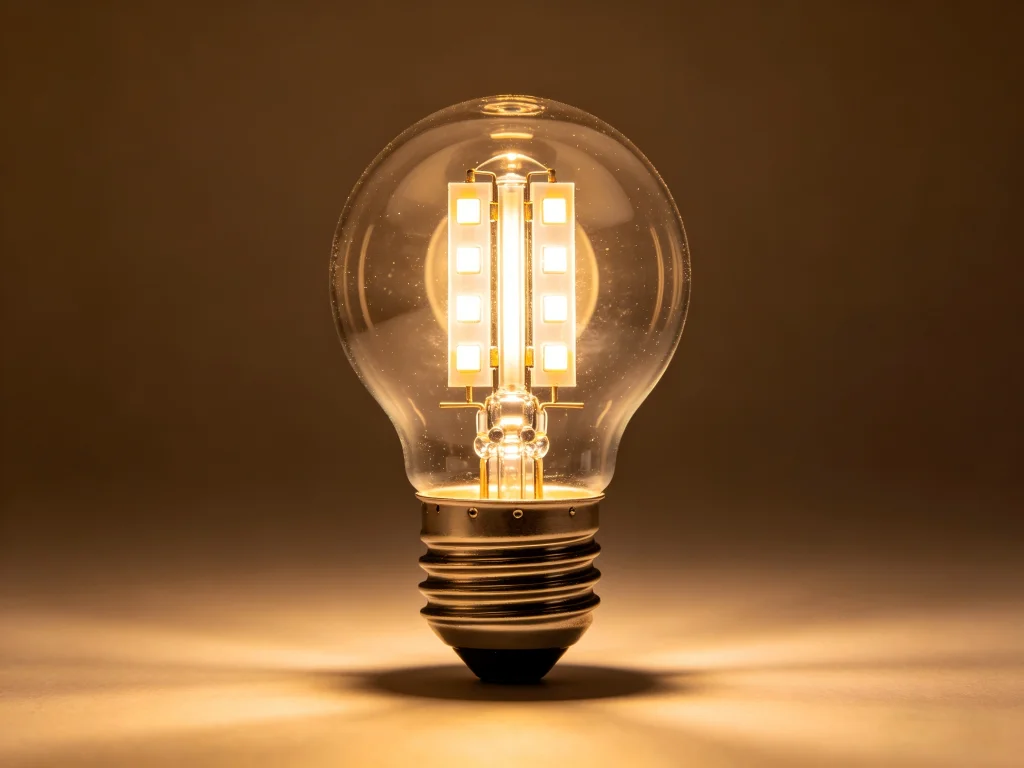
1. Understanding Bi-Pin Base Types: The Codes That Determine Fit
Bi-pin LED bulbs must match their sockets in two critical dimensions: pin spacing and pin diameter. The base codes — G4, GY6.35, GU5.3, G8, G9 — are not just model numbers. They are measurements. The number tells you the center-to-center distance between the two pins in millimeters. A G4 base has pins spaced 4mm apart. A G9 base has a 9mm spacing. Even a 1mm difference means the bulb won't fit or won't make proper electrical contact[reference:11]. This is not advice; it's a mechanical specification governed by IEC 60061, the international standard for lamp caps and holders[reference:12].
| Base Type | Pin Spacing | Typical Voltage | Aplikasi Umum | Pin Style |
|---|---|---|---|---|
| G4 | 4.0 mm | 12V AC/DC (low voltage) | Under-cabinet lights, landscape lights, RV, marine, pendant lights | Straight, thin pins |
| GU4 | 4.0 mm | 12V | MR11, MR8 reflector lamps | Straight with small flange |
| GU5.3 | 5.3 mm | 12V | MR16 reflector lamps, track lighting, recessed lamps | Straight pin, thicker |
| GY6.35 | 6.35 mm | 12V | Accent, display, landscape, some under-cabinet | Straight pin |
| G8 | 8.0 mm | 120V (line voltage) | Decorative under-cabinet fixtures | Straight pin |
| G9 | 9.0 mm | 120V (US) / 230V (EU) | Wall lamps, pendants, chandeliers, decorative | Circular pin |
G9 bases require special attention because their circular pin design is unique among bi-pin types. Unlike the straight, needle-like pins on G4, G9 pins are oval loops that provide a different mechanical connection[ref:13]. This loop design serves a functional purpose: G9 bulbs operate at line voltage, and the looped pins create a more secure connection for the higher currents involved. G4 and G9 are not interchangeable. They are completely different products for completely different electrical systems[ref:14].
2. 12V vs. 120V LED Bi-Pin Bulbs: The Decision That Makes All the Difference
The voltage question is the first fork in the road when purchasing 2-pin LED bulbs. Choose wrong, and the consequences range from a bulb that never lights up to one that burns out immediately.
| Fitur | 12V LED Bi-Pin Bulbs (G4, GY6.35, GU5.3) | 120V LED Bi-Pin Bulbs (G8, G9) |
|---|---|---|
| Requires transformer/driver | Yes — fixture includes transformer | No — connects directly to line voltage |
| Transformer compatibility concerns | High — older transformers may not work with low LED loads | Not applicable |
| Typical wattage range | 1W–5W (replaces 10W–35W halogen) | 2W–7W (menggantikan halogen 20W–60W) |
| Ukuran fisik | Sangat ringkas — periksa kecocokan di rumah yang sempit | Sedikit lebih besar — lebih banyak ruang untuk komponen driver |
| Aplikasi terbaik | Lanskap, RV, kelautan, bawah kabinet, tampilan | Lampu dinding, liontin, lampu gantung, beberapa bawah kabinet |
| Ketersediaan ritel umum | Toko lampu khusus, online, pemasok RV | Toko perkakas besar, ruang pamer lampu |
Banyak pemilik rumah Kanada mencari bola lampu LED pin ganda Canadian Tire saat halogen terbakar secara tidak terduga. Canadian Tire dan pengecer serupa memang menyediakan pengganti LED G4 dan G9 terbatas di bagian otomotif dan lampu rumah mereka. Bola lampu ini berfungsi untuk penggantian langsung di mana transformatornya modern dan dimensi perlengkapannya luas. Tetapi mereka bukan solusi universal. Jika transformator perlengkapan Anda lebih tua, bola lampu yang dibeli di toko mungkin berkedip atau gagal — terlepas dari merek pada kotaknya.
LED 12V yang dipasang di perlengkapan 120V akan hancur seketika. LED 120V di perlengkapan 12V tidak akan menyala. Selalu verifikasi persyaratan voltase perlengkapan Anda sebelum memesan LED pengganti. Sebagian besar perlengkapan memiliki informasi voltase yang dicetak di dekat soket atau pada label[referensi:15].
3. Faktor Kritis untuk Membandingkan Bola Lampu LED Pin Ganda
After base type and voltage, this is the factor that distinguishes professional-grade light bulbs from disposable ones. We have arranged them in order of importance based on our testing and field experience.
- CRI (Color Rendering Index) — Can You Really See What You See? CRI measures how accurately a light source reveals the colors of objects compared to natural light, on a scale of 0 to 100. Incandescent and halogen bulbs score 100. Quality LEDs should score at least 80. For kitchens, retail displays, vanity areas, or anywhere color accuracy matters, look for CRI 90+[reference:16]. CRI 80 is adequate for general utility lighting. Below 80, skin tones appear sallow, food looks unappetizing, and fabrics appear different from their true colors. Many cheap bi-pin LED bulbs don't even list CRI on their packaging — that silence speaks volumes.
- Actual Lumen Output vs. Marketing Claims. The lighting industry has a credibility problem with lumen ratings. Some manufacturers advertise “raw” or “chip” lumens — what the LED component produces under laboratory conditions before optical or thermal losses. Others advertise “effective” lumens — what actually comes out of the finished bulb after the driver circuit, lens, and thermal throttling take their toll. The difference can be 30% or more. When comparing bulbs, ask whether the lumen figure represents measured output of the complete product or theoretical chip output. A 300-lumen bulb that actually produces 300 lumens is better than a “500-lumen” bulb that produces 285.
- Color Temperature — The Mood of Your Space. Color temperature, measured in Kelvin (K), determines whether light appears warm (yellowish) or cool (bluish). 2700K mimics traditional incandescent — warm, cozy, flattering. 3000K is a neutral warm white, excellent for kitchens and bathrooms. 4000K is a cool white, good for task lighting and workspaces. 5000K-6500K is daylight — crisp, clinical, energizing. Using a 6500K bulb in under-cabinet kitchen applications creates harsh shadows and makes food look unappetizing. Using 2700K in a workshop reduces contrast and makes fine detail work more difficult. Match color temperature to the function of the space[reference:17].
- Build Materials: Plastic vs. Silicone vs. Glass. Cheap bi-pin LED bulbs use thin plastic housings that yellow and become brittle over time, especially in fixtures that trap residual heat. Silicone-coated bulbs offer better durability and a degree of water resistance — useful in landscape or marine applications but unnecessary indoors. Glass bulbs provide the best light diffusion and the most premium appearance, but they are heavier and more fragile. For high-end residential and commercial applications, glass or high-grade polycarbonate is the standard.
- Driver Circuit Quality and Dimming Compatibility. The driver circuit converts incoming power into the constant current required by the LED chips. Poorly designed drivers result in flicker, audible hum, and incompatibility with dimmers. Quality drivers include components that smooth voltage fluctuations, suppress electromagnetic interference, and communicate reliably with both leading-edge and trailing-edge dimmer switches. If dimming is important in your application, ensure both the bulb and the dimmer are explicitly rated for LED dimming. Even among “dimmable” bulbs, performance varies widely — some dim smoothly from 100% down to 5%, while others flicker below 20%.
- Wattage Equivalence Accuracy. Common claim: “3W LED replaces 20W halogen.” This equivalence is based on lumen output, not wattage, so verify the actual lumen numbers. A quality 3W LED produces around 250-350 lumens. A 20W halogen produces about 200-300 lumens. But a low-efficiency 3W LED might only produce 180 lumens — dimmer than the halogen it's supposed to replace. Check lumen ratings against your existing bulb before assuming wattage equivalence means equal brightness.
- Beam Angle — Where Does the Light Go? Bi-pin LED bulbs come in various beam patterns depending on the arrangement of LED chips and lens design. Corn-style bulbs with LEDs arranged around a cylindrical core produce a wide 270-360 degree light distribution — ideal for chandelier bulbs and decorative fixtures where the bulb is visible and omnidirectional light is desired. Single-sided or disc-style bulbs focus light in one direction — better for puck lights and directional task lighting. If your fixture uses a reflector, choose a bulb with a focused forward beam pattern rather than a 360-degree design that wastes light inside the housing.
- Certifications and Safety Marks. For the North American market, look for the UL or ETL certification mark on the product or packaging. This indicates that the bulb has been tested to recognized safety standards for electrical and fire safety. The CE mark alone is not equivalent to UL/ETL listing and does not meet North American electrical inspection requirements. If you are installing double-pin LED bulbs in a commercial environment, rental property, or anywhere an electrical inspection may occur, use listed products.
4. Application-Specific Buying Guide: Matching the Bulb to the Job
4.1. Under-Cabinet Kitchen Lighting
For puck lights with a G4 base, the priorities are: compact size (measure your fixture depth before buying), warm color temperature (2700K-3000K for residential kitchens), and transformer compatibility (test one bulb before buying six). G8 and G9 bases are also common in newer under-cabinet fixtures — these use direct line voltage, avoiding transformer issues altogether. For food preparation areas, a CRI of 90+ is worth the extra cost. You want to see if the chicken is done, not guess under dim light[reference:18].
4.2. 12V RV and Marine Lighting
RV owners looking for 2-pin LED bulbs typically replace the standard 12V G4 halogen capsules found in dome ceiling lights, reading lights, and exterior patio fixtures. The key considerations here differ from residential: voltage range tolerance (RV battery systems can swing from 11V to 14.5V), physical size (RV fixtures are often very shallow), and color temperature (3000K-4000K works well for RV interior living spaces). Marine applications add corrosion resistance as a concern — look for bulbs with sealed electronics if the fixture is exposed to salt air or moisture[reference:19].
4.3. Wall Sconces and Pendant Lights (G9 Base)
G9 double-pin LED bulbs are standard for many contemporary wall sconces and pendant lights. These fixtures typically operate on 120V line voltage, so transformer compatibility is not an issue. The priorities here are: lumen output (sconces and pendants are often the primary light source in a room), color rendering (CRI 85+ is recommended for living spaces where people spend time), and physical appearance (the bulb may be visible through clear glass shades, so choose a globe style that looks intentional, not industrial). Dimmability is a plus for dining areas and living rooms where mood control is important.
4.4. Landscape and Outdoor Lighting
Low-voltage landscape lighting almost exclusively uses G4, GY6.35, or GU5.3 double-pin bases. These systems are powered by 12V transformers that may be magnetic (older, heavier, more reliable with LEDs) or electronic (newer, lighter, more likely to have minimum load issues). For outdoor use, verify the bulb's IP rating or at least ensure the fixture itself provides adequate weather sealing. Silicone-bodied bulbs resist moisture better than bare PCB designs. Color temperature choice here affects curb appeal — 2700K creates a warm, inviting glow for pathways and gardens; 4000K is better for security lighting.
5. Double-Pin LED Socket Types: The Connection Point That Defines Reliability
The double-pin LED bulb socket often overlooked during the purchase decision, but it is the single interface between the bulb and the power source. Poor socket contacts cause flickering, intermittent operation, sparking, and premature bulb failure. Double-pin sockets use friction connections rather than screw threads or twist locks, which makes them compact and simple but also prone to loosening over time, especially in fixtures subject to vibration (RVs, boats, ceiling fans)[reference:20].
When inspecting existing fixtures before upgrading to LED, pay attention to the socket contacts. Are they clean and shiny, or corroded and dull? Corroded contacts create electrical resistance, which generates heat and reduces the voltage reaching the bulb. In 12V systems, even a small voltage drop at the socket means a significant percentage of the total supply. Clean the contacts with electrical contact cleaner and a cotton swab before installing new LED bulbs. If the socket grips the bulb pins loosely — if the bulb wobbles or pulls out with minimal force — the socket may need replacement. Loose connections that spark intermittently will damage the LED driver circuit much faster than continuous operation at rated voltage.
G4 sockets have two small holes spaced exactly 4mm apart. The bulb pins push straight in — no twisting, no locking mechanism. This design has been standardized for decades and works reliably when both pins make strong, clean contact. GU5.3 and GY6.35 sockets are similar but sized for their respective pin spacings. G9 sockets accommodate the distinctive looped pins of G9 bulbs and provide a slightly more secure connection due to the larger contact surface area of the loop design.
6. Why GTR Dual-Pin LED Products Earn Their Place in Professional Installations
Among brands serving the dual-pin LED market, GTR Lighting occupies a distinct position: automotive-grade engineering applied to specialty lighting. Our manufacturing philosophy does not chase the lowest possible unit cost. It pursues the lowest total cost of ownership — a bulb that is installed once and runs reliably for years.
Our product specifications reflect real-world measured performance. When we state lumen output, it means the effective lumens of the complete assembled bulb, not theoretical chip lumens. When we quote CRI ratings, it is a measured value, not aspirational. When we specify a voltage range, the bulb operates reliably across that entire range, not just at the nominal midpoint.
Our dual-pin LED bulbs are built around wide-input driver circuits that tolerate voltage fluctuations common in RVs, marine, and older residential electrical systems — the same engineering approach we use in our automotive LED lines, where alternator voltage can vary by several volts during normal driving. This resilience means our bulbs survive conditions that cause cheaper alternatives to fail prematurely.
We design our bulb bodies to match the dimensional footprint of the halogen capsules they replace, minimizing the fitment issues that plague generic LED retrofits. We use quality heatsink materials — not plastic shells with token aluminum discs — to manage LED junction temperatures and maintain brightness and color accuracy over tens of thousands of hours.
Kunjungi rhgtr.com to explore our complete range of dual-pin LED globe options, including low-voltage G4, line-voltage G9, and special application bulbs. For commercial and wholesale inquiries, ledcxr.com offers additional information on customization options, OEM capabilities, and volume pricing. Our team works with lighting designers, electrical contractors, and facility managers every day — we can help you specify the right product for your installation, not just sell you a bulb.
7. FAQ: Answers to Questions Buyers Search Before Purchasing
7.1. What does the "G" mean in G4 and G9 bulb codes?
“G” historically indicated that the original bulb used glass construction. Today, it simply denotes a multi-pin base type. The number — 4, 8, 9, etc. — is the center-to-center distance between the pins in millimeters[reference:21].
7.2. Are G4 and G9 bulbs interchangeable?
No. G4 bulbs have a 4mm pin spacing and are almost always low voltage (12V). G9 bulbs have a 9mm pin spacing and operate at line voltage (120V or 230V). They have different pin styles (straight vs. looped), different voltage requirements, and different physical dimensions. They are completely incompatible[reference:22].
7.3. Bagaimana saya tahu apakah bohlam yang ada saat ini adalah G4 atau G9 tanpa melepasnya?
Jika Anda dapat melihat pin, ukur jarak di antara keduanya. 4mm = G4; 9mm = G9. Jika Anda tidak dapat mengakses pin, periksa label perlengkapan untuk tegangan: 12V hampir pasti menunjukkan G4; 120V bisa jadi G8 atau G9. Jika ada transformator di langit-langit atau dasar perlengkapan, Anda berurusan dengan sistem G4 bertegangan rendah[referensi:23].
7.4. Apa yang terjadi jika saya memasukkan bohlam LED 12V ke soket G9 120V?
Bohlam akan langsung rusak — driver internal menerima tegangan sepuluh kali lipat dari ratingnya dan gagal. Dalam beberapa kasus, kegagalan ini disertai dengan bunyi letupan, asap, atau pemutus sirkuit yang trip. Jangan pernah mencoba memaksakan bohlam ke soket yang tidak dirancang untuk itu[referensi:24].
7.5. Mengapa beberapa bohlam LED bi pin berharga $3 sementara yang lain berharga $15?
Perbedaan harga mencerminkan kualitas komponen: chip LED itu sendiri (merek terkenal vs. generik), desain sirkuit driver (teratur vs. berbasis resistor minimal), bahan heatsink (aluminium vs. plastik), peringkat CRI (80+ vs. tanpa peringkat), dan sertifikasi keselamatan (terdaftar UL/ETL vs. tidak bersertifikat). Bohlam $3 mungkin menghasilkan cahaya saat pertama kali dipasang, tetapi kemungkinan besar akan cepat rusak, berkedip, berubah warna, atau menimbulkan bahaya kebakaran — terutama di perlengkapan tertutup dengan ventilasi terbatas.
7.6. Bisakah saya mencampur bohlam halogen dan LED pada sirkuit 12V yang sama?
Ya, dan dalam beberapa kasus menambahkan bohlam halogen ke sirkuit LED menstabilkan transformator dan menghentikan kedipan dengan meningkatkan total beban di atas ambang minimum transformator. Namun, ini adalah solusi sementara untuk mengatasi masalah, bukan solusi permanen yang direkomendasikan. Bohlam halogen masih mengonsumsi daya yang signifikan dan perlu diganti setiap 2.000 jam, sebagian mengalahkan tujuan peningkatan LED. Mengganti transformator dengan driver yang kompatibel dengan LED adalah perbaikan jangka panjang yang tepat.
7.7. Apakah saya perlu teknisi listrik untuk mengganti bohlam halogen bi pin saya dengan LED?
Untuk sebagian besar perlengkapan G9 tegangan saluran, tidak — penggantiannya plug-and-play. Untuk sistem G4 bertegangan rendah di mana transformator mungkin perlu diganti, dan untuk pemasangan apa pun yang melibatkan kabel listrik utama, teknisi listrik disarankan. Di properti sewaan dan bangunan komersial, kode kelistrikan mungkin mensyaratkan teknisi listrik berlisensi untuk pekerjaan apa pun selain sekadar mengganti bohlam di soket yang ada.
Referensi: Spesifikasi dasar bi-pin didefinisikan oleh IEC 60061 (Komisi Elektroteknik Internasional). Pengukuran tipe dasar dan klasifikasi tegangan didasarkan pada standar industri dan spesifikasi pabrikan. Selalu verifikasi persyaratan spesifik perlengkapan Anda sebelum membeli bohlam pengganti.