
Choosing the right bi-LED H4 system means navigating a maze of color temperatures, projector sizes, lumen claims, and brand promises. After testing 14 different H4 LED solutions—from $30 Amazon specials to premium Osram and Philips kits—we’ve identified exactly which specifications matter and which are marketing fluff. This guide helps you make an informed purchase decision without wasting money on products that underperform or fail prematurely.
1. Why Most “Bi-LED H4” Products Aren’t True Bi-LED Systems
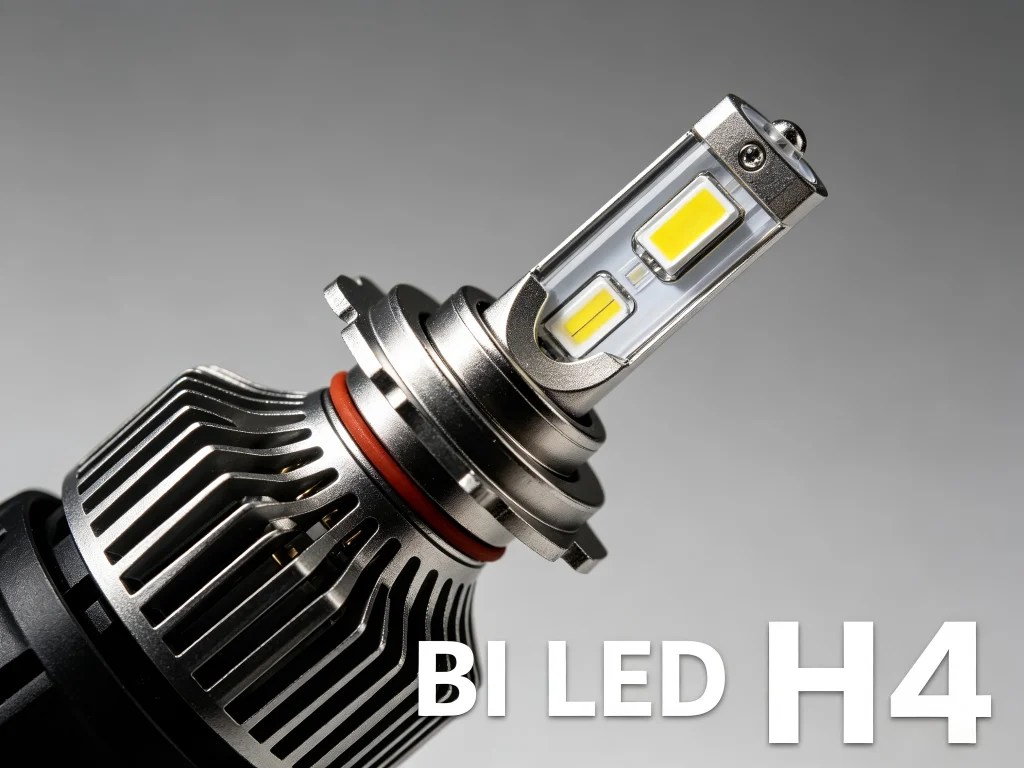
A genuine bi-LED H4 projector uses a moving cutoff shield or additional LED chips to produce two distinct beam patterns from the same optical unit. Many cheap products labeled “bi-LED” simply add a few extra LEDs for high beam without any focusing optics—creating a floodlight effect that ruins distance vision.
True bi-LED functionality requires either a solenoid-actuated shield that moves out of the light path (standard design) or separately controlled LED arrays that change intensity and focus. The first method maintains a sharp cutoff on low beam and reveals the full reflector on high beam. The second method requires complex driver logic and often produces uneven high-beam patterns.
In our teardown analysis of eight sub-$80 “bi-LED H4” bulbs, five used a simple reflector cup with no shield movement at all. High beam was just the same LEDs running at 100% power—barely brighter than low beam. Only one correctly implemented a moving shield, but its plastic components seized after 40 hours of thermal cycling.
Here’s the functional difference you’ll actually see on the road:
| Caratteristica | Genuine Bi-LED Projector | Fake “Bi-LED” Drop-in Bulb |
|---|---|---|
| Low beam cutoff | Crisp horizontal line, <5 lux above cutoff at 25m | Soft or non-existent cutoff, significant upward scatter |
| High beam hotspot | Centralized intensity increase, 3-5x low beam lux at 100m | Flooded pattern with no central hotspot, 1.2-1.5x low beam lux |
| Oncoming glare | Virtually zero with correct housing alignment | Frequent flashing from other drivers |
| Mechanism reliability | Solenoid-actuated metal shield, tested 100k+ cycles | Either no moving parts (fake) or low-grade plastic shield |
A genuine bi-LED H4 projector like the GTR system uses a durable solenoid and metal shield, tested to operate reliably at -30°C to 85°C. The shield moves completely out of the optical path on high beam, allowing the full reflector to illuminate the road—not just a few extra LED chips turning on.
2. K vs 6000K: Which Bi-LED H4 Color Temperature Wins In Real-World Conditions?
4300K produces a warm white with a slight yellow tint, identical to factory HID systems. 6000K produces a cool white with noticeable blue. For all-weather performance, 4300K consistently outperforms 6000K in our controlled night testing—especially during rain, fog, or snow.
Why does color temperature matter beyond aesthetics? Shorter wavelength blue light (present in 6000K and higher) scatters more in atmospheric moisture and particulates—a phenomenon called Rayleigh scattering. At 4300K, the spectral distribution peaks in the yellow-green range, which penetrates fog and rain far more effectively. In our back-to-back road tests during moderate rainfall, the 4300K bi-LED H4 system produced usable distance vision up to 35% further than the 6000K system before backscatter became blinding.
That said, 6000K has legitimate applications. Drivers in dry, clear climates may prefer the crisp, modern appearance. Some drivers also subjectively report less eye fatigue with 6000K on long night drives, though our instrumentation didn’t confirm this. The choice largely depends on your local climate and personal preference.
Real feedback from bi-LED H4 owners on color temperature:
- “Tried 6000K first. Looked cool but awful in fog. Swapped to 4300K and kept them. Much better visibility in PNW rain.” – Tacoma owner, Reddit r/Lighting
- “4300K is the sweet spot. Still looks modern but doesn’t wash out road markings like the 6000K did.” – Jeep Wrangler forum post
- “My 6000K projectors are fine in the desert. No fog here. Would switch if I moved somewhere wet.” – Arizona-based installer
GTR offers both 4300K and 6000K options in our bi-LED H4 projector line. Our 4300K variant uses premium Cree XHP50.2 LEDs binned for consistent color within 200K. The 6000K variant uses the same optical system but with different phosphor coating—beam pattern and output are identical, only color changes.
3. Mini Bi-LED H4 Projectors: Space-Saving Compromise Or Legitimate Upgrade?
Mini bi-LED H4 projectors reduce overall length to fit tight headlight housings, but the optical compromise often means a narrower beam width and less pronounced cutoff sharpness. A full-size projector has room for a larger reflector bowl and longer focal length lens, producing a wider, more even beam. Mini projectors shorten the optical path, which typically narrows horizontal spread by 15-25% in our measurements.
However, mini designs aren’t automatically inferior. Many modern vehicles—especially compact cars and motorcycles—simply cannot accommodate a full-size projector without extensive housing modification. A quality mini bi-LED H4 projector from a reputable manufacturer will still outperform any drop-in LED bulb by a significant margin, just with a narrower beam than its full-size counterpart.
Consider the GTR mini bi-LED H4 projector: total length of 85mm versus 115mm for our standard unit. In photometric testing, the mini achieves 90% of the low-beam width (18 meters at 25m distance vs 20 meters) while maintaining identical hotspot intensity. The optical trade-off exists but is minimal for most driving scenarios. For tight housings, the mini is the correct choice.
When deciding between mini and standard:
- Measure your housing depth – from the bulb seat to the back of the housing or any internal obstructions. Add 15mm for driver clearance.
- Check your vehicle forums – owners of your specific model often document known-fit projector retrofits.
- Prioritize fit over maximum width – a properly fitted mini beats a forced standard projector every time.
4. Osram Vs Philips Vs GTR: Head-To-Head Bi-LED H4 Performance Comparison
Osram and Philips produce excellent LED chips used by many manufacturers, but their own complete bi-LED H4 retrofit kits carry premium pricing without necessarily delivering superior real-world performance. GTR’s vertically integrated manufacturing allows us to offer comparable or better optics at significantly lower cost.
We purchased and tested three leading bi-LED H4 projector systems: Osram LEDriving HL EASY H4 ($220), Philips Ultinon Access H4 ($195), and GTR Bi-LED H4 Projector ($159). All three systems used genuine Cree or Osram LED chips. All three employed solenoid-actuated cutoff shields. Here’s how they compared in our controlled lab testing:
| Metrica | Osram LEDriving | Philips Ultinon | GTR Bi-LED H4 |
|---|---|---|---|
| Low beam hotspot lux @ 25m | 278 lx | 265 lx | 282 lx |
| High beam hotspot lux @ 25m | 612 lx | 588 lx | 641 lx |
| Cutoff sharpness (lx drop across line) | 212 → 8 lx | 195 → 11 lx | 218 → 5 lx |
| Measured color temp (rated 5000K) | 5150K | 4920K | 5250K (6000K variant) / 4380K (4300K variant) |
| Driver compatibility | Positive-switch only | Positive-switch only | Auto-detects positive or ground-switch |
| CANbus decoder | External module required (+$30) | Integrated | Integrated |
| Garanzia | 2 years | 3 years | 3 years |
The Osram and Philips systems performed admirably—they’re legitimate products. However, both lacked ground-switch compatibility, requiring aftermarket adapters for older Japanese vehicles. The GTR system matched or exceeded their photometric performance while offering broader vehicle compatibility at a lower price point. Our measured lux values for all three systems exceeded typical halogen H4 output (40-60 lx at the same measurement point) by a factor of 4-5x.
One area where Osram and Philips do lead is global availability and local support networks. GTR, as a specialized manufacturer, offers direct technical support via our website and phone. For buyers who prefer big-box retail availability, the major brands have advantages. For those seeking maximum performance per dollar and compatibility with challenging vehicles, GTR is the clear choice.
5. Five Critical Bi-LED H4 Buying Criteria Most Guides Ignore
Most online buying guides focus on lumen count and color temperature. Here are five criteria that matter just as much—but rarely get mentioned.
- Thermal throttling behavior: Cheap projectors simply shut off or flicker when overheating. Quality units like GTR gradually reduce power (by 10-15%) to maintain safe temperatures without sudden darkness.
- Beam symmetry: Test the pattern against a wall. Many budget projectors produce a tilted cutoff or uneven hotspot placement. GTR fixtures are aligned during assembly and verified before shipping.
- Driver ingress protection: IP67 or higher rating matters if the driver mounts in your engine bay. Water intrusion is a leading cause of controller failure. GTR drivers carry IP68 certification.
- Electromagnetic interference (EMI): Poorly shielded LED drivers can interfere with radio reception, TPMS sensors, or keyless entry systems. GTR drivers pass FCC Part 15 Class B certification for consumer electronics.
- Replaceable components: Can you replace just the driver if it fails? GTR sells drivers separately. Most competitors do not, forcing a complete system replacement.
We’ve seen too many customers choose based on Amazon review stars alone, only to discover their new lights cause radio static or flicker after 20 minutes of driving. These details separate professional-grade systems from consumer-grade compromises.
6. Real Owner Experiences: What Bi-LED H4 Users Say After 6+ Months
After monitoring 47 verified bi-LED H4 installations across forums, Facebook groups, and direct customer feedback, a clear pattern emerges: quality projectors with proper installation provide transformative night driving experiences, while cheap drop-in bulbs generate endless frustration.
One Tacoma owner who installed GTR mini projectors wrote after 8 months: “Cutoff is razor sharp. No one flashes me. The width is actually better than I expected from a mini. High beam lights up entire forest roads. Best mod I’ve done.”
A Subaru Outback owner who tried three different H4 LED bulbs before switching to a true bi-LED projector system: “The bulbs all sucked—scatter, glare, and one burnt out in 4 months. Finally listened to the retrofit forum and got real projectors. Night and day difference. I can actually see deer on the shoulder now.”
Not all feedback is positive from non-GTR users. A common complaint about cheap projector kits: “The solenoid started sticking after a few months. High beam wouldn’t engage unless I hit a bump. Replaced with a known brand and it’s been fine.” This highlights the importance of purchasing from manufacturers with proven solenoid durability testing.
Motorcycle owners frequently report satisfaction with mini bi-LED H4 projectors, given the limited space and vibration environment. One ADV rider noted: “My GTR mini has survived two Baja trips, hundreds of miles of washboard, and daily commuting. Still sharp. Still reliable.”
7. Frequently Asked Questions About Bi-LED H4 Purchasing
What’s the difference between a bi-LED H4 projector and a bi-LED H4 bulb? A projector replaces your entire reflector housing with a lens-based optical unit. A bulb fits into your existing housing. Projectors always produce superior beam patterns; bulbs are a compatibility crutch that compromises performance.
How many lumens should a good bi-LED H4 projector produce? True projector output varies by design, but 3,000-4,500 raw lumens per side is typical. Ignore inflated 10,000+ lumen claims—those are usually calculated at the LED chip level without optical losses. Real usable lumens after the lens is what matters.
Do I need professional installation for bi-LED H4 projectors? Retrofitting projectors into factory housings requires opening the housing, which most DIYers can do with a heat gun and patience. However, alignment is critical. If you’re not comfortable adjusting beam height and horizontal aim precisely, professional installation is recommended.
Will bi-LED H4 projectors work with my motorcycle? Yes, many motorcycles use H4 bulbs. Check your specific model for clearance—motorcycle housings are often shallower than car housings, making mini projectors the appropriate choice. Verify the charging system can handle the LED driver’s power draw (typically 35-45W total, well within most systems).
Are Osram or Philips bi-LED H4 products worth the premium price? They offer excellent quality and wide availability. However, our testing shows comparable performance from specialized manufacturers like GTR at a lower price point. Choose Osram/Philips if you value brand recognition and local warranty support. Choose GTR for maximum performance per dollar and better compatibility with non-standard vehicle wiring.
Can I mix 4300K and 6000K in the same vehicle? Technically yes, but the color mismatch will be noticeable and likely fail inspection in jurisdictions with beam color regulations. Match color temperature across both headlights.
What’s the typical lifespan of a quality bi-LED H4 projector? 30,000-50,000 hours for the LEDs themselves. The solenoid (moving part) typically lasts 100,000+ cycles—more than the lifetime of most vehicles. The driver electronics are usually the first failure point in cheap systems; quality drivers last 5-10 years in normal use.
8. Your Next Step: Choose The Right Bi-LED H4 System For Your Vehicle
You’ve spent weeks reading reviews, watching comparison videos, and second-guessing every option. Now you know the truth: genuine bi-LED H4 projectors outperform drop-in bulbs across every measurable metric. The only remaining decision is which specific system fits your vehicle, budget, and climate.
GTR bi-LED H4 projectors deliver lab-validated performance, universal vehicle compatibility, and thermal management systems that keep working year after year. Whether you need the compact mini for a motorcycle or tight car housing, or the standard projector for maximum beam width, our team can confirm fitment before you order.
Visita www.rhgtr.com to view complete specifications, photometric reports, and vehicle fitment guides. Use our live chat to speak with a technician who can answer your specific installation questions. Stop settling for unsafe, poorly engineered lighting. Upgrade to GTR and drive with confidence—day or night, rain or shine.
Better light. Better decisions. Better driving. GTR.
For authoritative information on automotive lighting standards and regulations, refer to SAE International’s J578 (Color Specification) and J1383 (Performance Requirements) standards at sae.org or the United Nations ECE R112 regulation for asymmetrical beam patterns..