
正しい選択 off road led lights for your vehicle isn’t straightforward. Walk into any off-road shop or scroll through Amazon, and you’re confronted with hundreds of options — different sizes, different beam patterns, different price points, and wildly different claims about brightness and durability.
Most of those claims are exaggerated. Many of those lights will fail within 18 months. And almost none of the buying guides out there tell you what actually matters.
This guide is different. We’re going to break down everything you need to know — the technology, the specifications, the marketing tricks, and the real-world factors that separate lights that perform from lights that disappoint.
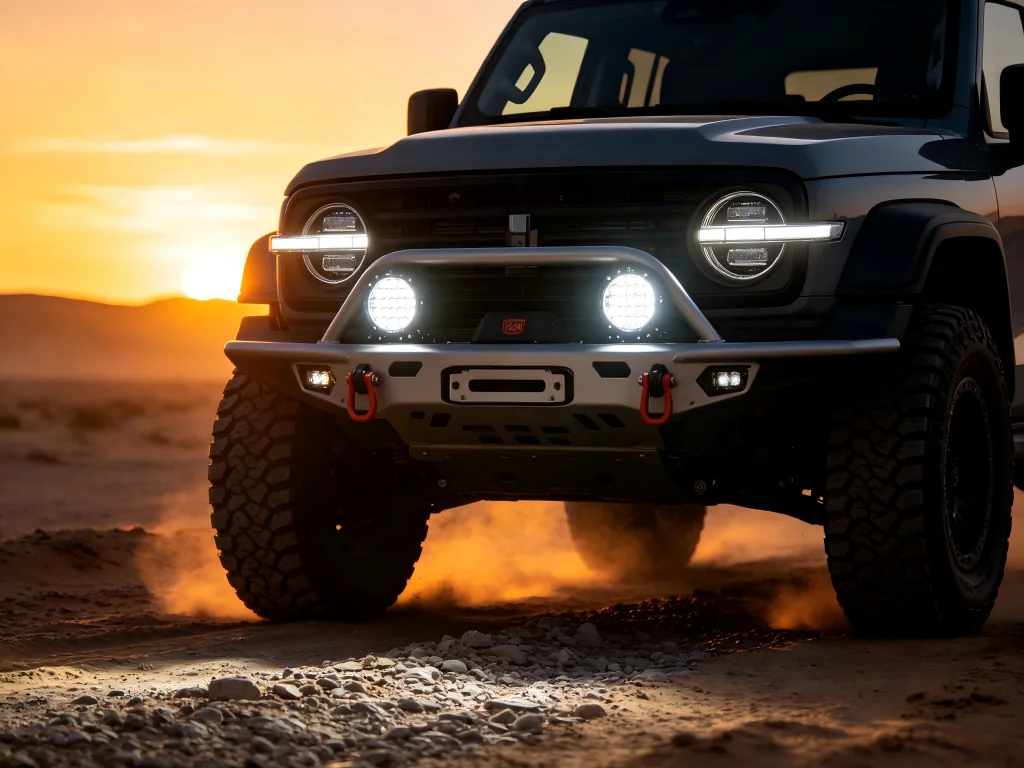
1. LED vs. Halogen vs. HID: Which Technology Wins?
Before we dive into specific products, let’s settle the technology debate once and for all.
1.1. Halogen — The Old Standard
Halogen lights use a heated filament to produce light. They’ve been the standard in automotive lighting for decades.
Pros: Cheap to buy. Easy to replace. Functional in most conditions.
Cons: Short lifespan (400-1,000 hours). Poor efficiency. Produce yellowish, less-clear light. Draw more power for less output. A standard 55W halogen produces roughly 1,000-1,500 lumens.
1.2. HID (High-Intensity Discharge) — Bright but Complicated
HID lights use an electrical arc to produce light. They’re extremely bright — often the brightest option available.
Pros: Very high output. Wide color temperature range.
Cons: Expensive. Require warm-up time. Can blind oncoming traffic. Complex installation.
1.3. LED — The Clear Winner for Off-Road
LED (light-emitting diode) lights use electroluminescence to produce light — not heat.
直接的な回答: LEDs are the superior choice for off-road lighting because they deliver more light per watt, last 10-50 times longer than halogen, withstand vibration and impact better, and reach full brightness instantly with no warm-up time.
Pros:
- 5-10x longer lifespan than HID, 50x longer than halogen
- 80% less energy draw than comparable halogen lights
- Instant-on — full brightness immediately
- More robust housings that withstand vibration, water, and mud
- More compact design for flexible mounting
Cons:
- Higher upfront cost than halogen
- Quality varies enormously between manufacturers
| 要素 | ハロゲン | HID | LED |
|---|---|---|---|
| 寿命 | 400-1,000 hours | 2,000-5,000 hours | 30,000-50,000 hours |
| Lumens per Watt | ~20-30 | ~80-100 | ~100-150+ |
| Warm-up time | Instant | 5-15 seconds | Instant |
| Durability | 壊れやすいフィラメント | 中程度 | Extremely robust |
| Cost | Low | 高 | Medium-High |
2. Light Bars vs. Pod Lights: Which Should You Choose?
This is one of the most common questions off-roaders ask. The answer depends on your vehicle, your terrain, and your driving style.
2.1. LED Light Bars — Maximum Coverage
An LED light bar is a long, linear lighting solution designed to deliver maximum forward-facing illumination across a wide area.
Best for: Trucks, SUVs, UTVs, and race vehicles that operate at night or in low-visibility conditions. High-speed desert running. Wide, open terrain.
Key advantages: Massive light output. Wide coverage. Clean, uniform beam. One light, one installation.
Considerations: Higher upfront cost. Larger footprint limits mounting options. Fixed beam pattern — less adjustable than pods.
2.2. LED Pod Lights — Targeted Precision
Pod lights are compact, modular lights built for targeted illumination. They can be aimed precisely where you need light most.
Best for: Technical terrain like rock crawling. Slow-speed trail riding. Supplementing a light bar. Vehicles with limited mounting space.
Key advantages: Highly adjustable. Can be mounted almost anywhere. Modular — start with a few and add more as needed.
Considerations: Lower output per unit. May require multiple pods to match a single bar’s output.
The pro move: Many serious off-roaders use both — a light bar for wide, forward coverage and pod lights for cornering, ditch lighting, or specific terrain needs.
3. Beam Patterns: Choosing the Right Light for Your Terrain
Beam pattern determines how usable your light is. A poorly focused 10,000-lumen light will underperform a properly focused 6,000-lumen light every time.
3.1. Flood Beams
Spread light wide and close. Excellent for illuminating terrain right in front of you — rocks, ruts, and obstacles within 20-30 feet. Ideal for slow, technical driving.
3.2. Spot Beams
Throw light far and narrow — 100+ feet down the trail. Ideal for high-speed runs where you need to see hazards in the distance and plan your line well ahead.
3.3. Combo Beams
Blend both patterns. The center produces a tight spot while the outer ring floods the sides. Most serious off-roaders use combo patterns because they handle variable terrain and speeds.
For most 4×4 and pickup truck applications, choose a combination beam with at least 40% spot content.
4. Color Temperature: What Kelvin Rating Should You Choose?
Color temperature is measured in Kelvin (K) and affects how well you see detail and how your eyes respond.
- 3000K (Warm/Amber): Yellow-ish light. Easier on the eyes during long drives. Better in fog and dust because warm light scatters less. Essential for harsh environments like desert silt or heavy fog.
- 4000-5000K (Neutral White): True white light with balanced visibility and eye comfort. Works well in most conditions. Around 5000K mimics natural daylight and reduces eye strain for long hours on the trail.
- 6000-6500K (Cool White): Blue-white light. Appears brighter at the same lumens but may cause more eye fatigue. Often used for aesthetic reasons but less practical for extended night driving.
Recommendation: For most off-road applications, choose 4000-5000K for balanced visibility and minimal eye fatigue. Keep amber (3000K) lights for fog and dust conditions.
5. IP Ratings: What They Mean and Why They Matter
IP (Ingress Protection) ratings tell you how well a light is sealed against dust and water.
- IP67: Dust-tight. Protected against immersion up to 1 meter for 30 minutes.
- IP68: Dust-tight. Protected against continuous immersion beyond 1 meter — depth and duration vary by manufacturer.
- IP69K: Dust-tight. Protected against high-pressure, high-temperature water jets — the highest rating available.
直接的な回答: For serious off-road use, look for at least IP68 or IP69K. These ratings ensure your lights can handle deep water crossings, heavy mud, and pressure washing without failing.
But remember: IP rating alone doesn’t guarantee long-term sealing. Look for pressure-equalizing vents that prevent moisture ingress during temperature changes. Look for robust sealing materials that won’t harden and crack over time.
6. The Hidden Costs of Cheap LED Lights
That $60 light bar on Amazon might seem like a bargain. But here’s what you’re actually buying:
- Exaggerated lumen claims — A $300 light bar might claim 5,000 lumens but deliver only 3,500.
- Poor thermal management — Heat kills LEDs. Cheap lights lack proper heat sinking, leading to rapid degradation.
- Weak sealing — Water ingress is the second-most-common failure mode. Cheap seals fail within months.
- Unstable drivers — Voltage spikes from your alternator can kill cheap lights instantly.
- Scattered beam patterns — Cheap optics produce uneven light with bright spots and dark spots.
When you add it all up, that “$60 bargain” costs you more than a properly engineered light — in replacements, in frustration, and in safety.
7. Real-World Lumen Requirements by Driving Style
How much light do you actually need? Here’s a practical breakdown:
- Casual trail riding: 5,000-10,000 total lumens. A single 20-30 inch LED light bar (120-180W) on the bumper or grille provides this output.
- Moderate off-roading: 10,000-20,000 total lumens. Combine a light bar with pod lights for broader coverage.
- Aggressive off-roading (rocks, obstacles at speed): 8,000-12,000 lumens from a single bar or 15,000+ from a multi-light setup.
- Slow rock crawling (under 10 mph): 3,000-5,000 lumens from headlights and pods may be sufficient.
8. Frequently Asked Questions About Off-Road LED Lights
8.1. Are expensive off-road LED lights worth the money?
Yes. A premium light bar from a reputable manufacturer delivers the advertised lumens because the internal electronics and optics are engineered properly. A budget light may claim the same output but deliver only 60-70% of it — and fail much sooner.
8.2. What size light bar do I need for my truck?
A 40-50 inch bar fits most full-size truck roofs. A 30-40 inch bar suits midsize trucks. A 20-inch bar fits bumpers, grilles, and tight spaces.
8.3. Can I mix light bars and pod lights on the same vehicle?
Absolutely. Many serious off-roaders use both — a light bar for wide, forward coverage and pod lights for cornering, ditch lighting, or specific terrain needs.
8.4. What's the difference between raw lumens and effective lumens?
Raw lumens measure total light output from the LEDs. Effective lumens measure usable light that actually reaches the ground. A high-quality light will typically have an effective lumen rating of about 65-75% of its raw rating.
8.5. How do I know if an off-road LED light is street legal?
Look for SAE (Society of Automotive Engineers) approval. SAE-approved lights are street legal in the US, with beam patterns designed to prevent glare and avoid blinding other drivers. Non-SAE lights deliver maximum output but should be reserved for off-road use only.
8.6. Why do some off-road lights have amber or yellow lenses?
Amber/yellow light cuts through fog, dust, and inclement weather better than white light. It scatters less in particulates, giving you better visibility in harsh conditions.
9. Why GTR Stands Above the Competition
At GTR, we’ve spent years engineering lighting solutions for the toughest conditions on earth. Our off-road LED lights are built to a standard, not a price point.
Here’s what sets us apart:
- In-house manufacturing: We control quality from raw materials to finished product. No outsourcing. No corners cut.
- CNC-machined aluminum housings: Maximum heat dissipation. Maximum durability. Minimum weight.
- Premium LED drivers: Constant current output. Over-voltage protection. Reverse-polarity protection. Thermal regulation.
- IP68/IP69K certified: Tested and certified by independent labs. Not just claimed.
- Impact-resistant polycarbonate lenses: UV-stable. Scratch-resistant. Shatter-proof.
- Precision optics: Clean, consistent beam patterns. No dark spots. No scattered light.
- 30,000+ hour rated lifespan: Years of reliable performance.
We don’t just sell lights. We engineer solutions that get you home safely — night after night, trail after trail.
10. Ready to Upgrade Your Off-Road Lighting?
Stop guessing. Stop settling. Stop replacing failed lights every 18 months.
Choose lighting that’s engineered for the trail — not for the shelf. Choose lighting that delivers what it promises. Choose lighting from a manufacturer that stands behind every product.
Explore our full range of off-road LED lighting solutions at https://www.rhgtr.com.
Whether you need a light bar for high-speed desert running, pod lights for technical rock crawling, or a complete lighting system for your overland rig — we have the solution. And we have the engineering expertise to back it up.
Because when the trail goes dark, you need lights you can trust.。