
당신은 “업그레이드해야 할까”라는 질문을 넘어섰습니다. 당신은 원한다는 것을 알고 있습니다. h4 램프 led 헤드라이트 전구. 이제 당신은 엄청나게 다양한 가격, 루멘 주장, 기능 목록을 가진 수십 가지 옵션을 바라보고 있습니다. 모든 브랜드가 자신들이 가장 밝다고 말합니다. 모든 목록이 플러그 앤 플레이 설치를 약속합니다.
This guide cuts through the marketing noise. Based on our engineering analysis and real-world testing of H4 LED headlight bulbs across multiple vehicle platforms, we'll show you exactly what separates the $40 bulb from the $150 bulb—and why the expensive one is often cheaper in the long run.
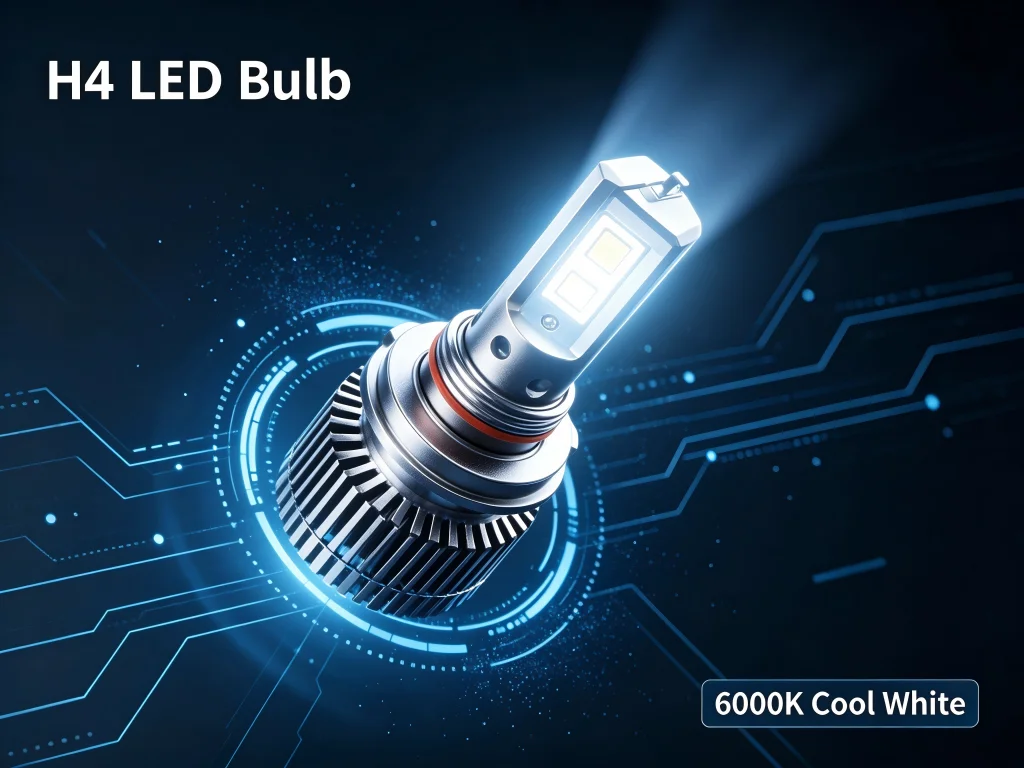
1. There are only four factors that really matter.
Beam pattern accuracy, thermal management, CANBUS compatibility, and physical fit determine whether an H4 LED headlight bulb works properly in your vehicle. Everything else is marketing noise.
We'll break down each factor so you can evaluate H4 LED headlight bulbs like a professional.
1.1. Beam pattern accuracy: the non-negotiable
H4 bulbs use a dual-filament design: one for low beam, one for high beam. The reflector or projector housing is designed around the exact position of these filaments. Move the light source even slightly, and the beam pattern breaks.
LED chip placement is the most critical engineering decision in any H4 LED headlight bulb. Premium manufacturers use digitally precise placement that mirrors the halogen filament position. Budget brands use approximations, and the result shows as scattered light, dark spots, and glare.
What to look for: bulbs that explicitly mention “1:1 filament position” or “same beam pattern as halogen.” Avoid bulbs that only mention lumen output without addressing beam quality.
1.2. Thermal management: the longevity factor
LEDs generate heat at the chip junction. If this heat isn't dissipated, the chip degrades. Brightness drops, color shifts. Then the bulb fails.
H4 LED headlight bulbs have two cooling methods:
| 냉각 유형 | Advantages | Disadvantages |
|---|---|---|
| Active cooling (fan) | Effective; can handle higher wattage | Moving parts can fail; possible noise; dust ingress |
| Passive cooling (heat sink) | No moving parts; completely silent; more reliable | Requires sufficient surface area; may not fit in tight housings |
Quality fans use sealed bearings for quiet operation. Cheap fans are noisy and short-lived. Passive cooling works well for low-wattage bulbs. What to check: bulbs that specify the cooling method and provide thermal data.
1.3. CANBUS compatibility: peace on the dashboard
Modern vehicles monitor electrical load to detect bulb failures. Halogen H4 consumes about 55 watts. H4 LED headlight bulbs consume much less. If the vehicle computer detects lower consumption, it assumes the bulb is dead and turns on a warning light.
Some bulbs solve this with built-in CANBUS drivers that mimic the halogen load. Others require external decoders or resistors. External solutions introduce additional failure points and complicate installation.
What to check: bulbs with “built-in CANBUS” or “error-free” features. Avoid bulbs that require separate decoders unless you enjoy troubleshooting electrical issues.
1.4. Physical fitment: installation reality
The headlight housing has limited space behind the bulb. Some H4 LED headlight bulbs have bulky heat sinks or fan assemblies that won't fit, requiring modification or removal of the dust cover.
Things to check: bulbs advertised as “1:1 size” or “mini design.” Before purchasing, check your vehicle's dust cover clearance and dimensions.
2. H4 LED vs. Halogen: Real Comparison
| Metric | Halogen H4 | Budget H4 LED | Premium H4 LED |
|---|---|---|---|
| Effective Lumens | 1,000–1,500 | 1,500–2,500 | 2,500–4,000+ |
| Power consumption | 55W | 20–30W | 16–43W |
| 수명 | 400–1,000 hours | 3,000–10,000 hours | 30,000–50,000 hours |
| Beam Pattern | OEM Spec | Often Scattered | 1:1 Halogen Match |
| Canbus Compatibility | Native | External decoder required | Built-in |
| Warranty | None | 6–12 months | 수명 |
One driver's experience sums up the difference: “These bulbs are not brighter than the halogen bulbs I was replacing. They are just whiter. Moreover, they do not spread light evenly.” This is the experience of low-cost LEDs.
Another driver reported: “Compared to my previous halogen bulbs, the difference is like night and day. The LED headlights provide a much clearer and wider beam.” This is what proper engineering delivers.
3. What the spec sheet hides
3.1. The trap of raw lumens
Many H4 LED bulbs advertise 50,000 or 75,000 lumens. This number is only the theoretical maximum of the LED chips, not the amount that actually reaches the road. Effective lumens are always lower. Always.
More important than raw lumens are:
- Beam uniformity—no dark spots or bright spots
- Cutoff sharpness—a clean line that does not dazzle oncoming traffic
- Color consistency—stable 6000K without blue shift over time
- Thermal stability—Output does not drop even when the bulb heats up
3.2. Legal Compliance Issues
Not all H4 LED bulbs are legal for road use. Some are explicitly marked “off-road only.” Before purchasing, check DOT/SAE compliance for US roads or ECE approval for the European market.
One buyer noted: “Special note: This bulb does not comply with DOT / FMVSS108 standards and is not road-legal for headlight use in the US. This bulb is intended for fog light and off-road use.”
Do not make this mistake. Check compliance before purchasing.
4. Premium vs. Budget: Real Cost Comparison
A $40 H4 LED bulb may seem cheap. However, consider the total cost of ownership:
- Budget bulb: $40, lasts 6–12 months, poor beam pattern, flickering issues
- Mid-range bulb: $70–100, lasts 2–3 years, decent beam pattern
- Premium bulb: $120–150, lasts 5+ years, perfect beam pattern, lifetime warranty
Over 5 years of use, the premium bulb costs less per year than the budget bulb, and provides better visibility every night.
5. Real Customer Experiences
“The £8.89 H4 9003 LED bulb was advertised at 900 lumens, which may be true and consumed only 4W, but there was no beam pattern at all—light scattered in all directions in both low and high beam.”.
“A very bright bulb with the LED placed almost exactly in the same position as the incandescent H3 filament, making the light pattern very close to OEM specifications.”.
“I can't say the 4.0 light output or beam pattern is noticeably better than GTR Lighting products. If I were looking for a replacement, I'd go back to the GTR Mini, which fits better without needing adjustment inside the headlight mount and has no fan.”.
6. Frequently Asked Questions
6.1. What is the difference between H4 and 9003?
H4 and 9003 are the same bulb standard. Both use a 3-pin P43t-38 base and dual filament design. HB2 is another name for the same bulb. All three are interchangeable with each other.
6.2. Do H4 LED bulbs work in reflector housings?
Yes, but chip selection is important. CSP (Chip Scale Package) chips from the latest generation designs have significantly reduced the beam quality gap and work well in reflectors.
6.3. Do H4 LED bulbs need a CANBUS decoder?
It depends on the vehicle. Some vehicles with sensitive CANBUS systems require a decoder. Premium bulbs with built-in CANBUS drivers eliminate this need.
6.4. Why do H4 LED headlights flicker at idle?
Low voltage at idle can cause flickering. This is more common in vehicles with idle stop systems or weak batteries. Quality bulbs with voltage stabilization technology prevent this.
6.5. How important is the IP rating for H4 LED bulbs?
IP65 or higher means protection against dust and water jets. IP68 provides protection against continuous immersion. For daily driving in humid climates, a higher IP rating offers peace of mind.
6.6. What is the optimal color temperature for H4 LED headlights?
5000K~6000K (pure white to cool white) provides maximum visibility. 6500K leans blue and reduces usable light in rain and fog. 3000K (yellow) is better suited for fog lights but not ideal for main headlights.
7. Decision Framework
How to choose an H4 LED headlight bulb:
- Check the housing—Reflector or projector? This determines which chip array works best.
- Measure the gap—How much space is behind the bulb? The 1:1 mini design fits almost anything.
- Check your vehicle's CANBUS sensitivity—Some vehicles are more sensitive than others.
- Verify DOT/ECE compliance—Road legality matters.
- Compare thermal solutions—Fan or heatsink? Which suits your use case?
The GTR Lighting Ultra 3.0 H4/9003 LED bulb meets all criteria. 2,900 low beam lumens per bulb. 5750K pure white. PWM interface module for perfect CANBUS compatibility. 1:1 size for perfect fitment. Lifetime limited warranty.
The GTR CSP Mini series offers an alternative: 16 watts, 2,500 low beam lumens, Philips Z ES high-efficiency chips, fanless passive cooling. No moving parts. Completely silent. Exceptional reliability.
Both options deliver what spec sheets don't tell you: dependable real-world performance.