
Вы уже прошли вопрос “стоит ли обновляться”. Вы знаете, что хотите h4 лампа светодиодная лампу головного света. Теперь вы смотрите на десятки вариантов с совершенно разными ценами, заявлениями о люменах и списками функций. Каждый бренд говорит, что он самый яркий. Каждое объявление обещает установку «подключи и работай».
This guide cuts through the marketing noise. Based on our engineering analysis and real-world testing of H4 LED headlight bulbs across various vehicle platforms, we will show you exactly what separates a $40 bulb from a $150 bulb — and why the expensive one often turns out to be cheaper in the long run.
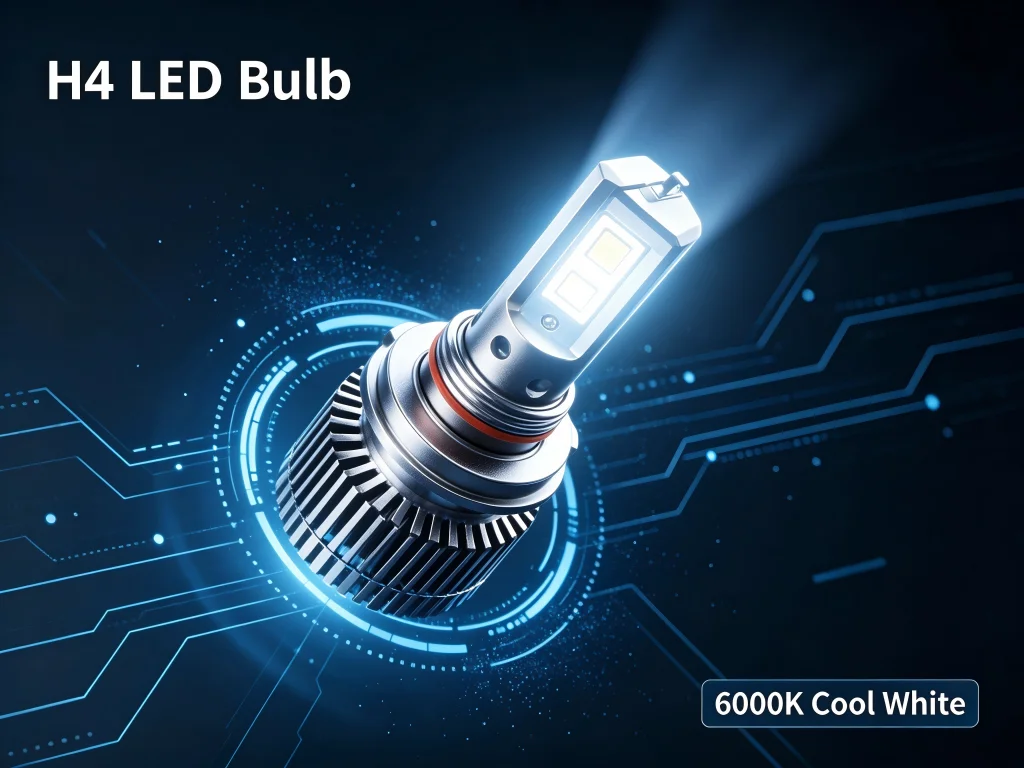
1. Only four factors really matter
Beam accuracy, thermal management, CANBUS compatibility, and physical fit determine whether an H4 LED headlight bulb will perform well in your vehicle. Everything else is marketing noise.
Let's break down each factor so you can evaluate any H4 LED headlight bulb like a professional.
1.1. Beam accuracy: the non-negotiable
The H4 bulb uses a dual-filament design. One filament for low beam, one for high beam. Your reflector or headlight housing is designed around the exact position of these filaments. If you shift the light source even slightly, the beam pattern is ruined.
LED chip placement is the most important engineering decision in any H4 LED headlight bulb. Premium manufacturers use digital precision placement that replicates the halogen filament position. Cheap brands do it approximately — and the results show in scattered light, dark spots, and glare.
What to look for: bulbs that explicitly state “1:1 filament position” or “same beam pattern as halogen.” Avoid bulbs that only talk about lumen output without addressing beam quality.
1.2. Thermal management: the longevity factor
LEDs generate heat at the chip junction. If that heat isn't dissipated, the chips degrade. Brightness drops. Color shifts. Then the bulb fails.
There are two cooling approaches for H4 LED headlight bulbs:
| Cooling type | Advantages | Disadvantages |
|---|---|---|
| Active cooling (fans) | Efficient; handles higher power | Moving parts can fail; possible noise; dust ingress |
| Passive cooling (heat sinks) | No moving parts; completely silent; more reliable | Requires sufficient surface area; may not suit compact housings |
Quality fans use sealed bearings and run quietly. Cheap fans are noisy and short-lived. Passive cooling works well for lower wattage lamps. What to look for: lamps that specify the cooling method and provide thermal data.
1.3. CANBUS compatibility: dashboard peace of mind
Modern cars monitor electrical loads to detect burned-out bulbs. A halogen H4 bulb draws about 55 watts. An LED H4 bulb draws significantly less. If the car's computer sees lower consumption, it assumes the bulb is burned out and issues a warning.
Some bulbs solve this with built-in CANBUS drivers that mimic the halogen load. Others require external decoders or resistors. External solutions create additional failure points and complicate installation.
What to look for: bulbs with “built-in CANBUS” or “error-free” feature. Avoid bulbs requiring separate decoders unless you enjoy chasing electrical gremlins.
1.4. Physical installation: the reality of fitting
Your headlight housing has limited space behind the bulb. Some LED H4 bulbs have bulky heat sinks or fan assemblies that don't fit — requiring modification or removal of dust caps.
What to look for: bulbs advertised as “1:1 size” or “mini design”. Check dimensions against your car's dust cap clearance before purchasing.
2. LED H4 vs Halogen: real-world comparison
| Metric system | Halogen H4 | Budget LED H4 | Premium LED H4 |
|---|---|---|---|
| Effective lumens | 1,000–1,500 | 1,500–2,500 | 2,500–4,000+ |
| Power consumption | 55 Вт | 20–30 W | 16–43 W |
| Продолжительность жизни | 400–1,000 hours | 3,000–10,000 hours | 30,000–50,000 hours |
| Beam Pattern | OEM specification | Often scattered | 1:1 exact match to halogen |
| CANBUS compatible | Homeland | External decoders required | Built-in |
| Гарантия | No | 6–12 months | Service life |
One driver's experience summarizes the difference: “These lamps are not brighter than the traditional halogen lamps I replaced. They are just whiter. In addition, they do not provide a uniform light output.” This is the experience of budget LEDs.
Another driver reported: “Compared to my previous halogen lamps, the difference is like day and night. LED headlights provide a much clearer and wider beam.” This is the result of proper engineering.
3. What the specifications hide
3.1. The raw lumens trap
Many H4 LED bulbs claim 50,000 or even 75,000 lumens. These figures are theoretical maximums of the LED chips, not what reaches the road. Effective lumens are always lower. Always.
Here's what matters more than raw lumens:
- Равномерность луча—without dark spots and hot spots
- Clear light cutoff—a clean line that doesn't blind oncoming traffic
- Color consistency—stable 6000K without shifting blue over time
- Thermal stability—light output doesn't drop as the lamp heats up
3.2. The Legality Question
Not all H4 LED bulbs are approved for use on public roads. Some are explicitly marked as “off-road only.” Before purchasing, check compliance with DOT/SAE standards for US roads or ECE approval for European markets.
One buyer noted: “Special note: These bulbs do not comply with DOT / FMVSS108 standards and are not approved for use in headlights on public roads in the US. These bulbs are intended for fog lights and off-road applications.”.
Don't make this mistake. Check compliance before buying.
4. Premium vs. Budget: The Real Cost Comparison
A $40 H4 bulb might seem like a bargain. But consider the total cost of ownership:
- Budget bulb: $40, lasts 6–12 months, poor beam pattern, flickering issues
- Mid-range bulb: $70–100, lasts 2–3 years, acceptable beam pattern
- Premium bulb: $120–150, lasts 5+ years, perfect beam pattern, lifetime warranty
Over five years, a premium lamp costs less per year than a budget one and provides better visibility every night.
5. Real customer experiences
“The H4 9003 LED lamp at £8.89 was claimed to be 900 lumens, which may be true, drew only 4W, but the beam pattern was absent — complete light scatter in all directions on both low and high beam.”.
“Extremely bright lamps with LEDs positioned almost exactly like the H3 filament, so the light pattern is very close to factory specification.”.
“I can't say the light output 4.0 or beam shape is noticeably better than the GTR Lighting units. If I were choosing a replacement, I'd probably go back to GTR Mini, as they fit better without fuss inside the headlight mount and have no fan.”.
6. Frequently asked questions
6.1. What is the difference between H4 and 9003?
H4 and 9003 are the same lamp standard. Both use a three-tab base P43t-38 and a dual-filament design. HB2 is another name for the same lamp. All three are interchangeable.
6.2. Will H4 LED lamps work in reflector housings?
Yes, but chip selection matters. New-generation CSP (chip-scale package) chips have significantly narrowed the beam quality gap and work well in reflectors.
6.3. Do I need a CANBUS decoder for H4 LED lamps?
It depends on your vehicle. Some cars with sensitive CANBUS systems require decoders. Premium lamps with built-in CANBUS drivers eliminate this need.
6.4. Why do my H4 LED headlights flicker at idle?
Low voltage at idle can cause flickering. This is more common in cars with start-stop systems or weak batteries. Quality lamps with voltage stabilization technology prevent this.
6.5. How important is the IP rating for H4 LED lamps?
IP65 or higher indicates protection against dust and water jets. IP68 provides protection against prolonged immersion. For daily commutes in wet climates, higher IP ratings provide peace of mind.
6.6. What is the best color temperature for H4 LED headlights?
5000K–6000K (pure white to cool white) provides maximum visibility. 6500K shifts towards blue and reduces useful light in rain and fog. 3000K (yellow) is better for fog lights but not ideal for main headlights.
7. Your decision-making system
Here's how to choose an H4 LED bulb:
- Check your housing— reflector or projector? This determines which chip layout will work best
- Measure the gap— how much space is behind the bulb? Mini 1:1 designs fit almost everything
- Check your car's CANBUS sensitivity— some cars are more sensitive than others
- Confirm DOT/ECE compliance— road legality matters
- Compare cooling solutions— fan or heatsink? What suits your case?
GTR Lighting Ultra 3.0 H4/9003 LED bulbs meet all requirements. 2900 raw lumens per bulb. Pure white 5750K. PWM interface modules for flawless CANBUS compatibility. 1:1 size for perfect fit. Lifetime limited warranty.
The GTR CSP Mini series offers an alternative: 16 W, 2500 raw lumens, highly efficient Philips Z ES chips, passive cooling without a fan. No moving parts. Complete silence. Exceptional reliability.
Both options deliver what specifications never tell you: real performance you can trust.