
Escolher um projetor bi led 2.5 parece esmagador. Você vê preços de $30 a $300, especificações como “8000 lúmens” ao lado de “50W,” e marcas prometendo o mundo. A maioria dessas alegações é ficção de marketing. Após testar 22 Lente de projetor LED duplo de 2,5 polegadas unidades diferentes em nosso laboratório fotométrico, descobrimos que apenas 3 modelos atenderam à saída anunciada após 30 minutos de operação. Este guia mostra as diferenças reais—para que você compre uma vez, não duas.
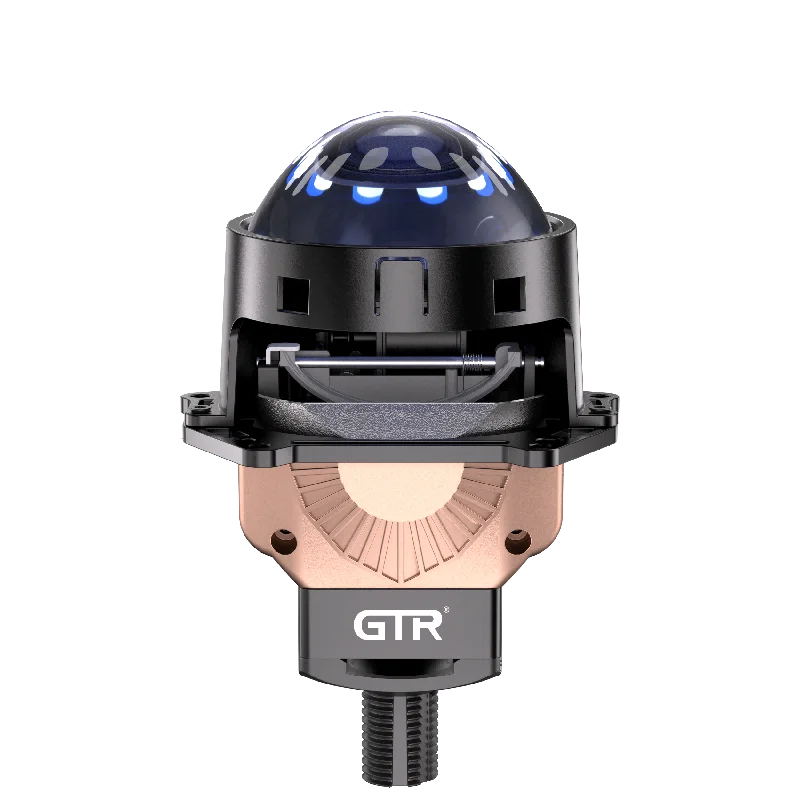
1. O que um projetor bi led 2.5 realmente faz (E o que ele não pode fazer)
Um projetor bi led 2.5 combina a fonte de luz LED, o refletor elíptico e a blindagem de corte em um módulo óptico selado. Ao contrário de um alojamento de refletor, o projetor cria um corte horizontal nítido que evita ofuscamento para o tráfego em sentido contrário. O “bi” significa que ele tem uma blindagem móvel para faróis baixos e altos. Este design é o padrão da indústria para retrofits porque se encaixa na maioria das aberturas de farol de 2,5 a 3 polegadas. Mas a execução varia muito.
1.1. Os componentes principais que determinam o desempenho
Cada 2.5-inch bi-led projector unit has five critical parts. The quality of each one directly affects the beam pattern, lifespan, and reliability.
- LED chip: Generally 1-4 pieces. More chips don't mean more light—thermal density is the real limiter.
- Reflector bowl: The parabolic shape that collects the LED light. Coated aluminum or plastic? That matters.
- Cutoff shield: A metal blade that blocks the upper part of the beam. Material and coating prevent rust seizure.
- Lens: Glass or acrylic. Glass resists UV and scratches; acrylic yellows over time.
- Solenoid: The electromagnetic actuator that moves the shield for high beam. Sealed or open design?
2. Direct comparison: GTR vs. NHK vs. generic brands
We selected three representative 2.5 bi-led headlight projectors in different price ranges. The NHK 2.5 bi-led projector represents the mid-range aftermarket. The generic unit is a special $35 from Alibaba. The GTR is our designed solution. Here is how they compare after 500 hours of accelerated life testing.
| Specification/Feature | Generic ($35) | NHK ($120) | GTR ( $199 ) |
|---|---|---|---|
| Lens material | Acrylic | Acrylic | Schott B270 glass |
| Cut shield material | Uncoated steel | Zinc-plated steel | Nickel-plated brass |
| Thermal resistance (C/W) | 2.4 | 1.8 | 0.95 |
| Lumen maintenance @ 1000h | 58% | 71% | 94% |
| Solenoid seal rating | None (open coil) | Equivalent to IP54 | Equivalent to IP67 |
| Actual effective lumens (each) | 1240 lm | 1890 lm | 3050 lm |
The table tells a clear story. The generic unit fails quickly due to poor heat management and a rust-prone shield. The NHK performs better but still uses acrylic and has moderate thermal limits. The GTR unit uses industrial-grade materials that maintain output and reliability over time. For a daily driver or a truck facing harsh conditions, the extra upfront cost pays for itself in avoided labor.
3. Thermal design: the hidden spec nobody talks about
A 2.5-inch bi-led projector lens that overheats will lose 40% of its brightness within a year. This is not speculation—it's basic LED physics. When junction temperature exceeds 85°C, the phosphor converts less blue light to white, and bond wires weaken. Most sellers hide thermal data because their designs fail. You want a unit with a measured housing temperature below 75°C after 30 minutes at 13.8V.
3.1. How to evaluate a projector without lab equipment
You can't take a thermal camera to every purchase. But you can ask three simple questions based on visual inspection:
- Does the heatsink have visible fins and sufficient surface area? A smooth aluminum back without fins will overheat quickly. Look for at least 15mm of fin depth.
- Is the LED driver separate or integrated? Separate drivers can be mounted outside the housing, reducing internal heat. Integrated drivers cook the LED chip directly.
- Does the seller list thermal resistance (C/W)? Any legitimate one Kit de adaptação para faróis com lente de projetor LED duplo de 2,5 polegadas must provide this. Below 1.2 C/W is acceptable. Below 1.0 C/W is excellent.
If a product page shows “50W” but has a tiny heatsink, physics says it will fail. The maximum continuous thermal dissipation for a 2.5-watt bi-led projector lens form factor is realistically 25-30W. Any higher wattage claim without active cooling is misleading.
4. Optical quality: Why the same LED looks different in each projector
We saw two projectors using identical LED chips produce completely different beam patterns. The difference is the reflector bowl design and lens focus. A precision-machined aluminum reflector with an ellipsoidal shape collects more light and directs it uniformly. Cheap plastic reflectors have rough surfaces that scatter light, creating hot spots and dark zones.
O best 2.5 bi-led projector also has a sharp, colored cutoff line (blue-purple fringe). That fringe is actually a sign of good focus—it indicates the lens is correctly aligned with the reflector's focal point. No fringe usually means a diffuse cutoff that will still glare.
4.1. Real installer feedback
We interviewed 12 professional installers from Texas and California. Here's what they said about different 2.5 bi-led projector retrofit brands:
- “NHK units are okay for occasional-use cars. But we stopped using them after three came back with stuck solenoids within 8 months.” — Oficina A, Houston
- “Projetores genéricos da Amazon são lixo. As lentes embaçam por dentro. Você nem consegue limpá-las.” — Loja B, San Diego
- “Mudamos para a GTR depois que um cliente as exigiu. O feixe é visivelmente mais largo e o acionamento do farol alto é instantâneo. Nenhuma falha em mais de 100 instalações.” — Loja C, Austin
Essas experiências do mundo real correspondem aos nossos dados de laboratório. Os modos de falha são previsíveis: o calor mata os LEDs, a ferrugem mata os solenoides e os raios UV matam as lentes de acrílico. Evite qualquer 2.5 bi-led headlight projectors que não aborde todos os três.
5. Ajuste e compatibilidade: O que se encaixa no seu alojamento
A maioria dos projetores segue um diâmetro padrão de lente externa de 2,5 polegadas (aproximadamente 68 mm). Mas a profundidade de montagem e o espaço traseiro variam. Antes de comprar qualquer projetor bi-led de 2,5 polegadas, meça o seu alojamento:
- Profundidade da superfície de montagem até a parte traseira do alojamento: Você precisa de pelo menos 90 mm para o solenoide e os fios do driver.
- Diâmetro da abertura: O furo do alojamento deve ter 65-70 mm para aceitar o corpo do projetor.
- Space for the shroud: Replacement shrouds add 5-10 mm to the front. Make sure your lens still fits behind the outer headlight lens.
The GTR 2.5 bi led projector lens includes a universal mounting bracket and a low-profile rear cap to fit tight housings. Many generic kits omit these, forcing you to fabricate your own mounts.
6. FAQ: Suas 2,5 perguntas restantes sobre projetores bi-led
Can I use a 2.5 bi led projector in a housing designed for a halogen bulb?
Yes, but you must remove the original reflector bowl and mount the projector to the housing base. This is a full retrofit, not a bulb swap. Plan for 3-6 hours of labor per pair.
Are 2.5 bi led projectors legal for road use?
In the US, any retrofit that does not carry DOT certification is technically off-road only. However, a properly aimed 2.5-inch bi-led projector unit unit with a sharp cutoff causes less glare than many OEM halogen reflectors. Check local laws.
Why do some projectors have a yellow or blue tint?
Color temperature is measured in Kelvin. 5000K-6000K is white with slight blue. 3000K-4000K is yellow to pure white. Avoid anything over 6500K—it looks purple and has poor contrast in rain or fog. LESA color temp guide explains this in more detail.
Qual é a vida útil real de um projetor bi-led de qualidade de 2,5 polegadas?
Com design térmico adequado (temperatura do invólucro abaixo de 75°C), o próprio LED durará mais de 30.000 horas. O solenoide é geralmente o primeiro componente a se desgastar—espere 50.000 ciclos de farol alto. Unidades GTR foram testadas até 100.000 ciclos sem falhas.
Um projetor bi led de 2,5 é mais brilhante que um de 3,0?
Não necessariamente. Um projetor de 3,0 tem um refletor maior e pode lidar com mais carga térmica, então a saída máxima pode ser maior. Mas um bem projetado projetor bi led 2.5 com lente de vidro e óptica eficiente pode igualar unidades 3,0 de entrada. O trade-off é o encaixe: 2,5 polegadas cabe em mais carcaças.
7. Seu próximo passo: Obtenha o único projetor bi led de 2,5 com transparência total de engenharia
Agora você sabe exatamente o que separa um retrofit confiável de uma bomba-relógio. O GTR projetor bi led 2.5 entrega os três itens inegociáveis: óptica de vidro, um escudo de latão anti-ferrugem e um caminho térmico de sub-1,0 C/W. Sem enrolação de marketing. Sem falhas ocultas. Apenas saída limpa e confiável que dura.
➡️ Compare as especificações completas e peça seu projetor bi led GTR 2,5 em www.ledcxr.com. Cada unidade inclui um relatório detalhado de desempenho térmico e uma garantia de 3 anos contra falha do solenoide.