
A maioria dos guias de compra de lâmpadas LED de pino bi-pino são educados. Eles listam equivalentes de potência, mencionam lúmens e sugerem que você “escolha uma marca respeitável”. Eles não dizem que a lâmpada $1.79 da caixa de liquidação vai piscar no seu transformador halógeno. Eles não explicam por que duas lâmpadas G4 ‘equivalentes a 20W“ podem ter qualidade de luz completamente diferente. E certamente não explicam a eletrônica do driver que determina se uma lâmpada dura dois anos ou vinte. Este guia faz isso. Ele foi feito para você — seja substituindo luzes sob armários, luzes de caminho de paisagem, lâmpadas internas de RV ou cápsulas de lustre — e vai ajudá-lo a comprar a lâmpada certa uma vez, não a errada três vezes. A GTR fabrica iluminação LED desde 2009, e as percepções aqui vêm de milhares de testes de compatibilidade, centenas de configurações de transformadores e o tipo de conhecimento difícil de adquirir que você só obtém quando projeta o produto você mesmo.
1. O Panorama dos Bi-Pinos: Entendendo o que Você Realmente Está Comprando
Uma lâmpada LED de pino bi-pino não é um produto — é uma família de lâmpadas que compartilham uma base de dois pinos, mas divergem significativamente em tamanho, voltagem, emissão de luz e engenharia interna. Entender o panorama antes de clicar em ‘comprar“ é a maneira mais eficaz de evitar devoluções, cintilação e lâmpadas que não se encaixam.
1.1. Tipos de Base: G4, G9 e Aqueles que Causam Confusão
O “G” em G4 ou G9 significa “vidro” — uma referência histórica ao design original da cápsula halógena. O número é o espaçamento dos pinos em milímetros. G4 significa 4mm entre os pinos. G9 significa 9mm. Simples o suficiente. Mas aqui é onde fica complicado:
- G4 é a base bi-pino mais comum em aplicações de baixa voltagem (12V) — luzes de pia sob armários, luzes de caminho de paisagem, luminárias de teto de RV e alguns lustres. Os pinos são finos, retos e espaçados 4mm.
- G9 é principalmente uma base de voltagem de linha (120V–240V), encontrada em lustres, luminárias pendentes e alguns acessórios de banheiro. Os pinos são mais grossos e espaçados 9mm. Lâmpadas G9 quase nunca funcionam em 12V.
- GY4, GZ4, GU4 são variantes do G4 com geometrias de pino ou invólucros de base ligeiramente diferentes. Os pinos GY4 são ligeiramente mais grossos (0,7mm vs. 0,65mm para G4). GU4 e GZ4 adicionam um clipe de base de plástico. Eles são menos comuns, mas podem causar confusão — uma lâmpada que ‘parece“ G4 pode não se encaixar corretamente se for realmente GY4 e seu soquete esperar o diâmetro de pino mais fino do G4.
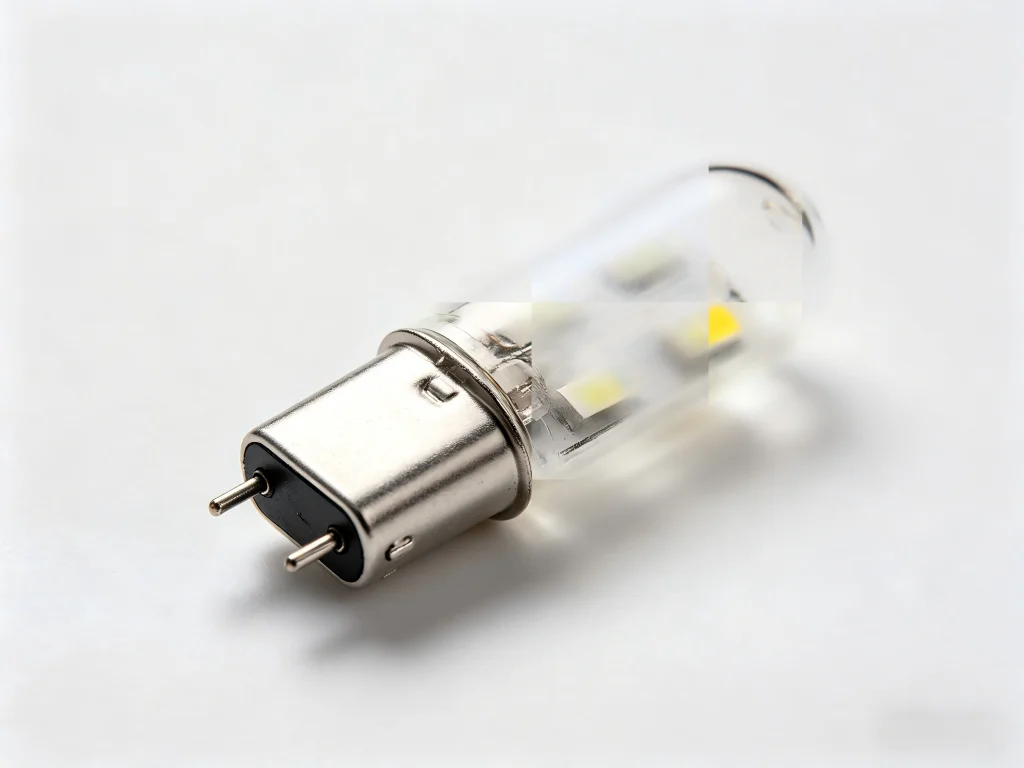
- T3 não é um tipo de base — é um código de forma para a cápsula de vidro (tubular, diâmetro de 3/8 de polegada). Lâmpadas T3 quase sempre têm bases G4. Uma lâmpada LED de pino bi-pino t3 g4 é simplesmente um LED baseado em G4 em um formato de cápsula tubular T3.
1.2. Voltagem: A Encruzilhada
É aqui que a maioria dos erros de pedido acontece. Lâmpadas bi-pino vêm em duas famílias de voltagem, e elas não são intercambiáveis:
- 12V (baixa tensão) — Usado em iluminação paisagística, luminárias para RV/barcos, luzes de embutir sob armários e alguns trilhos de iluminação. Essas luminárias possuem um transformador (magnético ou eletrônico) que reduz a tensão de linha de 120V para 12V. Uma lâmpada de 12V conectada diretamente a uma luminária de tensão de linha explodirá — instantânea, dramática e perigosa.
- 120V (tensão de linha) — Usado em lustres, algumas luminárias pendentes, barras de luz para banheiro e a maioria das luminárias G9. Essas lâmpadas conectam-se diretamente à rede elétrica sem transformador. Uma lâmpada de 120V em um soquete de 12V mal acenderá, se é que acenderá.
Relacionado a isso está a operação CA versus CC. Um sistema de lâmpadas LED bipino de 12 volts pode fornecer CA (de um transformador magnético), CC (de um driver LED eletrônico ou sistema de bateria) — ou a lâmpada precisa lidar com ambos. Uma lâmpada classificada apenas para CC conectada a um circuito CA piscará visivelmente a 60Hz. Uma lâmpada classificada para CA/CC possui retificação interna e lida com qualquer entrada sem problemas. Em aplicações para RV e marinhas, onde a fonte de alimentação alterna entre CA da rede e CC da bateria, lâmpadas classificadas para CA/CC são indispensáveis.
1.3. Lúmens, Potência e o Jogo do Equivalente
“Equivalente a 20W” é a frase mais abusada no marketing de LED. Uma lâmpada halógena G4 consome 20 watts e produz aproximadamente 250–300 lúmens — essa é a referência. Muitas lâmpadas LED rotuladas como “equivalente a 20W” produzem 180–220 lúmens, significativamente menos. Outras produzem 350 lúmens, significativamente mais. Não há padrão, e o número na caixa pode refletir mais o otimismo do fabricante do que a saída real da lâmpada.
The only number that matters is lumens. Here's a quick reference for common bi-pin equivalents based on our photometric testing:
| Halogen Wattage | Typical Halogen Lumens | LED Replacement Wattage | Equivalent LED Lumens to Match | Common Base |
|---|---|---|---|---|
| 10W | 100–140 lm | 1–1.5W | 120–160 lm | G4 |
| 20W | 250–300 lm | 2–3W | 250–350 lm | G4 |
| 35W | 400–500 lm | 3.5–5W | 400–550 lm | G4 |
| 50W | 600–800 lm | 5–7W | 600–850 lm | G4 |
| 25W G9 | 200–250 lm | 2.5–3W | 200–280 lm | G9 |
| 40W G9 | 400–500 lm | 4–5W | 400–550 lm | G9 |
| 60W G9 | 600–750 lm | 6–8W | 600–800 lm | G9 |
Source: GTR internal photometric testing. Individual product results may vary. Always check the lamp's published lumen output before ordering — never rely solely on wattage equivalence claims.
2. The Internal Engineering Nobody Talks About
2.1. Driver Quality: The PCB Inside Your Lamp
Open a premium bi-pin LED lamp (destructively, in our lab) and you'll find a miniature PCB packed with surface-mount components. Open a generic one and you might find a single diode, a resistor, and little else. The driver circuit determines everything about the lamp's performance — flicker resistance, dimmer compatibility, voltage tolerance, and lifespan.
A well-designed driver includes:
- Bridge rectifier — four diodes arranged to convert AC to DC, regardless of input polarity. That's why the lamp works when plugged in either direction and doesn't flicker on AC transformers.
- CI de corrente constante — um circuito integrado dedicado que regula a corrente para o emissor de LED, mantendo brilho consistente numa faixa de entrada (por exemplo, 8V–24V). Sem isto, o brilho varia com a tensão de alimentação.
- Capacitor eletrolítico — suaviza a corrente contínua retificada e elimina ondulação residual. Em lâmpadas dimerizáveis, este capacitor deve ser dimensionado cuidadosamente para evitar cintilação visível em níveis baixos de dimerização.
- Proteção térmica — um termistor ou CI térmico dedicado que reduz a corrente se a temperatura da PCB exceder limites seguros, tipicamente em torno de 85–100°C na junção do LED.
Lâmpadas de baixo custo omitem esses componentes para atingir um preço competitivo. Uma lâmpada sem ponte retificadora cintilará perceptivelmente em circuitos CA. Uma lâmpada sem regulação de corrente constante ficará mais escura em uma extensão longa de cabo onde há queda de tensão, ou mais brilhante (e mais quente) perto do transformador onde a tensão é alta. Uma lâmpada sem proteção térmica superaquecerá em um invólucro fechado e sofrerá rápida depreciação de lúmens — ela pode até “funcionar” após um ano, mas estará emitindo metade da luz que emitia quando nova.
2.2. Tipo de emissor: LEDs COB, SMD e estilo filamento
O emissor de LED em si vem em vários formatos, cada um com suas compensações:
- Chips-on-Board (COB) empacota múltiplos dies de LED em um único substrato coberto por uma camada uniforme de fósforo. Emissores COB produzem uma fonte de luz uniforme de ponto único, semelhante a um filamento halógeno. Eles são comuns em designs de bulbo LED e produzem boa uniformidade de feixe. A desvantagem é que emissores COB podem concentrar calor em uma área pequena, exigindo gerenciamento térmico cuidadoso.
- SMD (Dispositivo de Montagem em Superfície) usa chips de LED individuais soldados à PCB, tipicamente ao redor do corpo da lâmpada para distribuição de luz de 360 graus. Designs SMD oferecem melhor saída omnidirecional — importante em lustres e luminárias decorativas onde a lâmpada é visível — mas podem produzir pontos brilhantes visíveis se o espaçamento dos chips for irregular.
- Estilo filamento LED It mimics the appearance of a traditional incandescent filament with a thin glass rod coated with micro-LEDs. These are popular in decorative G9 lamps where appearance matters. Light distribution is excellent and the look is authentic, but the thin glass substrate is more fragile than a solid PCB and thermal management relies heavily on the inert gas inside the glass envelope.
2.3. Color Quality: CRI, R9, and Why Warm White Isn't Standardized
Two lamps can both be labeled “warm white 3000K” and reproduce colors completely differently. The reason is CRI — Color Rendering Index — and specifically R9, which measures how accurately the lamp reproduces deep red tones. Halogen lamps have a perfect CRI of 100 and an R9 close to 100. Most low-cost LEDs achieve CRI 70–80 and R9 values below 20, meaning reds, wood tones, and skin look dull or slightly off.
For task lighting under cabinets, where you're preparing food or reading labels, CRI 80+ is the minimum. For retail display, gallery lighting, or applications where color accuracy matters, CRI 90+ with R9 above 50 is worth the premium. The difference isn't subtle once you know what to look for — a tomato under CRI 70 light looks brownish-red and unappetizing; under CRI 90+ light, it looks like a tomato.
GTR's bipolar pin LED product line specifies CRI values explicitly in product documentation — not every manufacturer does this, and a missing CRI value is usually explained by a low number the manufacturer prefers not to advertise.
3. The Comparison Matrix: Head-to-Head Where It Matters
3.1. G4 vs. G9: Choosing the Right Base for Your Fixture
The G4 vs. G9 decision isn't a choice — it's dictated by your fixture. But understanding the differences helps you avoid ordering the wrong lamp:
| Característica | G4 Bi-Pin | G9 Bi-Pin |
|---|---|---|
| Pin Spacing | 4mm | 9mm |
| Typical Voltage | 12V (baixa tensão) | 120V–240V (line voltage) |
| Requires Transformer? | Yes — external 12V transformer or driver | No — direct connection to mains |
| Common Applications | Landscaping, under cabinets, RV/boat, puck lights | Chandeliers, pendants, vanity bars, table lamps |
| Typical LED lifespan | 25,000–50,000 hours | 25,000–40,000 hours |
| Dimming options | Available; check transformer compatibility | Widely available; check dimmer compatibility |
| Main warning | Never connect to 120V — requires 12V transformer | 120V only — not for RV or landscaping DC systems |
3.2. G4 LED bulb 20W equivalent: What the Input Level Gets Wrong
The 20W equivalent G4 LED bi-pin is the most common retrofit bulb on the market — and the one with the widest quality variation. Cheap 20W equivalent G4 LEDs often cut costs on:
- AC compatibility: No rectifier means flicker on magnetic transformers.
- Lumen output: 150–180 lumens instead of the 250–300 lumens that a real 20W halogen bulb produces.
- Color consistency: Poor binning of emitters means that “warm white” can vary from 2,700K to 3,200K between bulbs from the same package.
- Build quality: Thin PCB substrates that warp under heat, cheap electrolytic capacitors that dry out and fail within two years.
A quality G4 base LED bulb equivalent to 20W should consume 2–3 watts, produce at least 250 lumens, specify 2700–3000K or your preferred color temperature, indicate whether it requires DC or accepts AC/DC, list its CRI (minimum 80+), and have a warranty longer than the return period. If these specifications are not stated on the product page or packaging, assume they are missing for a reason.
3.3. LED Bi-Pin vs. Halogen Bi-Pin: Lifetime Cost Comparison
The initial price difference between a 20W G4 halogen and a 3W G4 LED seems significant — until you calculate replacement and energy costs over a realistic lifespan. Here is the math for a single G4 fixture running 4 hours per day:
| Cost Factor | 20W G4 Halogen | 3W G4 LED (Eq. 20W) |
|---|---|---|
| Initial bulb cost | $2.00 | $12.00 |
| Vida útil (horas) | 2,000 | 30,000 |
| Replacements over 30,000 hours | 15 bulbs | 0 (original bulb still working) |
| Total lamp cost over lifetime | $30.00 | $12.00 |
| Energy cost over lifetime (at $0.14/kWh) | $33.60 | $5.04 |
| Total cost of ownership — 30,000 hours | $63.60 | $17.04 |
The LED saves more than $46 per socket over its lifetime — and that's before considering the labor of climbing a ladder fifteen times or the inconvenience of a burned-out bulb when you need light. Multiply by ten fixtures, and the savings exceed $460.
4. Avoiding the Four Most Expensive Buying Mistakes
4.1. Mistake 1: Ordering Line-Voltage Bulbs for a Low-Voltage Fixture (or Vice Versa)
This is the mistake that literally burns. A 120V G9 LED bulb with bi-pin base won't fit into a 12V G4 socket — the pin spacing is different — so physically forcing it is nearly impossible. But a 12V G4 LED connected to a 120V fixture (through a miswired socket or an incorrectly identified fixture) will fail instantly, often with a pop, a flash, and sometimes damage to the socket itself.
The safe approach: test the voltage at the socket terminals with a multimeter before ordering replacement bulbs, especially in older homes or buildings where the fixture voltage may not match what you assume. A 120V reading means line-voltage bulbs only. A 12V reading means a transformer is present — and you need low-voltage bulbs.
4.2. Mistake 2: Assuming All Dimmable Bulbs Work with Your Dimmer
Dimmer compatibility is a two-sided equation. A bulb listed as “dimmable” has circuitry that responds to phase-cut dimming signals. But the dimmer switch itself must be compatible with LED loads. Older leading-edge dimmers, designed for incandescent loads (60W minimum), often cannot regulate the tiny 3W–5W draw of an LED bulb, resulting in flicker, limited dimming range, or complete failure to dim.
If you're installing dimmable bi-pin LED bulbs, pair them with a trailing-edge LED-compatible dimmer. Some dimmable G9 bi-pin bulbs list compatible dimmer models in their documentation — if they don't, and you have an existing dimmer, check the bulb's minimum load specification against the dimmer's minimum load rating.
4.3. Mistake 3: Buying Based on Wattage Equivalent Alone
“20W equivalent” said something fifteen years ago, when LED bulbs were new and the public needed a familiar reference point. Today it's more misleading than helpful. Two bulbs with the same wattage equivalent claim can differ in actual lumen output by 40% or more. Always check lumens. 250–300 lumens is the real performance of a 20W G4 halogen. If an LED ‘equivalent“ lists 180 lumens, it's not equivalent — it's dimmer, and you'll notice.
4.4. Mistake 4: Ignoring Physical Fit in Enclosed Fixtures
Bi-pin LED bulbs are almost always larger than the halogens they replace. The driver PCB, the heat sink body, the emitter array — these add millimeters in every dimension. In a fixture with tight clearance, those millimeters matter. Before ordering, measure the internal diameter and depth of the fixture housing with the lens or diffuser removed. Compare with the bulb's published dimensions (including length — LED bulbs often extend further out of the socket than halogens). If the fixture has a reflector that comes close to the bulb, measure that clearance specifically.
For enclosed fixtures — sealed glass globes, waterproof landscape housings, RV ceiling pucks — confirm the LED bulb is rated for enclosed fixture use. Bulbs not rated for enclosed fixtures will overheat internally, degrading lifespan and potentially tripping thermal protection that dims the bulb intermittently.
5. Application-Specific Recommendations
5.1. Landscaping and Outdoor: IP Rating, Waterproofing, and Beam Angle
Bi-pin bulbs for outdoor use expose the bulbs to moisture, temperature variations from -20°F to +110°F, and direct contact with rain or sprinklers. An IP65 rating is the minimum for landscape bulbs in damp locations — IP65 means dust-tight and protected against water jets from any direction. For path lights buried in snow or subject to standing water, IP67 or IP68 is recommended.
The beam angle matters more outdoors than indoors. A 360-degree omnidirectional bulb in a path light with a reflector directs more light upward than downward — not ideal for illuminating a walkway. Look for bulbs with 120°–180° beam spread or directional designs that focus light where needed. Some t3 g4 bi pin led light bulb products designed specifically for landscape use emit light in a forward hemisphere, improving ground-level brightness without wasting lumens skyward.
5.2. Under Cabinet, RV, and Enclosed Spaces
These applications share tight spaces, heat sensitivity, and a preference for warm to neutral color temperatures. For under-cabinet task lighting, CRI 80+ at 3,000K–4,000K provides the best combination of color accuracy and visual comfort. For RV ceiling fixtures, bulbs must support 12V DC battery power (and sometimes 12V AC from shore power converters), so AC/DC compatibility is mandatory.
In all cases, verify the bulb is rated for enclosed use. RV ceiling pucks and under-cabinet housings trap heat, and a bulb not designed for that environment will fail prematurely — sometimes taking the fixture socket with it.
6. Point-of-Purchase Questions
6.1. How do I know if my transformer is compatible with LED bi-pin bulbs?
Magnetic transformers designed for halogen loads may not operate stably with the low current draw of LED bulbs. If your transformer emits an audible hum, or if your LED bulbs flicker after installation, the transformer is likely the issue. Electronic transformers and dedicated LED drivers (which provide regulated DC) are compatible with all LED bi-pin bulbs. If you are unsure about your transformer type, try one LED bulb on the circuit before purchasing a full set — this will immediately reveal compatibility issues without a large upfront commitment.
6.2. What is the warranty on GTR LED bi-pin bulbs?
GTR LED bi-pin bulbs carry our standard product warranty covering defects in materials and workmanship. For specific warranty terms on a particular product, visit https://www.rhgtr.com or contact our support team directly. The warranty is backed by a manufacturing defect rate below 0.1%, achieved through multi-point inspection at every stage of production — from emitter sorting to final burn-in testing.
6.3. Posso obter lâmpadas LED bipino GTR em configurações personalizadas?
Sim. Para parceiros OEM e de distribuição em volume, oferecemos configurações de voltagem personalizadas (incluindo variantes de entrada AC/DC de 24V e ampla faixa), embalagem de marca própria, classificação de temperatura de cor personalizada (por exemplo, 3.000K ±50K consistente em todo um pedido) e personalização de conectores para designs de luminárias específicos. Os prazos de entrega típicos para configurações personalizadas são de 15 a 30 dias úteis para pedidos em volume. Faça sua consulta através dos canais de contato em nosso site.
7. Uma Sequência de Decisão Que Funciona
- Identifique o seu tipo de base. G4 (pinos de 4mm, provavelmente 12V) ou G9 (pinos de 9mm, provavelmente 120V). Verifique com um paquímetro se não tiver certeza.
- Meça a sua voltagem. Use um multímetro no soquete. 12V AC ou DC significa lâmpadas G4 de baixa voltagem. 120V significa lâmpadas G9 de voltagem de linha (ou G4 de 120V, menos comum).
- Compare lúmens, não alegações de equivalência de wattagem. Se a sua halógena era de 20W produzindo ~275 lúmens, encontre um LED que liste 250+ lúmens reais.
- Verifique o ajuste físico. Meça a folga do dispositivo e compare com as dimensões publicadas da lâmpada LED.
- Verifique a compatibilidade com transformador e dimmer. Lâmpadas com classificação AC/DC funcionam em qualquer lugar. Instalações com dimerização precisam de dimmers compatíveis com LED.
- Compre de uma marca que publique suas especificações. CRI ausente, saída de lúmens ausente, faixa de voltagem de entrada ausente — estes não são descuidos. São indicadores.
If you've absorbed this guide, you know more about bi-pin LED bulbs than most people who sell them. You know which specifications matter (lumens, CRI, voltage range, AC/DC compatibility), which are noise (wattage equivalence alone), and where the real quality differences are (driver electronics, emitter binning, thermal design). Now it's a matter of matching the right bulb to your device and your priorities.
Explore the full range of GTR bi-pin LED products at https://www.rhgtr.com. Need help confirming fit or compatibility? Contact our technical support team through the site's contact form with your device details. We answer technical questions within one business day — because the right advice before you order saves much more time than processing a return later.