
Choosing the brightest light bulb for your vehicle isn’t about picking the highest number on a spec sheet. It’s about understanding how different technologies produce light, where that light actually goes, and whether the bulb you install will work with your specific housing. This guide compares LED, HID, and halogen options across the metrics that matter—and explains why Iluminação GTR consistently outperforms in independent testing.
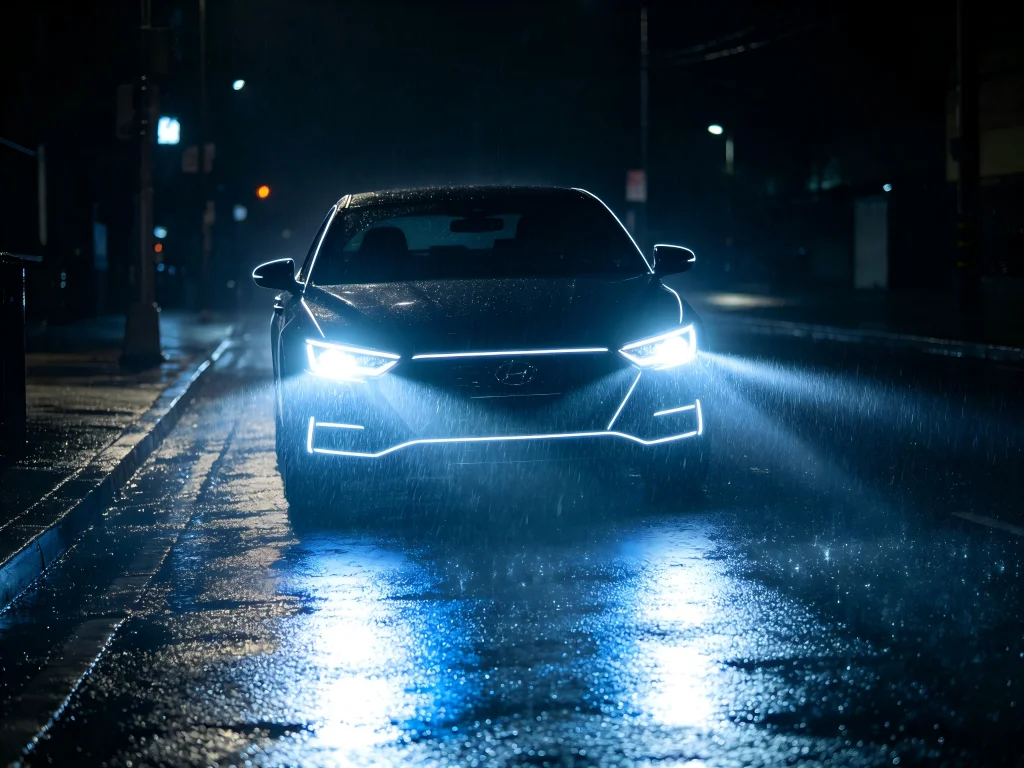
1. LED vs HID vs Halogen: What's Actually Different?
Halogen bulbs produce light by heating a tungsten filament. HID bulbs create an electrical arc through xenon gas. LED bulbs use semiconductor chips that emit light directly. LED wins on efficiency, lifespan, and instant-on performance—but only if the emitter is positioned correctly in the housing.
The technology behind your bulb determines everything about its performance characteristics. Halogen bulbs are essentially controlled fires in a glass chamber. They’re cheap and work with any housing designed for them, but they waste roughly 85-90% of their energy as heat rather than light. A standard H7 halogen produces about 1,500 lumens while consuming 55 watts.
HID (High-Intensity Discharge) bulbs, also called xenon, create light by arcing electricity between two electrodes through xenon gas. They’re more efficient than halogens—around 3,200 lumens at 35 watts—but they require a few seconds to reach full brightness and have a finite lifespan as the electrodes degrade.
LED bulbs convert electrical energy directly into light through semiconductor junctions. A quality LED can produce 2,000-4,000 lumens while consuming only 15-30 watts, and they reach full intensity instantly. The challenge isn’t making LEDs bright—it’s making them bright in the right place.
2. Why Raw Lumen Ratings Are Misleading
When you see a bulb advertised as “40,000 lumens,” that number is almost certainly fabricated or measured at the LED chip before any optical or thermal losses. Independent testing consistently shows that real-world output at the bulb is typically 40-60% of advertised figures.
A kit honestly rated at 5,500 usable lumens will outperform a kit claiming 15,000 lumens that’s engineered for marketing rather than performance. The difference shows up in how much light actually reaches the road versus how much gets scattered as glare or converted to heat.
This is why Headlight Revolution’s 25-bulb shootout measured light output at the road surface rather than at the chip. In that test, the GTR Lighting Ultra 2 delivered 709% more usable light than stock halogen in a reflector housing—a figure that reflects actual performance, not theoretical claims.
3. Beam Pattern: The Metric That Actually Matters
Beam pattern determines whether your “bright” bulb illuminates the road or blinds oncoming traffic. It’s the single most important factor in whether an LED retrofit is safe and effective.
Reflector housings are the most common headlight design on the road. They rely on precise positioning of the light source to focus the beam through the reflector. When you install an LED bulb whose chips are offset from the original filament position, the light scatters in unpredictable directions. You get hot spots near the car, dark zones at distance, and glare that makes other drivers flash their high beams at you.
Projector housings are more forgiving because the lens focuses light from a wider source area. But even in projectors, emitter position matters. Bulbs with chips offset by just 1-2mm produce a blurry cutoff line and reduced usable output.
The best LED retrofits use compact chip designs that mimic the geometry of a halogen filament. The GTR Ultra Series uses a custom TST 7045 chipset with digitally optimized positioning for exactly this reason.
4. Direct Comparison: GTR Ultra vs Common Alternatives
| Característica | Stock Halogen | Budget LED Kit | Philips Ultinon | GTR Ultra Series |
|---|---|---|---|---|
| Actual Output (per bulb) | 1,000-1,500 lm | 1,500-2,500 lm | 1,600 lm | 4.700 lm |
| Temperatura de cor | 3000K | 6000K-8000K | 5800K | 5750K |
| Qualidade do Padrão de Feixe | Referência | Poor (scattered) | Bom | Excelente |
| Thermal Management | N/A | Passive only | Active cooling | Active + TST |
| Esperança de vida | 300-500 hours | 500-2,000 hours | 5,000 hours | Lifetime warranty |
| Garantia | None | 1 year typical | 5 years | Lifetime |
This table reveals a pattern. Budget LED kits claim high lumens but deliver poor beam patterns and short lifespans. Premium options like Philips offer quality engineering and good warranty coverage, but at lower absolute output than GTR’s Ultra Series. The GTR approach prioritizes both maximum usable light and beam precision, backed by a warranty that signals confidence in the product’s durability.
5. What to Avoid: Three Common Traps
5.1. The Multi-Chip "COB" Design
Some LED bulbs use a cylindrical arrangement of chips (Chip-on-Board) that radiates light in all directions. These produce high lumen numbers on paper but create terrible beam patterns in reflector housings because the light source geometry is completely different from a halogen filament.
5.2. Inflated Lumen Claims
Any bulb advertising 10,000+ lumens per bulb is either lying or measuring at the chip. Legitimate manufacturers publish real-world output figures and explain their testing methodology.
5.3. Inadequate Cooling
Heat is the enemy of LED longevity. Poorly designed bulbs with undersized heat sinks lose 40-50% of their output within 3 months. Look for active cooling (fans) and thermal separation between the LED chips and the driver electronics.
6. Installation Considerations
Modern LED retrofits are designed for plug-and-play installation. Most quality kits install in 15-30 minutes using basic hand tools. But a few compatibility issues can arise:
- CANBUS errors: Some vehicles detect the lower power draw of LEDs as a bulb failure. Anti-flicker harnesses or built-in CANBUS drivers resolve this.
- Dust covers: LED bulbs with cooling fans are often longer than halogen bulbs. Some vehicles require extended dust covers to accommodate them.
- Bulb retainers: Certain vehicles use proprietary retainer clips that may require adapters for aftermarket bulbs.
7. Legal Considerations
Aftermarket LED bulbs exist in a regulatory gray area in many jurisdictions. In the United States, DOT certification applies to the complete headlight assembly, not individual bulbs. Technically, replacing a halogen bulb with an LED in a halogen-certified housing may not be legal.
In practice, enforcement focuses on bulbs that produce excessive glare or improper beam patterns. A quality LED kit with correct emitter positioning and a clean cutoff line is functionally safer than worn-out halogens. Drivers should check local regulations and prioritize beam pattern quality over raw brightness.
8. Why GTR Lighting Leads in Independent Testing
GTR Lighting has been manufacturing automotive lighting solutions for over 18 years. Our 30,000-square-meter facility produces LED headlights, bi-lens systems, and lighting accessories for more than 80 global partners.
The Ultra Series represents our flagship consumer product, but the same engineering principles apply across our entire range. Every bulb we manufacture undergoes:
- Thermal cycling tests to verify long-term reliability
- Lumen maintenance testing to ensure output doesn’t degrade over time
- Beam pattern verification in both reflector and projector housings
For B2B partners, we offer OEM and ODM services with full customization capabilities. Whether you need specific chip configurations, custom branding, or vehicle-specific fitments, our engineering team can deliver.
9. Perguntas mais frequentes
9.1. What is the brightest light bulb you can get for a vehicle?
The GTR Lighting Ultra Series produces 4,700 actual lumens per bulb with a 5750K color temperature, ranking among the highest-output street-legal LED retrofits available.
9.2. What is the brightest light bulb for home use?
For standard household fixtures, the brightest option is typically a 300-watt equivalent LED producing around 4,000-5,000 lumens. These are usually workshop or utility bulbs, not general lighting.
9.3. Is daylight or soft white brighter?
Brightness depends on lumens, not color temperature. However, 5000K-6500K “daylight” bulbs are perceived as brighter because of their higher blue content. Soft white (2700K-3000K) appears warmer and is easier on the eyes in living spaces.
9.4. What is the brightest light bulb for a bathroom?
Bathroom fixtures typically max out at 100-watt equivalent LEDs (1600 lumens). A 4000K color temperature provides good task lighting for grooming without harsh shadows.
9.5. What is the brightest light bulb for a ceiling fan?
Ceiling fan fixtures have wattage limits—usually 60-100 watts per socket. A 100-watt equivalent LED at 1600 lumens is typically the brightest safe option.
9.6. Are LED bulbs brighter than HID?
HID bulbs produce more raw lumens at peak output—typically 3,200 lumens compared to 2,000-4,000 for quality LEDs. However, LEDs reach full brightness instantly, last longer, and draw less power. For most drivers upgrading from halogen, LED is the better choice.
10. Make the Right Choice the First Time
The brightest light bulb isn’t the one with the biggest number on the box. It’s the one that puts usable light on the road where you need it, maintains that performance over thousands of hours, and doesn’t blind the drivers coming toward you.
Every GTR Lighting product is engineered with that philosophy. Whether you’re an individual driver upgrading your daily commute or a distributor looking for a manufacturing partner who prioritizes performance over marketing claims, we’re ready to help.
Visitar https://www.rhgtr.com to compare the full Ultra Series lineup, request technical specifications, or discuss OEM/ODM opportunities with our engineering team.