
You are past the “should I upgrade” question. You know you want h4 led headlight bulbs. Now you are staring at dozens of options with wildly different prices, lumen claims, and feature lists. Every brand says they are the brightest. Every listing promises plug-and-play installation. Every review seems contradictory.
This guide cuts through the noise. Based on our engineering analysis and real-world testing of H4 LED headlight bulbs across multiple vehicle platforms, we will show you exactly what separates a $40 bulb from a $150 bulb — and why the expensive one is often cheaper in the long run.
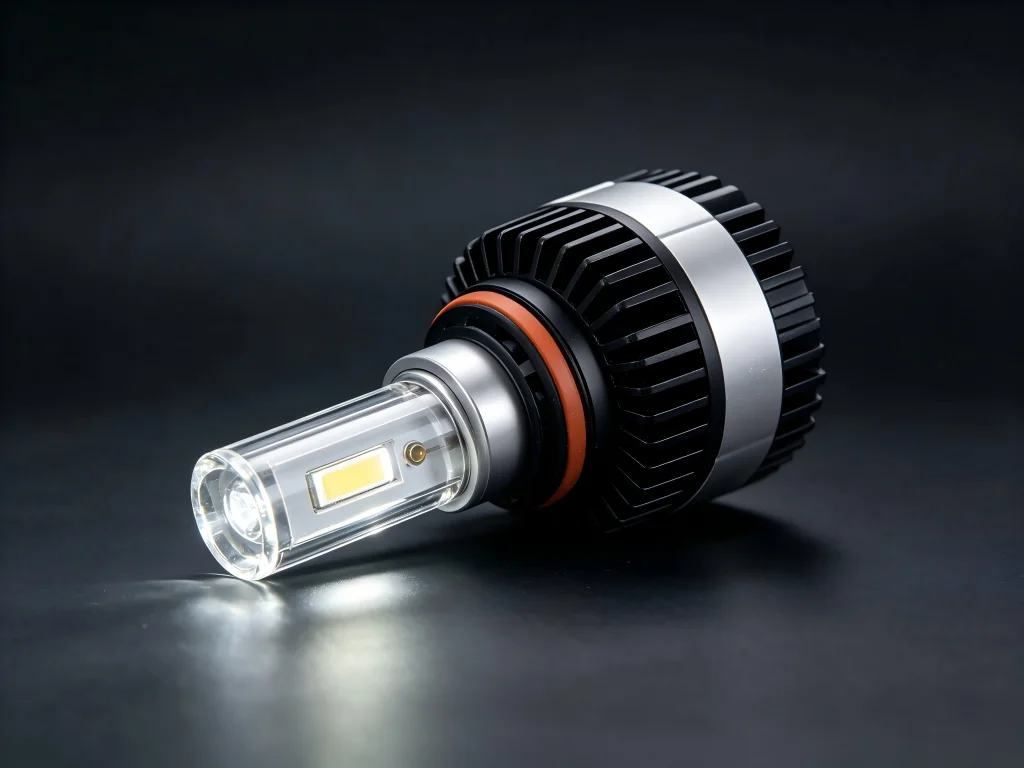
1. Understanding the H4 Platform: Why It Is Different
An H4 bulb is a dual-beam unit. It contains both low beam and high beam functions in a single bulb. This is fundamentally different from H7 (single low beam), H11 (single low beam), or 9005 (single high beam) bulbs.
Resposta direta: The H4 bulb’s dual-beam design creates unique engineering challenges. The LED chips must replicate two filament positions — one for low beam and one for high beam — within a compact envelope. Get the chip placement wrong, and you lose beam pattern on both low and high beams.
É por isso que as lâmpadas LED H4 são mais difíceis de projetar do que as lâmpadas de feixe único. E é por isso que a maioria das lâmpadas LED H4 baratas tem desempenho ruim.
The H4 bulb uses a dual-filament design. One filament for low beam, one for high beam. The reflector or projector housing in your headlight is engineered around the exact position of these filaments. Move the light source even slightly, and the beam pattern breaks.
2. Critical Factor #1: LED Chip Position and Beam Pattern Replication
This is the single most important factor in any H4 LED headlight bulb. Your headlight housing’s optics — whether reflector or projector — were designed around the precise position of a halogen filament. The filament is a narrow, linear light source. The optics shape that light into a specific beam pattern.
LED chips are flat and directional. If they do not sit exactly where the filament sat, the beam pattern breaks. Light scatters. Glare increases. Usable light on the road decreases.
What to look for: Premium H4 LED bulbs use a 1:1 filament replication design. The LED chips are positioned precisely where the halogen filament was, in both low beam and high beam positions.
Some manufacturers advertise “1:1 halogen size” but miss the critical chip positioning. Ask: does this bulb replicate the filament position, or just the overall size?
One forum member summarized the challenge perfectly: “The modern, quality H4 replacement LED systems use emitters that are very close in size, shape and position to the original filaments”.
3. Critical Factor #2: LED Chip Quality and Type
The LED chip is the heart of the bulb. Not all chips are equal.
| Chip Type | Advantages | Disadvantages | Best for |
|---|---|---|---|
| Philips ZES (Luxeon Z ES) | Gold standard for beam accuracy. 1.6mm x 2.0mm — closely matches halogen filament width. Low defect rate. Excellent color consistency | Brilho moderado por watt | Drivers who prioritize beam pattern over maximum lumens |
| CSP (Pacote em Escala de Chip) | Maior brilho por watt que ZES. Mais compacto. Mais barato de fabricar | Newer-generation chips required for good beam quality | Drivers who want high brightness with good beam quality |
What to look for: Established brands disclose their chip supplier. Philips, Osram, and premium CSP chips from Seoul Semiconductor indicate quality. Generic “automotive-grade” chips without brand disclosure are a red flag.
4. Critical Factor #3: Thermal Management and Cooling System
LEDs generate significant heat. If that heat is not dissipated, the chips degrade. Brightness drops. Color shifts. Eventually, the bulb fails.
The cooling system is the single most common failure point in H4 LED bulbs. Cheap bulbs use undersized heat sinks or noisy, low-quality fans that fail within months.
4.1. Arrefecimento Ativo (Ventoinhas)
Effective but introduces moving parts that can fail or become noisy. Quality fans use sealed bearings and run quietly. Cheap fans are loud and short-lived. One reviewer noted: “The main disadvantage is the cooling fans — once they spin … the car is turned off”.
4.2. Arrefecimento Passivo (Dissipadores de Calor)
No moving parts, completely silent. Requires sufficient surface area to dissipate heat. Works well for lower-wattage bulbs. One user reported: “Heat dissipation seems to be excellent, despite the absence of a fan or big heat sink”.
What to look for: Lâmpadas que especificam o método de resfriamento e fornecem dados térmicos. Evite lâmpadas onde o sistema de resfriamento parece uma reflexão tardia.
5. Critical Factor #4: CANBUS Compatibility
Veículos modernos monitoram cargas elétricas para detectar falhas de lâmpadas. Um H4 halógeno consome cerca de 55 watts. Uma lâmpada de farol LED H4 consome significativamente menos. Se o computador do veículo perceber o consumo menor, ele assume que a lâmpada está queimada e acende uma luz de aviso.
Algumas lâmpadas resolvem isso com drivers CANBUS integrados que imitam a carga do halógeno. Outras exigem decodificadores ou resistores externos. Soluções externas introduzem pontos de falha adicionais e complicam a instalação.
What to look for: Lâmpadas com capacidade “CANBUS integrado” ou “livre de erros”. Evite lâmpadas que exigem decodificadores separados, a menos que você goste de solucionar problemas elétricos.
6. Critical Factor #5: Physical Fitment
Seu alojamento do farol tem espaço limitado atrás da lâmpada. Algumas lâmpadas de farol LED H4 têm dissipadores de calor volumosos ou conjuntos de ventoinha que não cabem — exigindo que você modifique ou remova as tampas de proteção contra poeira.
What to look for: Lâmpadas que anunciam “tamanho 1:1” ou “design mini”. Verifique as dimensões em relação à folga da tampa de proteção do seu veículo antes de comprar.
7. H4 LED Headlight Bulbs Comparison: Budget vs. Premium
| Característica | LED H4 Econômico (<$50) | LED H4 Intermediário ($50–$100) | LED H4 Premium ($100+) |
|---|---|---|---|
| Beam pattern accuracy | Poor — scattered light, dark spots | Good — some scatter, acceptable cutoff | Excellent — sharp cutoff, even spread |
| LED chip quality | Generic, undisclosed | Mid-tier CSP | Philips ZES or premium CSP |
| Thermal management | Undersized, noisy fans | Adequate cooling | Engineered cooling with thermal data |
| CANBUS compatibility | Often requires external decoders | Built-in or external | Built-in, error-free |
| Encaixe físico | Bulky, may not fit | Fits most vehicles | 1:1 size, fits tight housings |
| Esperança de vida | 6–18 months | 2–3 years | 30,000–50,000 hours |
| Garantia | 30–90 dias | 1 ano | 2–5 anos |
8. Real-World Testing: What Users Actually Experience
We have analyzed feedback from thousands of real installations. Here is what the data shows:
8.1. Budget Bulbs: The Common Complaints
- “Started playing up after 3 months. Globes started flashing in brightness and occasionally did not work at all”
- “After a few months use … one of the bulbs started cutting out intermittently”
- “A lot of scatter and spots, outside it’s beam pattern”
- “Very bright light but the worst beam pattern possible it has a lot of dark area”
- “The lights are noticeably dimmer than the stock halogen bulbs”
8.2. Premium Bulbs: What Users Report
- “The beam pattern is excellent. Even sharper cutoff than the OEM halogen”
- “No fans, external boxes/connectors to fail”
- “Much better cutoff, even light spread on the road and really quiet fans”
- “After nearly 2 years of being installed, these headlights still function as intended”
9. Perguntas Frequentes Sobre Lâmpadas de Farol H4 LED
9.1. What vehicles use H4 LED headlight bulbs?
H4 bulbs are commonly found in vehicles from Toyota, Honda, Jeep, Suzuki, Subaru, and motorcycles like Yamaha and Royal Enfield. Always verify your bulb size in your owner’s manual before purchasing.
9.2. How much do H4 LED headlight bulbs cost in South Africa?
At retailers like Midas, H4 LED headlight bulbs range from R395 to R525. Online platforms like Takealot and Bobshop offer similar pricing.
9.3. How much do H4 LED headlight bulbs cost in Pakistan?
Prices range from Rs.1,100 for basic sets to Rs.20,000 for premium brands. Novsight H4 LEDs cost close to 20k, while Aux LEDs Pro 55W are around 14k.
9.4. Will H4 LED headlight bulbs work on motorcycles?
Yes — if your motorcycle uses a 12V DC electrical system. H4 LED motorcycle bulbs are widely available and many riders report excellent results. Confirm that your bike uses a halogen H4 bulb and operates on DC power (not 6V or AC).
9.5. Why do my H4 LED headlight bulbs flicker?
Flickering typically indicates your vehicle’s CANBUS system detecting lower power draw, an AC electrical system on a motorcycle, or poor quality bulbs with inadequate drivers.
9.6. Where can I buy H4 LED headlight bulbs near me?
Retailers like Autozone stock H4 LED bulbs. However, many big-box bulbs lack sophisticated EMI shielding required to prevent radio interference and ECU interference. For professional-grade options, consider specialized suppliers.
9.7. Are H4 LED headlight bulbs brighter than halogen?
Quality H4 LED bulbs can be significantly brighter — up to 230% brighter than the legal minimum for halogen bulbs. However, some cheap LEDs are actually no brighter than halogen; they are just whiter.
9.8. What is the best color temperature for H4 LED headlight bulbs?
6000K provides a cool white light that many drivers prefer. 5700K offers a more natural day-white look. 6500K is commonly available but can appear slightly blue. Choose based on your preference and local regulations.
10. A Vantagem GTR: Engenharia em que Você Pode Confiar
GTR has spent years engineering H4 LED headlight bulbs that solve every problem described in this guide. Here is what sets them apart:
- Precision 1:1 filament replication — Our H4 LED bulbs position the chips exactly where the halogen filament sat, preserving the factory beam pattern. This is the single most important factor in H4 LED performance.
- Premium LED chips — We use Philips ZES chips — the gold standard for beam accuracy — and premium CSP chips from Seoul Semiconductor.
- Gerenciamento térmico avançado — Engineered cooling systems with verified thermal data, not undersized heat sinks or noisy fans.
- Built-in CANBUS compatibility — No external decoders. No dashboard warning lights. No electrical gremlins.
- 1:1 size design — Fits in tight headlight housings without modifying dust covers.
- Industry certifications — Our bulbs meet rigorous quality standards that budget brands cannot match.
Stop gambling with cheap H4 LED headlight bulbs that compromise your safety and waste your money. Get it right the first time with GTR.
Ready to upgrade to H4 LED headlight bulbs that actually work? Visitar https://www.rhgtr.com to explore our engineered H4 LED solutions. Every bulb is designed for your safety — not just a spec sheet.