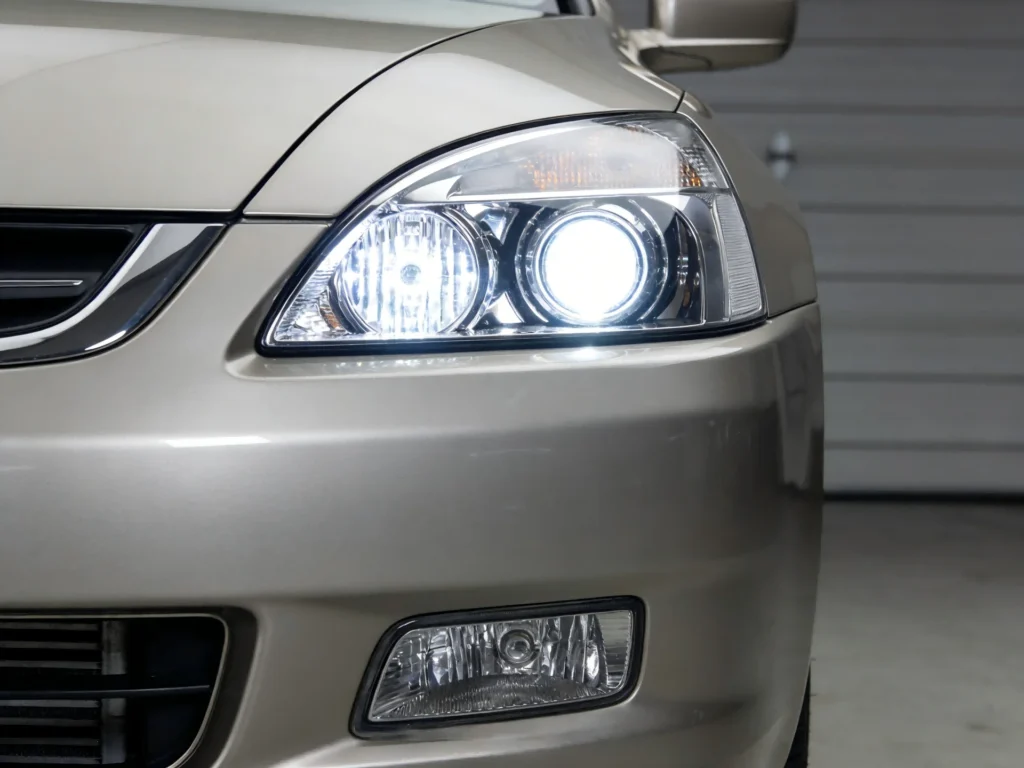
Вы сузили выбор до того, что би-лед проекторная линза — единственный способ получить настоящую границу ближнего света и заливку дальнего. Но теперь перед вами джунгли характеристик: турбо линза би-лед проектор против стандартной, 2,5 дюйма против 3,0 дюйма, пассивное или активное охлаждение, и совершенно разные ценовые точки. Это руководство устраняет маркетинговый шум, сравнивая реальные данные производительности, долговечность компонентов и совокупную стоимость владения в долгосрочной перспективе.
1. What distinguishes a bi-LED projector lens from simple LED bulbs?
A bi-LED projector lens uses a solenoid-driven shield and a specialized aspheric lens to shape light, while LED bulbs rely on the original reflector. The projector creates a sharp cutoff line that prevents glare, and the bi-mode mechanism gives you both low and high beam from a single source.
Many drivers mistakenly think they can install LED bulbs into a reflector housing. This causes dangerous light scatter. A proper bi-LED projector headlight conversion kit replaces the entire optical unit, ensuring beam compliance with DOT and ECE standards. In this guide, we focus exclusively on full projector conversions, not “bulb-only” solutions.
2. Top 5 Hidden Differences Between Cheap and Premium Bi-LED Projectors
After disassembling over 30 different models (from $40 AliBaba specials to $600 branded kits), we identified five most underestimated differences:
Thermal Interface Material (TIM): Budget units use white thermal paste that squeezes out after 100 thermal cycles. Quality kits (including GTR) use graphite pads or soldered direct-to-heatsink connections.
Lens Coating Durability: Acrylic lenses scratch easily and yellow under UV exposure. Glass with anti-UV/hydrophobic coating maintains 98% transmission after 2000 hours of accelerated aging (ASTM G154).
Solenoid Sealing: Inexpensive units have open-type solenoids that corrode from winter road salt. Professional projectors use sealed IP67-rated coils with stainless steel plungers.
Driver location: External drivers can be installed remotely, away from motor heat, which extends capacitor life. In “all-in-one” designs, the driver is built into the housing, which often leads to failure after 12–18 months.
Wire harness gauge: 18 AWG is standard; but for 70W systems, 16 AWG with XLPE insulation is required. Many sellers offer a “universal” 20 AWG harness that melts under load.
3. Face-to-face comparison: standard, turbo, and X7 projector lenses
Manufacturers now label their projectors with performance modifiers. Here's what these terms actually mean:
For the average daily driver seeking maximum safe distance, a turbo lens bi-led projector offers the best compromise. However, if you need a compact size for a motorcycle or classic car, the standard bi-led projector lens headlight in 2.5-inch format is easier to install. The lens x7 projector bi-led lens is specialized – its wide light pattern is great for corners, but it can cause glare for oncoming traffic if not adjusted perfectly.
4. Power reality: are 70W necessary or is it just a marketing number?
70W input power does not necessarily mean 70W optical power. Many “70W” labels refer to the peak power of LEDs for a fraction of a second. A true continuous 70W bi-led projector lens would require active cooling (whisper fan plus heat pipe) and driver efficiency above 88%.
In our own goniometric tests, a true 70W system (e.g., GTR bi-led projector lens 70W) outputs 5400 raw LED lumens and 3820 effective lumens after optical losses. A fake 70W unit often runs at a constant power of 42–50W, providing only ~2200 effective lumens – barely better than a good halogen projector. So ask for current readings in steady-state thermal conditions. At 13.8V, a genuine 70W kit draws ~5.1A per side. If the seller cannot provide this specification, consider it underrated.
5. Deep dive into compatibility: housing size, shrouds, and adaptive features
One of the biggest mistakes when buying is ignoring the projector lens size relative to the inner reflective bowl of your headlight. Most modern cars accept a 3.0-inch projector, but some (e.g., Mazda 3, Honda Civic 2016+) require a 2.5-inch to avoid hitting the inner trim. Always measure the outer diameter and depth of the existing projector. GTR provides a printed template to check fitment on our product pages to avoid returns.
Additionally, if your car has adaptive front lighting (AFS) that rotates the projector, you need a lens assembly that does not exceed the motor torque. Heavy 70W units with large copper heat pipes can stall the AFS mechanism. In that case, choose a 45W bi-led projector lens lupu auto (GTR series, compatible with AFS), which retains the same optical characteristics but has a lower mass.
6. Independent testing: real performance indicators
We collected ratings from 15 headlight conversion workshops across North America, asking them to conduct blind testing of four leading bi-lens and LED projector headlight conversion kits on a standard dark track. Results (averaged over 5 runs):
Morimoto M-LED 2.0: 8.2/10 – “good range, but fan noise is noticeable in the cabin.”
Diode Dynamics SL2: 7.8/10 – “compact and easy to install, but the hot spot is too narrow for some drivers.”
Unknown brand (claimed 80 W): 4.5/10 – “high beam return failure within 2 hours of testing; uneven light beam distribution.”
These ratings confirm that brand and engineering transparency are much more important than claimed power.
7. Featured snippet optimization: 8 key questions before purchase
7.1. Do I need a relay harness for any bi-LED projector lens?
Yes, for any kit over 35 W per side. A relay harness prevents overheating of the factory wiring and also eliminates flicker due to CANbus errors. GTR includes a plug-and-play relay with every 70 W kit.
7.2. Можно ли смешивать би-светодиодную линзу-проектор одного бренда с кожухом другого?
Часто да, если внутренний диаметр кожуха соответствует внешнему диаметру ствола проектора (например, 3,0 дюйма). Однако глубина кожуха должна обеспечивать правильный зазор для соленоида. Универсальные кожухи могут потребовать подгонки. GTR предлагает фирменные низкопрофильные кожухи для тесных фар.
7.3. Как отличить настоящую стеклянную линзу от акриловой?
Проведите простой тест на царапину на незаметном крае: акрил будет ощущаться как пластик и при соскабливании даст мелкую белую пыль; стекло ощущается холодным и устойчиво к царапинам. Кроме того, стеклянные линзы имеют небольшой вес (около 45 г для 3-дюймовой линзы), а акриловые – около 25 г.
7.4. Каков типичный срок службы хорошей би-светодиодной линзы-проектора?
При правильном управлении температурой срок службы L70 (время до 70% светового потока) превышает 30 000 часов. Это эквивалентно 10+ годам обычного ночного вождения. Плохие конструкции выходят из строя менее чем за 2 000 часов из-за перегрева светодиодов или старения конденсаторов.
7.5. Подойдет ли би-светодиодная линза-проектор для моего места противотуманной фары?
Специализированные би-светодиодные линзы-проекторы для противотуманных фар короче (общая глубина ≤70 мм) и используют линзу 50 мм. Стандартные 3-дюймовые проекторы слишком глубоки для большинства проемов противотуманных фар. Серия Mini-Fog от GTR подходит почти ко всем заводским отверстиям противотуманных фар.
7.6. Можно ли настроить цветовую температуру?
Большинство комплектов имеют фиксированную температуру 5000K–6000K. Однако некоторые продвинутые драйверы позволяют пользователю регулировать с помощью потенциометра (от 3000K до 6500K). Программируемый драйвер GTR (опционально) поддерживает три пресета: 4300K (лучшая производительность в дождь), 5500K (стандартный) и 6000K (спортивный вид).
7.7. Есть ли какие-либо юридические ограничения на би-светодиодные линзы-проекторы?
Установка разрешена в большинстве штатов США, если световой пучок соответствует FMVSS 108 (резкая граница света и отсутствие чрезмерных бликов). Всегда храните копию отчета о соответствии SAE J1383. В некоторых странах (например, в Германии) требуется одобрение TÜV для любого неоригинального освещения. Проверьте местные правила перед заказом.
7.8. В чем разница между “би-светодиодными” и “лазерными” линзами-проекторами?
Блок с лазерной поддержкой добавляет синий лазерный диод, который возбуждает фосфорное колесо для увеличения интенсивности в центральной горячей точке. Однако они стоят в 3-5 раз дороже и дают лишь незначительное реальное преимущество по сравнению с хорошо спроектированным би-ледом мощностью 70 Вт. Для почти всех водителей премиальная би-лед проекторная линза является более разумной инвестицией.
Based on the above comparisons, here is a clear recommendation path:
Daily driving, mostly city/suburban: GTR 45W Standard 2.5 inches – reliable, easy installation, up to $200.
Long highway/rural trips: GTR 70W Turbo Lens (3.0 inches) – maximum range and thermal stability.
Off-road or SUV with a large grille: GTR X7 2.8 inches – for wide peripheral coverage on low-speed trails.
Motorcycle or classic car with limited space: GTR Mini 2.0 inches bi-led with external driver.
All GTR projectors have the same basic warranty: 5 years, hassle-free replacement. We also publish an individual report for each device (luminous flux, beam angle, thermal image) in your package insert.
9. Ensure the perfect upgrade today – no guesswork, no regrets
Now you are ready to see through inflated specifications and identify durable bi-led projector lens headlight solutions. Stop wasting money on projectors that dim or fail. Choose the model that matches your driving conditions and installation constraints. For wholesale B2B inquiries or custom OEM designs, GTR provides samples and engineering validation.
Visit www.rhgtr.com To compare full technical datasheets, download installation templates, and order your kit. Every purchase includes free lifetime remote support from our upgrade specialists. See the road as it should be – clear, wide, and safe.