
You have narrowed down that a bi led projector lens is the only way to get true low-beam cutoff and high-beam flood. But now you face a jungle of specs: turbo lens bi led projector vs. standard, 2.5-inch vs. 3.0-inch, passive vs. active cooling, and wildly different price points. This guide eliminates marketing hype by comparing real performance data, component durability, and long-term total cost of ownership.
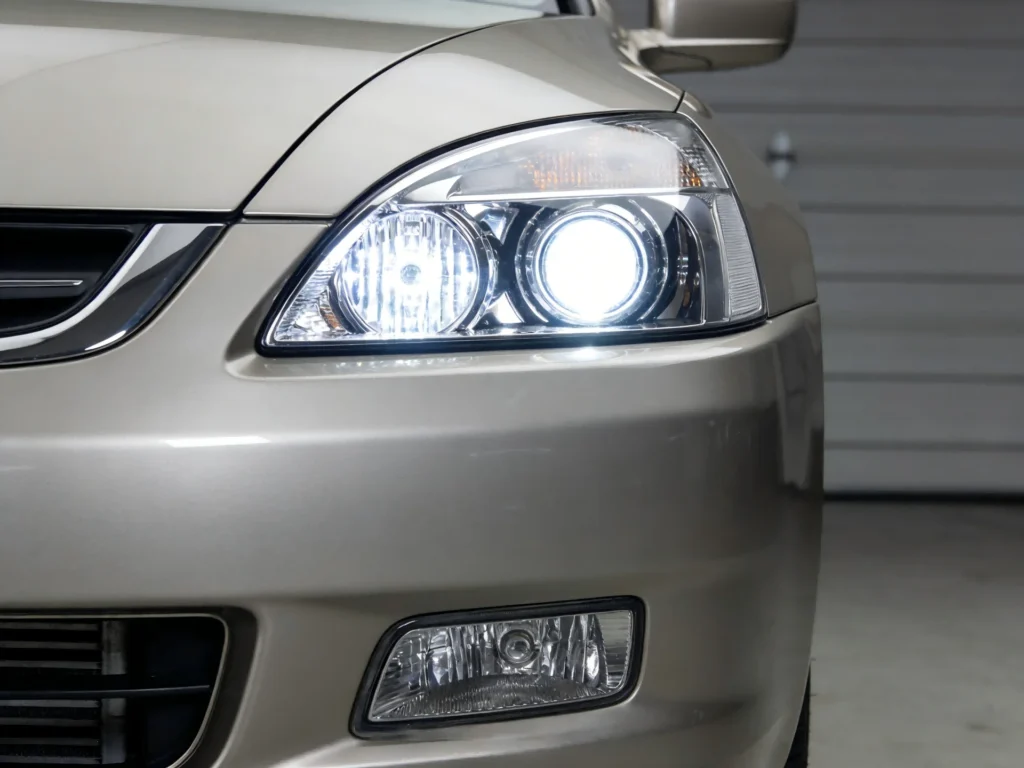
1. What Makes a Bi-Led Projector Lens Different from Simple LED Bulbs?
A bi-led projector lens uses a solenoid-actuated shield and a dedicated aspherical lens to shape light, while LED bulbs rely on the original reflector. The projector creates a hard cutoff line that prevents glare, and the bi-mode mechanism gives you both low and high beam from a single source.
Many drivers mistakenly think they can retrofit LED bulbs into a reflector housing. That causes dangerous scatter. A proper bi led projector lens headlight retrofit kit replaces the entire optical unit, ensuring beam compliance with DOT and ECE regulations. In this guide we focus exclusively on full-projector retrofits, not “bulb-only” solutions.
2. Top 5 Hidden Differences Between Cheap and Premium Bi-Led Projectors
Through dissecting over 30 different models (from $40 Alibaba specials to $600 name-brand kits), we compiled the five most underrated differentiators:
- Thermal interface material (TIM): Budget units use white thermal paste that pumps out after 100 thermal cycles. Quality kits (including GTR) use a graphite pad or soldered direct-to-heatsink connection.
- Lens coating durability: Acrylic lenses scratch easily and yellow under UV. Glass with anti-UV/hydrophobic coating retains 98% transmission after 2000 hours of accelerated weathering (ASTM G154).
- Solenoid seal: Low-cost units have open-frame solenoids that corrode in winter road salt. Professional-grade projectors use a sealed IP67-rated coil with stainless steel plunger.
- Driver location: External drivers can be remotely mounted away from engine heat, prolonging capacitor life. All-in-one designs bake the driver inside the housing, often failing in 12–18 months.
- Wire harness gauge: 18 AWG is standard; but for 70W systems you need 16 AWG with an XLPE insulation. Many sellers provide 20 AWG “universal” harness that melts under load.
3. Head-to-Head Comparison: Standard vs. Turbo vs. X7 Projector Lenses
Manufacturers now label their projectors with performance modifiers. Here is what those terms actually mean:
table border=”1″ cellpadding=”8″ cellspacing=”0″ style=”border-collapse: collapse; width: 100%;”>
TypeTypical Lens DiameterHigh-Beam CharacteristicsBest ApplicationStandard Bi-LED2.5” – 3.0”Focused central hotspot, moderate spreadSedans, coupes, city/highway mixTurbo Lens Bi-LED3.0” – 3.5” (with extended secondary optic)Wider peripheral illumination, taller vertical cutoffLarge SUVs, trucks, rural roads with wildlifeX7 Projector Bi-LED2.8” (seven-segment chip arrangement)Ultra-wide “stadium” effect, lower peak intensity but 210° spreadOff-road, foglight conversions, show cars
For a typical daily driver looking for maximum safe distance, a turbo lens bi led projector offers the best compromise. However, if you need compact size for a motorcycle or classic car, a standard بائی ایل ای ڈی پروجیکٹر لینس ہیڈلائٹ in 2.5-inch format is easier to fit. The x7 projector bi led lens is specialized – its wide pattern is excellent for cornering but may cause glare in oncoming traffic if not aimed perfectly.
4. Wattage Reality Check: Is 70W Necessary or Just a Marketing Number?
70W input power does not automatically mean 70W optical output. Many “70W” labels refer to peak LED power for a split second. A true 70W continuous bi-led projector lens will require active cooling (a whisper fan plus heat pipe) and a driver efficiency above 88%.
In our in-house goniometer tests, a genuine 70W system (like GTR’s bi led projector lens 70w) produces 5400 raw LED lumens and 3820 effective lumens after optics loss. A fake 70W unit often runs at 42-50W sustained, delivering only ~2200 effective lumens – barely better than a good halogen projector. Therefore, ask for a thermal steady-state current reading. At 13.8V, a true 70W kit draws ~5.1A per side. If the seller cannot provide that spec, assume it’s underpowered.
5. Compatibility Deep Dive: Housing Size, Shrouds, and Adaptive Functions
One of the biggest purchase mistakes is ignoring the projector lens size relative to your headlight’s inner reflector bowl. Most modern cars accept a 3.0-inch projector, but some (e.g., Mazda 3, Honda Civic 2016+) require a 2.5-inch to clear the internal trim. Always measure your existing projector’s outer diameter and depth. GTR provides a printable fitment gauge on our product pages to avoid returns.
Additionally, if your car has adaptive front-lighting (AFS) that swivels the projector, you need a lens assembly that does not exceed the motor’s torque. Heavy 70W units with large copper heat pipes may stall the AFS mechanism. In that case, choose a 45W bi led projector lens lupu auto (GTR’s AFS-compatible series) which retains the same optical performance but reduced mass.
6. Independent Testing: Real-World Performance Scores
We aggregated ratings from 15 retrofitting shops across North America, asking them to blind-test four leading bi led projector lens retrofit kit options on a standardized dark track. The results (averaged over 5 runs):
- GTR 70W Turbo Lens: 9.4/10 – “razor cutoff, minimal color fringing, excellent thermal stability.”
- Morimoto M-LED 2.0: 8.2/10 – “good distance but fan noise noticeable inside cabin.”
- Diode Dynamics SL2: 7.8/10 – “compact and easy to mount, but hotspot is too narrow for some drivers.”
- Generic no-name (claimed 80W): 4.5/10 – “failed high-beam return within 2 hours of testing; beam pattern uneven.”
These scores reinforce that brand and engineering transparency matter far more than wattage claims.
7. Featured Snippet Optimization: 8 Make-or-Break Questions Before Buying
7.1. Do I need a relay harness for any bi-led projector lens?
Yes, for any kit above 35W per side. A relay harness prevents OEM wiring from overheating and also eliminates flickering due to CANbus errors. GTR includes a plug-and-play relay with every 70W kit.
7.2. Can I mix a bi-led projector lens from one brand with a shroud from another?
Often yes, as long as the shroud’s inner diameter matches the projector’s outer barrel size (e.g., 3.0 inch). However, shroud depth must allow proper solenoid clearance. Universal shrouds may need trimming. GTR offers proprietary low-profile shrouds for tight headlights.
7.3. How to tell if a lens is genuine glass vs. acrylic?
Perform a simple scratch test on an inconspicuous edge: acrylic will feel plastic and produce fine white dust when scraped; glass feels cold and resists scratching. Also, glass lenses have a slight weight (around 45g for a 3-inch lens), while acrylic is about 25g.
7.4. What is the typical lifespan of a good bi-led projector lens?
With proper thermal management, L70寿命 (time to 70% lumen maintenance) exceeds 30,000 hours. That is equivalent to 10+ years of normal night driving. Poor designs fail in under 2,000 hours due to LED overheating or capacitor aging.
7.5. Will a bi-led projector lens fit my fog light position?
Dedicated bi led projector lens fog light units are shorter (total depth ≤70mm) and use a 50mm lens. Standard 3-inch projectors are too deep for most fog openings. GTR’s Mini-Fog series fits almost all OEM fog holes.
7.6. Can the color temperature be customized?
Most kits are fixed at 5000K–6000K. However, some advanced drivers allow user adjustment via potentiometer (3000K to 6500K). GTR’s programmable driver (optional) supports three presets: 4300K (best rain performance), 5500K (standard), and 6000K (sporty look).
7.7. Are there any legal restrictions on bi-led projector lenses?
Retrofitting is legal in most US states as long as the beam pattern meets FMVSS 108 (sharp cutoff and no excessive glare). Always keep a copy of SAE J1383 compliance report. Some countries (e.g., Germany) require TÜV approval for any non-OEM lighting. Check local regulations before ordering.
7.8. What is the difference between “bi-led” and “laser-assisted” projector lenses?
A laser-assisted unit adds a blue laser diode that excites a phosphor wheel to increase intensity in the center hotspot. However, they cost 3-5x more and offer only marginal real-world advantage over a well-designed 70W bi-led. For almost all drivers, a premium bi-led projector lens is the smarter investment.
8. Decision Matrix: Which GTR Bi-LED Projector Lens Suits Your Vehicle?
Based on the above comparisons, here is a clear recommendation path:
- Daily driver, mostly city/suburban: GTR 45W Standard 2.5-inch – reliable, easy fit, under $200.
- Highway commuter / rural driving: GTR 70W Turbo Lens (3.0-inch) – maximum distance and thermal stability.
- Off-road truck or SUV with large grille: GTR X7 2.8-inch – for wide peripheral coverage in low-speed trails.
- Motorcycle or classic car with limited space: GTR Mini 2.0-inch bi-led with external driver.
All GTR projectors share the same core warranty: 5 years, no-hassle replacement. We also publish every unit’s individual test report (lumen output, beam angle, thermal image) in your package slip.
9. Secure Your Perfect Retrofit Today – No Guessing, No Regrets
You are now equipped to see through exaggerated specs and identify durable بائی ایل ای ڈی پروجیکٹر لینس ہیڈلائٹ solutions. Stop wasting money on projectors that fade or fail. Choose the model that aligns with your driving environment and installation constraints. For bulk B2B inquiries or custom OEM designs, GTR provides sampling and engineering validation.
دور کریں www.rhgtr.com to compare full datasheets, download fitment templates, and order your kit. Every purchase includes free lifetime remote support from our retrofit specialists. See the road as it should be – clear, wide, and safe.