
ตลาดสำหรับ h4 led headlamp bulbs has a strange problem: almost every product claims to be brighter, cooler, smaller, and longer-lasting than the one beside it. Yet two H4 LED bulbs with similar specifications can produce completely different results on the road.
For consumers, that makes comparison difficult. For distributors and professional buyers, it creates a larger commercial risk.
This guide explains how to compare h4 led headlight bulbs from an engineering and purchasing perspective. Instead of ranking products by marketing numbers, we will examine optical geometry, beam pattern, thermal stability, driver design, installation, color temperature, compatibility, and supplier capability.
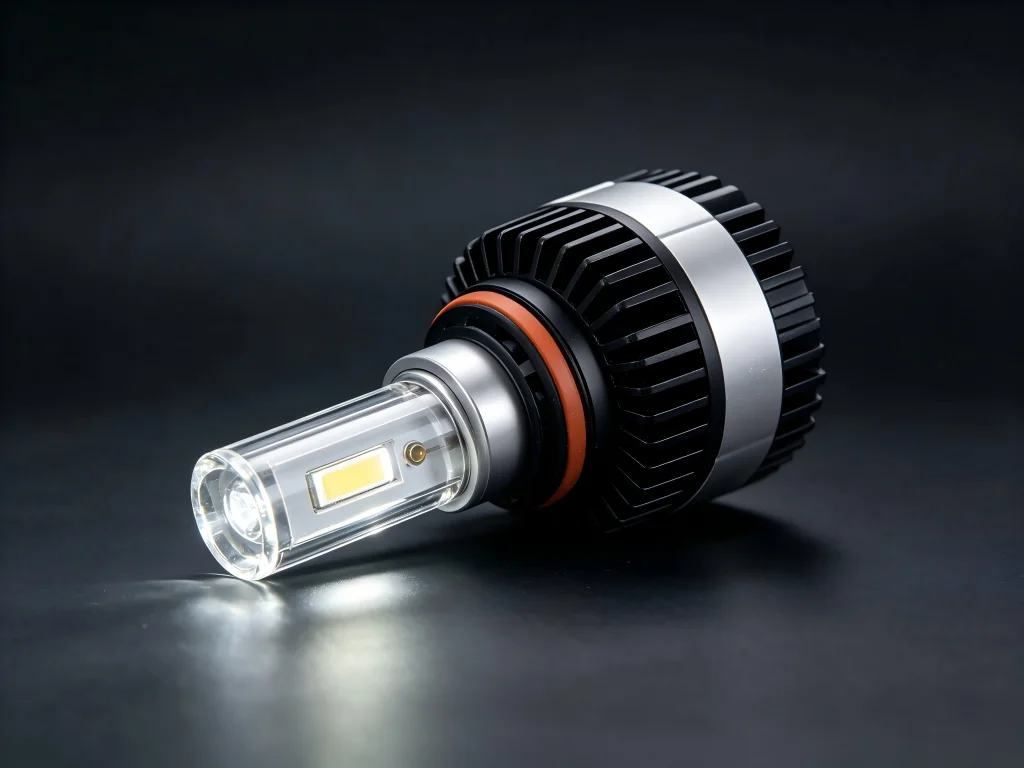
1. What Are the Best H4 LED Headlamp Bulbs?
The best H4 LED headlamp bulbs combine accurate LED chip positioning, controlled low and high beams, stable hot-state output, efficient cooling, reliable electronics, practical installation dimensions, and vehicle compatibility. Do not judge quality by maximum lumens alone. Usable beam intensity and long-term stability matter more in real driving.
This gives us a useful buying principle:
Evaluate the complete lighting system, not one number.
A product claiming 30,000 lumens is not automatically better than one claiming less. Unless the measurement method, operating temperature, voltage, power level, and test conditions are known, lumen figures are difficult to compare fairly.
2. H4 LED vs Halogen vs HID: Which Should You Choose?
Halogen offers simple installation and predictable optical compatibility. LED can provide higher efficiency, whiter light, fast response, and strong output in a compact package. HID can deliver high intensity but requires additional components. For an H4 retrofit, LED is attractive when beam geometry and vehicle compatibility are properly engineered.
| ปัจจัยในการตัดสินใจ | H4 Halogen | H4 LED | HID Conversion |
|---|---|---|---|
| ความซับซ้อนในการติดตั้ง | ต่ำ | ต่ำถึงปานกลาง | ปานกลางถึงสูง |
| Startup speed | Fast | ทันที | อาจต้องอุ่นเครื่อง |
| Electrical efficiency | Lower | Generally higher | Generally higher than halogen |
| Color appearance | อบอุ่น | Usually white | Depends on system |
| Additional electronics | น้อยมาก | LED driver | Ballast/igniter |
| Thermal challenges | Hot filament/bulb | LED junction heat | ขึ้นอยู่กับระบบ |
| Retrofit optical risk | Lowest with correct original specification | Depends heavily on LED geometry | Can be significant in unsuitable optics |
| Best use cases | Simple OEM-style replacement | Modern performance upgrade | Specific compatible applications |
3. Buyer Criterion #1: LED Chip Position Beats Huge Lumen Claims
This is one of the most overlooked differences between cheap and professionally engineered h4 led light bulbs.
The reflector does not know how impressive the LED chip specification sounds.
It only reacts to the position and direction of light.
3.1. Why focal geometry matters
An H4 halogen bulb contains low-beam and high-beam filament structures in defined positions. The headlamp reflector is designed around those positions.
When converting to LED, the emitting surfaces should reproduce the functional light-source geometry as closely as possible.
If the LED board is excessively thick or the emitting area is too large, the effective light source shifts away from the intended focal zone.
That may create:
- Blurred beam boundaries
- Scattered light above the intended cutoff
- Poor center intensity
- Weak long-distance illumination
- Inconsistent high-beam focus
When comparing suppliers, ask for actual beam-pattern testing instead of accepting lumen specifications as proof of optical performance.
4. Buyer Criterion #2: Cold Lumens vs Hot Lumens
Here is a useful test that many buyers never request.
Measure the bulb when it starts.
Then measure it again after it has operated long enough to reach a stable thermal condition.
Why?
LED performance is temperature-sensitive. As junction temperature increases, electrical and optical behavior changes. A driver may also reduce current when thermal limits are approached.
4.1. The 30-minute question
When evaluating an H4 LED supplier, ask:
“What percentage of initial output remains after 30 minutes of continuous operation?”
This question is often more revealing than asking for maximum lumens.
In our engineering testing, thermal stability is one of the areas we examine because customers use headlights for hours, not five-minute demonstrations.
5. Buyer Criterion #3: Cooling System Design
There are two common approaches.
5.1. Fanless cooling
Fanless bulbs use passive heat dissipation. They eliminate a moving component and may operate silently. However, adequate surface area and thermal conductivity are required, particularly as power increases.
5.2. Active fan cooling
Fan-cooled products can move heat away from compact high-output LED structures more efficiently.
But the fan itself becomes part of the reliability equation.
Professional buyers should consider bearing quality, dust exposure, airflow restriction, operating temperature, fan noise, and long-term durability.
| Cooling Design | Main Advantage | Potential Weakness | Best Fit |
|---|---|---|---|
| Passive / Fanless | ไม่มีพัดลมเคลื่อนไหว | Heat dissipation may limit compact high-power designs | Moderate-output applications |
| Active Fan | Strong heat removal from compact structures | คุณภาพพัดลมกลายเป็นสิ่งสำคัญ | Higher-output compact bulbs |
| Hybrid Thermal Design | Combines conductive and active cooling | More engineering complexity | Performance-focused products |
6. Buyer Criterion #4: Driver Electronics
LED chips receive most of the attention in online product listings.
Experienced buyers also inspect the driver.
The driver helps regulate power supplied to the LEDs. Poor electronic design may contribute to flickering, unstable output, electromagnetic interference, premature failure, or compatibility problems.
A stronger purchasing evaluation should consider:
- Operating voltage range
- การควบคุมกระแสไฟฟ้า
- การป้องกันอุณหภูมิเกิน
- การป้องกันแรงดันเกิน
- การป้องกันขั้วกลับในกรณีที่เกี่ยวข้อง
- EMC/EMI performance
- PWM compatibility
- Vehicle bulb-monitoring compatibility
7. Buyer Criterion #5: Color Temperature
Higher Kelvin does not mean brighter.
This misconception leads some buyers toward extremely blue-looking bulbs because they appear visually “high-tech.”
Color temperature describes the appearance of the light, not its total luminous output.
| Approximate CCT | Appearance | Typical Character |
|---|---|---|
| 3000K-4000K | Warm to neutral | Less blue appearance |
| 5000K-6000K | Neutral to cool white | Popular modern headlight appearance |
| 6500K+ | Cooler/bluer | Stronger blue visual impression |
For road applications, buyers should balance appearance, visibility, market preference, and regulatory requirements rather than simply choosing the highest Kelvin figure.
8. Buyer Criterion #6: Low Beam and High Beam Must Both Work
H4 is different from a single-function bulb.
One H4 bulb typically provides low and high beam functions. That means an H4 LED replacement has two optical jobs to perform.
A product may produce an acceptable low beam but a weak high beam. Another may create a strong high beam while introducing excessive stray light on low beam.
For this reason, professional evaluation should include separate photometric or beam-pattern checks for both functions.
9. Buyer Criterion #7: Fitment Is More Than "H4"
Seeing “H4” on the box does not guarantee easy installation in every H4-equipped vehicle.
Check:
- Overall bulb length
- Heat sink diameter
- Fan clearance
- Connector position
- External driver dimensions
- Retaining spring compatibility
- Dust-cover clearance
- Polarity and wiring requirements
This becomes especially important for wholesalers selling one SKU across multiple vehicle platforms.
A slightly smaller product may sometimes create fewer installation complaints than a larger bulb designed only to maximize cooling capacity.
10. Buyer Criterion #8: Road Legality and Compliance
LED retrofit legality varies by jurisdiction, vehicle, lamp assembly, and product approval status.
Do not assume that an H4 base automatically makes an LED retrofit legal for public-road use.
UNECE regulations provide an important framework for vehicle lighting requirements in many markets. Buyers can review information through the UNECE vehicle regulations portal.
For distributors, regulatory research should happen before product launch rather than after inventory arrives.
11. H4 LED Headlight Bulbs South Africa: What Buyers Should Compare
South African consumers searching for h4 led headlight bulbs south africa often encounter several purchasing routes, from automotive parts retailers to marketplaces and specialist lighting suppliers.
This creates searches such as h4 led headlight bulbs midas, h4 led headlight bulbs midas south africa, h4 led headlight bulbs midas price, และ h4 led headlight bulbs takealot.
Instead of comparing price alone, use a cost-per-performance approach.
Ask whether the product includes credible information about:
- Actual power consumption
- Measured luminous output
- รูปแบบลำแสง
- Cooling design
- Driver architecture
- การรับประกัน
- Vehicle fitment
- After-sales support
A lower purchase price can become expensive if installation problems or warranty returns increase.
12. H4 LED Headlight Bulbs Ireland: Don't Ignore Regulations
For searches involving h4 led headlight bulbs ireland, product quality is only one part of the decision.
Drivers should confirm applicable vehicle inspection and road-use requirements before changing the original lighting technology.
This principle applies to other markets as well. A product that can physically fit into an H4 socket is not automatically approved for every headlamp or jurisdiction.
13. H4 LED Headlight Bulbs Near Me vs Factory Supply
Buying H4 LED bulbs locally offers speed and convenient retail support, while direct factory sourcing offers professional buyers greater control over specifications, packaging, consistency, and volume pricing. Consumers may prioritize convenience, but wholesalers and retrofit chains should evaluate manufacturing capability and long-term supply stability.
A search for h4 led headlight bulbs near me usually signals immediate purchasing intent.
That makes sense for a driver who needs one replacement pair.
The priorities change for a distributor purchasing hundreds or thousands of units.
B2B buyers need to ask:
Can the supplier maintain the same performance from batch to batch?
Can they support different markets?
Can they troubleshoot field problems?
Can packaging and specifications be adapted?
Can production capacity support future growth?
The cheapest sample is rarely the most important factor in a long-term supply relationship.
14. The H4 LED Specification Trap
Suppose Supplier A advertises:
40,000 lumens, 120W, 6500K.
Supplier B provides lower headline figures but shows thermal curves, beam testing, driver specifications, installation dimensions, and controlled production data.
Which supplier is safer?
For professional purchasing, Supplier B may deserve deeper evaluation.
Large numbers are easy to print.
Repeatable performance is harder to manufacture.
14.1. Questions procurement teams should send suppliers
- Are lumen figures measured or theoretical?
- Are specifications stated per bulb or per pair?
- At what voltage was power measured?
- What is the stabilized operating power?
- How does output change after thermal stabilization?
- Can you provide low-beam and high-beam pattern images?
- What thermal protection is built into the driver?
- Which vehicle electrical systems have been tested?
- What QC checks are performed during production?
- How are warranty claims handled?
15. How We Evaluate H4 LED Bulbs at GTR
Based on our years of manufacturing experience, we prefer to divide evaluation into four layers.
15.1. Layer 1: Optical performance
We examine whether the LED source and mechanical structure support effective beam formation. The objective is usable illumination rather than uncontrolled brightness.
15.2. Layer 2: Thermal performance
We evaluate heat transfer because LED temperature affects stability and service life. A bulb should not depend on impressive cold-start performance.
15.3. Layer 3: Electrical performance
Driver behavior matters because vehicle voltage is not a perfect laboratory power supply. The system needs to operate reliably under realistic automotive conditions.
15.4. Layer 4: Manufacturing consistency
This is particularly important for B2B customers.
A distributor does not buy an engineering prototype. They buy production batches.
Therefore, manufacturing repeatability matters almost as much as the performance of the original sample.
16. Why Professional Buyers Choose a Manufacturer, Not Just a Bulb
For an individual driver, the transaction may end when the headlights are installed.
For a wholesaler, that is when the real relationship begins.
Inventory must move.
Installers need support.
Warranty rates need to stay controlled.
Future batches must match previous ones.
New vehicle applications may require different configurations.
This is why GTR positions itself around automotive lighting manufacturing and product solutions rather than a single H4 specification.
Depending on project requirements, professional customers may need support with product selection, wholesale programs, packaging, market positioning, and customized product solutions.
17. Quick H4 LED Buyer Scorecard
| หมวดหมู่ | Weak Product | Better Product | Professional Buying Target |
|---|---|---|---|
| ออปติก | Only claims brightness | Shows beam photos | Controlled optical testing |
| Thermal | No data | Large heat sink | Stable measured hot-state behavior |
| ไดรเวอร์ | Unknown electronics | Basic protection | Stable automotive-oriented design |
| ความเข้ากันได้ในการติดตั้ง | “Universal H4” | Dimensions supplied | Application-focused verification |
| Quality | Sample-focused | Basic QC | Repeatable batch-level control |
| Supplier | Price seller | Product supplier | Long-term technical partner |
18. FAQ: H4 LED Headlamp Bulbs
18.1. What does H4 mean on a headlight bulb?
H4 identifies a common dual-function automotive bulb format used for low and high beam operation in the same bulb. Vehicle owners should confirm the required bulb type before purchasing a replacement.
18.2. Which H4 LED headlight bulbs are brightest?
The product with the largest advertised lumen number is not necessarily the most useful. Beam intensity, LED positioning, reflector compatibility, and thermal stability determine how much light actually reaches useful areas of the road.
18.3. How do I know if an H4 LED bulb has a good beam pattern?
Test low and high beam against a suitable aiming surface and inspect the distribution. Look for controlled illumination, useful central intensity, and limited stray light. Road testing should complement wall testing where appropriate and lawful.
18.4. Are fanless H4 LED bulbs better?
Not automatically. Fanless systems remove a moving component, while fan-cooled systems can provide stronger heat removal in compact high-output designs. The quality of the complete thermal system matters more than whether a fan is present.
18.5. Why do some H4 LED headlight bulbs cause dashboard errors?
Some vehicles monitor electrical load to detect failed bulbs. Because LEDs can draw power differently from halogen lamps, the vehicle may interpret the change as a fault. Compatible electronics or additional solutions may be required.
18.6. Can H4 LED bulbs damage a headlight housing?
A correctly engineered product should manage heat effectively, but installation conditions vary. Buyers should check clearance, airflow, power, heat-sink position, wiring, and compatibility with the headlamp assembly.
18.7. Should I choose 6000K or 6500K?
Both produce a cool white appearance, although actual color varies by LED and manufacturing tolerance. Color temperature should be considered alongside beam performance and local regulations rather than used as the main quality indicator.
18.8. Where can distributors buy H4 LED bulbs wholesale?
Professional buyers can source directly from automotive lighting manufacturers such as GTR when they require bulk purchasing, product configuration, technical support, packaging solutions, and more consistent long-term supply.
19. Choose H4 LED Performance You Can Defend to Your Customers
Anyone can compare prices.
Professional buyers compare risk.
They ask what happens after 30 minutes of operation. They examine beam geometry. They inspect the driver. They check installation dimensions. They question unusually large lumen claims. Most importantly, they evaluate whether the manufacturer can reproduce the same quality when the order moves from samples to commercial volume.
That is the difference between purchasing h4 led headlamp bulbs and building a profitable H4 LED product category.
If you are a distributor, automotive parts wholesaler, headlight retrofit chain, importer, or private-label brand, send GTR your target market, vehicle applications, positioning, and expected volume before committing to your next H4 LED order.
เยี่ยมชม GTR Automotive Lighting to discuss your project. Instead of choosing the supplier with the biggest number on the box, build an H4 LED lighting solution your dealers, installers, and customers will want to buy again.