
If you have spent more than 10 minutes researching headlight upgrades, you have already encountered conflicting claims. One brand says LED bulbs are brightest. Another swears by HID. A third insists a complete بائی ایل ای ڈی پروجیکٹر retrofit is the only safe answer. The truth depends entirely on what you value—raw lumens on a spec sheet, or controlled, usable light on the actual road at 60 mph. This guide breaks down every major lighting technology side by side, reveals the hidden specs that brands don’t want you to compare, and walks you through exactly which system fits your budget, vehicle, and driving conditions.
Based on our years of manufacturing expertise at GTR Lighting and thousands of customer installations, we have tested every popular headlight configuration on the market. This isn’t theory. These are data points from real projector test walls, lux meter readings at varying distances, and long-term reliability tracking across diverse vehicle platforms.
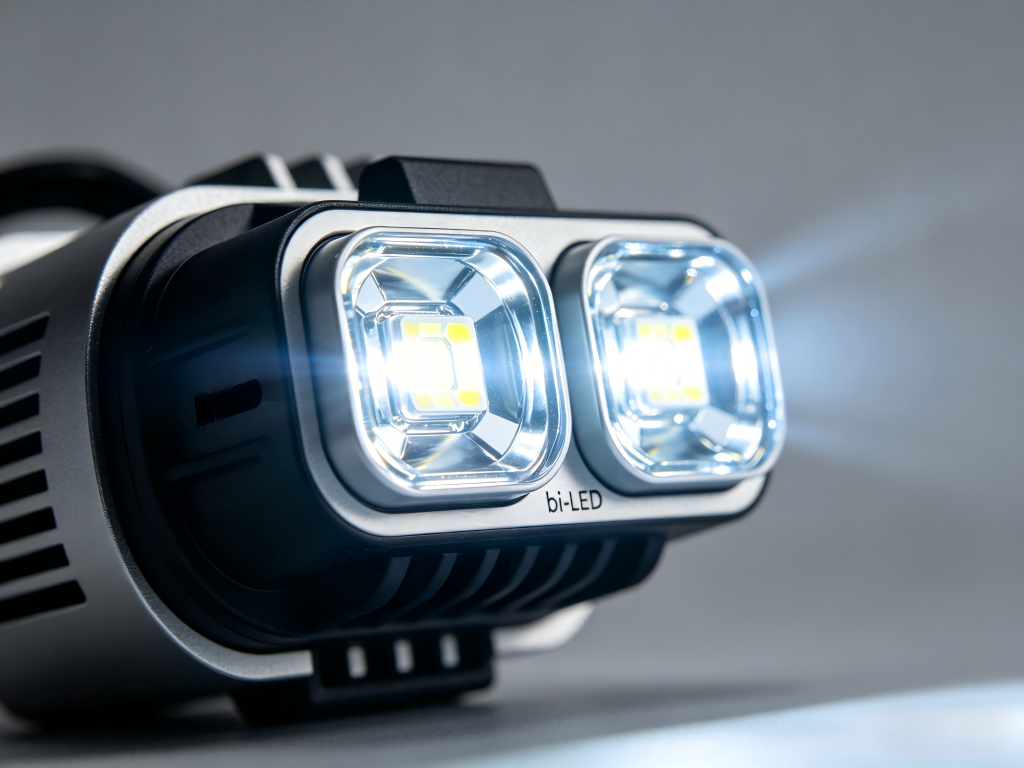
1. The Core Question: Single-Beam vs. Bi-Beam—What Are You Actually Buying?
Before comparing across technologies (LED bulb versus HID versus Bi-LED projector), you need to understand the fundamental distinction in function. This distinction alone determines whether your high beams work correctly or not.
A single-beam projector produces only one dedicated beam function, typically low beam. If the vehicle needs high-beam capability, it relies on a separate high-beam reflector, projector, or optical module mounted elsewhere in the headlight housing. This is the most common factory configuration—one projector for low beam, one reflector or second projector for high beam.
A بائی ایل ای ڈی پروجیکٹر uses a movable cutoff shield and Solenoid actuator to provide both low beam and high beam from the same projector assembly. When the Solenoid pulls the shield downward, the full LED output floods the road with high-beam intensity. When the shield defaults to its closed position, the sharp, glare-controlled low beam cutoff remains. This dual-function design simplifies headlight architecture, reduces parts count, and ensures perfect alignment between low and high beam patterns since both originate from the same optical system.
If you are considering a bi led projector vs led configuration where the “LED” option is simply a single-beam projector or a reflector housing with LED bulbs, the Bi-LED wins every time on beam control and dual-function integration. The ability to switch seamlessly between modes without separate optics is a genuine advantage, particularly in compact headlight housings where space is at a premium.
2. Head-to-Head Comparison: Bi-LED Projector vs. LED Bulb in Reflector Housing vs. HID Projector
Each technology has legitimate use cases. The following comparison is based on our engineering lab testing and real-world road evaluations across dozens of vehicle platforms.
| Scale | Bi-LED Projector | LED Bulb (Reflector Housing) | ایچ آئی ڈی پروجیکٹر |
|---|---|---|---|
| Glare Control | Excellent — physical cutoff shield | Poor to fair — geometry mismatch common | Very good — cutoff shield present |
| Low-beam width | Very wide, edge-to-edge coverage | Narrow to medium — often blotchy | Wide, though sometimes uneven |
| High-beam distance | Excellent — focused hotspot + wide fill | Poor — no secondary high-beam optics | Very good — warm-up delay present |
| Instant-on / flash-to-pass | Yes — zero warm-up | Yes — zero warm-up | Partial — 3-7 second warm-up |
| Color temperature options | 5000K to 6500K (daylight to cool white) | 3000K to 8000K+ (wide variation) | 4300K to 6000K (requires bulb swap) |
| عمر (گھنٹے) | 30,000–50,000+ | 15,000–30,000 (thermal dependent) | 2,000–8,000 (bulb + ballast failure) |
| Energy Efficiency | Very high (≈100–150 lm/W) | High (≈80–120 lm/W) | Moderate (≈70–100 lm/W) |
| Installation complexity | High — requires opening headlight housing | Low — plug and play | High — ballast mount + wiring + bulb alignment |
| Cost (complete system) | معتدل سے زیادہ | Low to moderate | اعتدال پسند |
| Ideal use case | Enthusiasts wanting maximum performance | Budget-conscious drivers on stock reflector housings | Legacy retrofits / pre-2015 platforms |
The verdict for most drivers: If you primarily drive on well-lit city streets, LED bulbs in reflector housings may be sufficient—but understand that you are accepting glare for oncoming traffic and limited high-beam performance. If you drive on dark rural roads, highways, or through mountainous terrain, a بائی ایل ای ڈی پروجیکٹر retrofit provides the widest, most controlled beam pattern with excellent distance illumination. HID projectors are increasingly obsolete for new builds—their warm-up delay and shorter bulb lifespan make them less practical than modern LED options.
3. The Optics That Matter: Beam Pattern Fundamentals Every Buyer Must Understand
Marketing materials love to blast lumen numbers. Our engineering team loves to ignore them. Here is why: Lumens measure total light output from the chip, but lux measures the focused intensity of that light on the road at distance. A projector could emit 10,000 lumens directly into a test sphere, but if the optics are poorly designed, barely 2,000 lux reaches the road surface at 100 feet. That is useless light—bright in the foreground, useless downrange.
When evaluating bi led projector lens candidates, ignore the lumen claim entirely. Instead, examine actual beam pattern photos or test-wall videos. A quality projector displays four critical characteristics:
- Razor-sharp cutoff line: The low-beam cutoff should be flat, intensely sharp, and free of scattering or color fringing. A small “step-up” on the passenger side (for left-hand drive countries) is normal and helps illuminate road signs without causing glare.
- Very wide beam width: The illuminated area should extend edge to edge across the road, reaching shoulders, sidewalks, and intersection corners. A narrow “tunnel vision” beam reduces peripheral awareness and contributes to accidents.
- Smooth, even distribution: There should be no dark spots, blotches, or “swimming” sections where the light intensifies and fades. Even distribution ensures consistent visibility across the entire field of view.
- Well-defined center hotspot: The most intense portion of the beam should sit precisely at the cutoff line’s center—neither too high (glare) nor too low (reduced distance). A strong hotspot provides long-range throw while the wider beam covers the foreground.
If a seller cannot provide clear beam pattern photographs taken under controlled conditions, consider that a major red flag. Any reputable دو ایل ایل ای ڈی manufacturer will proudly showcase their optical performance.
4. Size Matters: 3.0-Inch vs. 2.5-Inch vs. 1.8-Inch Bi-LED Projectors
بائی LED پروجیکٹر ہیڈلائٹس come in three common lens diameters, each suited to different applications. Choosing the wrong size leads to fitment issues, gap openings, or beam pattern degradation.
- 3.0-inch projectors: Standard size for most factory projector housings. Produces the widest beam pattern with the most pronounced hotspot. Best for sedans, SUVs, and trucks with sufficient housing depth. Requires approximately 4-5 inches of clearance behind the lens, depending on Solenoid depth.
- 2.5-inch projectors: Compact variant for housings with limited space, including many Asian and European compact cars. Slightly narrower beam width than 3.0-inch units but still significantly outperforms any reflector-based solution. Popular for retrofits into factory reflector bowls where full-depth projector conversion is desired.
- 1.8-inch projectors: Ultra-compact “mini” projectors for fog light housings, motorcycle headlights, or retrofit projects with extreme space constraints. Beam width and intensity are reduced compared to larger units, but controlled beam pattern remains far superior to scattered LED bulbs.
Any bi led projector lens, measure your headlight housing’s internal depth from the mounting surface to the back of the lens. Also, measure the available space around the Solenoid and wiring leads. Threedimensional printer templates or physical mock-ups can help validate fitment before cutting open a headlight assembly.
An improperly sized projector that crowds the housing walls may overheat due to restricted airflow, even if the thermal design is otherwise sound. Leave at least 1/2 inch of clearance around the entire projector body wherever possible.
5. Color Temperature: The 6000K Question
Color temperature measured in Kelvin (K) describes the perceived whiteness or blueness of the light output. Lower Kelvin values trend yellow/orange (halogen territory). Higher values trend blue/purple.
For بائی LED پروجیکٹر ہیڈلائٹس, 5000K to 6000K is the optimal range. This produces bright, crisp white light with a slight cool tint that maximizes contrast against dark asphalt without excessive blue scattering. 6000K delivers near-daylight color rendering, which reduces eye strain during extended night driving and improves recognition of road hazards, animals, and pedestrians.
Color temperatures above 6500K appear distinctly blue or purple. While some buyers find this “striking” or “modern” looking, blue-shifted light produces less usable contrast against dark backgrounds and scatters more in fog, rain, and mist—reducing effective visibility. Additionally, high-color-temperature light tends to cause more perceived glare for oncoming drivers even if the beam pattern itself is technically correct.
ہماری سفارش: 5500K to 6000K for general-purpose driving. If you frequently drive in snowy or foggy conditions, consider 5000K, which penetrates moisture slightly better than cooler white light.
6. Wiring and Installation: The Relay Harness Decision
A بائی ایل ای ڈی پروجیکٹر requires two power inputs: low beam (constant power to the LED chips) and high beam (power to the Solenoid actuator that shifts the cutoff shield). Most quality projectors include bare wire leads (typically red for low-beam positive, black for low-beam negative, plus two thinner wires for the Solenoid).
Factory headlight wiring was designed for 55W–65W halogen bulbs drawing 4–5 amps per side. LED projectors draw significantly less power for the low beam (typically 1.5–2.5 amps), but the Solenoid adds a momentary current spike during high-beam activation. In most single-projector-per-side configurations, factory wiring handles the load without issues.
However, in بائی ایل ای ڈی پروجیکٹر quad builds (two projectors per side), relay harnesses become essential. The combined current draw of four projectors (often exceeding 12 amps total low beam) overwhelms factory wiring, leading to voltage drop, flickering, and eventual fuse failure or wiring harness damage. A relay harness pulls power directly from the battery with appropriately sized 12-gauge or 14-gauge wire, triggered by the factory headlight signal. The vehicle’s original wiring only carries a tiny trigger current—not the full load—protecting the factory switchgear and providing stable voltage to the projectors.
Many bi led projector wiring diagram resources show this relay configuration: battery positive to relay input, relay output to projector low-beam positives, factory headlight positive serving as the trigger signal, and all negatives common-grounded. This configuration is industry standard for any multi-projector build or high-wattage single-projector installation.
6.1. Installation Validation Checklist
After installing any بائی ایل ای ڈی پروجیکٹر system, complete the following verification steps before considering the job finished:
- Check all ground connections—every ground wire must be bolted directly to bare, unpainted metal. Grounding to painted surfaces or wire-tapped chassis points introduces resistance and causes flickering, intermittent operation, or total failure.
- Test low-beam cutoff alignment—park 25 feet from a flat wall. The cutoff line should sit approximately 2–4 inches below the headlight center height. Driver-side cutoff should be slightly lower than passenger-side to prevent oncoming glare. Adjust aim using factory-leveling mechanisms or projector mounting brackets.
- Verify high-beam operation—with the vehicle running and low beams on, activate high beams. You should hear an audible “click” as the Solenoid activates and see the beam pattern shift upward and widen significantly. If the high beam does not activate, check Solenoid wiring polarity or supply voltage.
- Test CAN bus compatibility—drive the vehicle for 10–15 minutes, engaging high beams multiple times. No dashboard warning lights should appear. If flickering or bulb-out warnings occur, install appropriate CAN bus decoders or anti-flicker modules in line with the projector inputs.
- Monitor operating temperature—after 30 minutes of continuous low-beam operation in moderate ambient temperatures, the projector housing should feel warm but not painfully hot to touch. Excessive heat indicates insufficient thermal dissipation—a cause for immediate replacement.
7. Why GTR Lighting’s Bi-LED Projectors Outperform Aftermarket Alternatives
GTR Lighting has spent years refining بائی ایل ای ڈی پروجیکٹر optics, thermal management, and driver electronics. We do not simply assemble generic components—we design complete systems with optimizations that budget brands ignore.
First, our optical precision delivers a beam pattern that genuinely matches or exceeds OEM quality. The cutoff line is razor-sharp with controlled step-up for road signs. Beam width is expansive—edge to edge, with no dark spots. The center hotspot is well-defined and properly positioned, delivering long-range throw exactly where drivers need it. These characteristics are not happy accidents; they are the result of precise reflector cup geometry, high-borosilicate glass lenses, and sub-millimeter emitter placement tolerances.
Second, our thermal separation technology keeps LED chips cool even under heavy sustained use. We physically separate the LED die from the driver circuit on distinct thermal planes, reducing heat transfer between components. Combined with high-efficiency cooling fans and generously sized passive heat sinks, GTR projectors maintain consistent brightness across thousands of operating hours—not the dramatic drop-off common in cheaper units.
Third, our integrated drivers work across a wide 9V–32V range with built-in CAN bus tolerance. No external decoder boxes. No resistor kits to heat up your engine bay. Just plug-and-play compatibility with most modern vehicles, supported by comprehensive fitment validation across Honda, Toyota, Ford, BMW, Mercedes-Benz, and other major platforms.
Fourth, we back every projector with comprehensive technical support and an 18-month warranty against defects. When you purchase from GTR Lighting, you are not buying a box of unlabeled components from an online marketplace. You are buying engineering accountability from a brand with a documented track record.
8. Frequently Asked Questions: Your Bi-LED Purchase Decision, Simplified
8.1. Is Bi-LED brighter than standard LED headlights?
In terms of raw lumens, a high-quality LED bulb may match or exceed a بائی ایل ای ڈی پروجیکٹر’s total output. However, a projector’s controlled beam pattern delivers significantly higher lux (focused intensity) at distance, which means you see farther down the road even if total lumen output is theoretically lower. For real-world night driving, the bi led projector vs led comparison consistently favors the projector for usable distance illumination.
8.2. Can I put Bi-LED projectors in my factory halogen housing?
Yes—but only if you perform a complete retrofit, not just a bulb swap. A true بائی ایل ای ڈی پروجیکٹر retrofit requires opening the headlight housing, removing the factory reflector bowl or single-beam projector, mounting the new Bi-LED projector, sealing the housing watertight, and properly aligning the beam pattern. This is not a 15-minute job; plan for 4–6 hours for a first-time retrofit on a single vehicle.
8.3. How much should I spend on a quality Bi-LED projector set?
Budget options in the $50–$150 range typically use generic LEDs, undersized heat sinks, and questionable optics. Mid-range options from $150–$300 per pair represent the sweet spot—quality components with reliable thermal design and decent beam patterns. Premium options above $300 per pair (GTR’s tier) offer the best optics, highest-grade LEDs, advanced thermal management, and comprehensive warranty support. As with most automotive components, you get what you pay for—especially in thermal and optical precision.
8.4. Do Bi-LED projectors work with adaptive headlight systems?
Most aftermarket بائی LED پروجیکٹر ہیڈلائٹس are designed for static applications and do not interface with factory adaptive front-lighting systems (AFS) that steer beams around corners. If your vehicle has factory AFS functionality, consult GTR support for compatibility guidance before purchasing—some platforms can retain cornering functionality with custom wiring, while others cannot.
8.5. Will Bi-LED projectors fit my Honda Click / Civic / Accord?
Yes—GTR’s projector line supports most Honda applications, including bi led honda click motorcycle/scooter applications (via compact 1.8-inch projectors) and Civic/Accord passenger vehicles (via 2.5-inch or 3.0-inch projectors depending on housing generation). The NHK and other aftermarket projector brands have documented bi led honda click retrofits in enthusiast forums, confirming feasibility with proper mounting brackets. Contact GTR support with your exact model year and housing type for fitment verification.
9. Your Next Step: Stop Reading and Start Driving Safer Tonight
You have read the data, compared the beam patterns, and understood why scattered LED bulbs fail where controlled Bi-LED projectors succeed. Now, only one question remains: Will you spend another month driving with compromised headlights, or will you upgrade to lighting that actually performs?
GTR Lighting’s engineering team has already solved every problem discussed in this guide—glare, heat, CAN bus errors, poor beam width, weak hotspot, and short lifespan. Our بائی ایل ای ڈی پروجیکٹر systems deliver controlled, safe, powerful illumination without the compromises that plague cheap alternatives.
ہٹا دیں https://www.rhgtr.com now to select your vehicle platform, choose your preferred projector size and color temperature, and order the upgrade that turns unsafe nighttime driving into confident, stress-free travel. 18-month warranty. US-based technical support. Engineering you can trust.