
Walk into any auto parts store or scroll through Amazon, and you will find hundreds of LED headlight options ranging from $20 to $400. The specs all look similar — high lumens, long lifespan, plug-and-play installation. Yet the driving experience between a $20 bulb and a $200 bulb could not be more different. This guide cuts through the marketing noise and gives you a framework for evaluating led headlight bulbs based on engineering fundamentals, not advertising claims. By the end, you will know exactly what separates a premium LED headlight conversion kit from a budget disappointment.
1. What Actually Makes a Good LED Headlight Bulb?
Four factors determine LED headlight performance: emitter placement, thermal management, electrical compatibility, and build quality. Everything else — lumens, color temperature, price — is secondary to these fundamentals.
Let us break down each factor so you can evaluate any LED headlight for car upgrade with confidence.
1.1. Emitter Placement and Optical Geometry
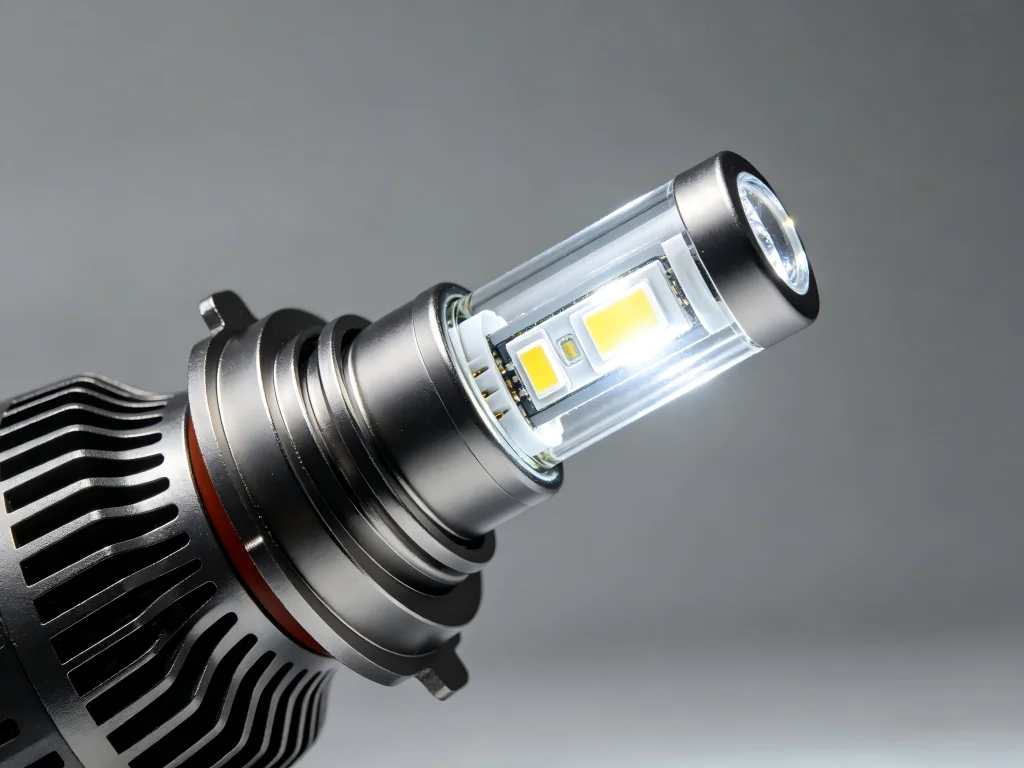
This is the single most important factor in LED headlight performance, and it is the one most manufacturers get wrong. Your headlight housing — whether reflector or projector — was designed around a halogen filament positioned at a precise focal point. When you replace that filament with an LED emitter, the emitter must be positioned at the exact same location and oriented in the same way. Even a 1mm deviation disrupts the focal point and produces scattered light.
The gold standard for beam accuracy is the Philips ZES (Luxeon Z ES) chip, which measures 1.6mm by 2.0mm — closely matching halogen filament width. This chip produces razor-sharp beam patterns with minimal scatter. CSP (Chip Scale Package) chips are more common in budget bulbs. They produce higher brightness per watt but have weaker bonds between the silicone layer and chip substrate, making them more susceptible to thermal stress over time.
| خصوصیت | Premium LED (GTR Ultra 3) | Budget LED | Halogen |
|---|---|---|---|
| Emitter placement accuracy | ±0.1mm of filament position | ±2mm or more | N/A (filament is the reference) |
| Beam pattern | Sharp cutoff, minimal scatter | Scattered, dark spots, glare | Factory-spec but dim |
| Brightness (lumens per bulb) | 2,400–4,000 | 1,500–2,500 | 700–1,500 |
| عمر (گھنٹے) | 30,000–50,000 | 5,000–15,000 | 450–1,000 |
1.2. Thermal Management — The Silent Performance Killer
LEDs generate heat at the semiconductor level. If that heat is not dissipated efficiently, the bulb reduces its output to prevent damage — a process called thermal throttling. This means your bright new led headlight bulbs gradually dim over time, often within the first few months of use.
Premium bulbs use a combination of:
- High-speed fans for active cooling
- Aviation-grade aluminum heat sinks for passive dissipation
- Copper-core heat pipes for maximum thermal transfer
Budget bulbs often rely on passive cooling alone — a small heatsink with no fan. This works for low-power LEDs but fails under the sustained heat of nighttime driving. If a bulb does not have an active cooling fan, treat it as a red flag for any application beyond occasional use.
1.3. Electrical Design and CANbus Compatibility
Modern vehicles use CANbus networks to monitor bulb status. LEDs draw significantly less power than halogens — typically 15-20 watts versus 55 watts per bulb. The vehicle’s computer interprets this lower power draw as a failed bulb and responds by either cutting power or triggering a dashboard warning.
A premium LED headlight conversion kit includes a driver that communicates properly with the vehicle’s CANbus system. This eliminates:
- Flickering and pulsing
- Dashboard error codes
- Hyper-flash (rapid blinking)
- Random shutoffs while driving
Some budget kits include external resistors or decoders that add complexity and failure points. A well-engineered bulb integrates the driver into the bulb body — no extra boxes to mount or wires to splice.
1.4. Build Quality and Durability
Your LED headlights for car applications need to survive vibration, moisture, and temperature extremes. Look for bulbs with:
- IP ratings for water and dust resistance
- Shock-resistant construction
- Corrosion-resistant connectors
- Sealed driver electronics to prevent moisture ingress
Premium manufacturers test their bulbs in real headlight housings under extreme conditions. Budget manufacturers often test only on a lab bench — a completely different environment from the engine bay of a daily driver.
2. LED vs Halogen vs HID: Which Upgrade Makes Sense?
If you are considering an led headlight upgrade, you have probably also looked at HID (xenon) kits. Here is how they compare:
| عنصر | LED | ایچ آئی ڈی (زینون) | Halogen |
|---|---|---|---|
| Brightness | High (2,400–4,000 lm) | Very high (~3,000 lm) | Low (700–1,500 lm) |
| Warm-up time | فوری مکمل روشنی | 10–30 seconds to full brightness | فوری |
| متوقع عمر | 30,000–50,000 گھنٹے | 2,000–3,000 گھنٹے | 450–1,000 hours |
| Energy Efficiency | Excellent (15–20W) | Good (35W) | Poor (55W) |
| Installation complexity | Plug-and-play (most vehicles) | Requires ballasts and wiring | Simple |
LED wins on every metric except initial cost. The higher upfront price is offset by a lifespan 30 to 50 times longer than halogen, and the instant-on capability is a significant safety advantage over HID’s warm-up delay.
3. Real-World Performance: What Independent Tests Show
Independent testing confirms that not all led headlight bulbs perform equally. The GTR Lighting Ultra 3, for example, delivered 1,498 lux on low beam in testing — a 302% increase over standard halogen. High beams performed even better, with a clean, focused beam and sharp cutoff lines.
Another independent test on a 2016-2021 Honda Civic showed the GTR Ultra 3 H11 delivering 920 max lux at the brightest point — 475% brighter than stock — while retaining the sharp cutoff line the projector housing was designed to produce.
Forum discussions echo these findings. One MG owner noted: “FWIW the GTR Ultra 3.0 are fantastic. I like the color, which seems even more reflective on road stripes than other LED I have used, beam width is broader than the Morimoto, can’t find any dark spots in the lighting”.
4. Common Mistakes When Buying LED Headlights
4.1. Mistake 1: Chasing Lumens
Higher lumens do not always mean better visibility. A 10,000-lumen bulb with a scattered beam pattern will illuminate less usable road than a 3,000-lumen bulb with a focused beam. Beam pattern integrity matters more than raw lumens.
4.2. Mistake 2: Ignoring Bulb Size
An H11 LED bulb has completely different engineering challenges than an H4 dual-beam bulb. The housing it goes into — reflector versus projector — changes which chip layout works best. Always verify your vehicle’s bulb size before purchasing any LED headlight conversion kit.
4.3. Mistake 3: Skipping CANbus Compatibility
If your vehicle was built after 2010, it almost certainly uses CANbus monitoring. A bulb without CANbus compatibility will flicker, throw error codes, or shut off randomly. Some drivers spend more on resistors and decoders than they saved on the bulbs themselves.
4.4. Mistake 4: Overlooking Installation Fit
Many LED bulbs have large heatsinks or fan assemblies that do not fit through standard dust caps. Measure your housing’s available depth before buying, or choose a bulb specifically designed to fit through OEM dust caps.
5. Frequently Asked Questions About LED Headlights
5.1. Are LED headlights legal?
Legality depends on beam pattern and certification. In many regions, LED headlight bulbs must be ECE or DOT certified for road use. In Malaysia, JPJ regulations prohibit non-factory headlight modifications that cause glare or scatter. Bulbs that maintain a proper beam pattern and sharp cutoff — like the GTR Ultra 3 — are less likely to attract enforcement attention.
5.2. How do I know which LED headlight bulb fits my car?
Check your vehicle manual or look at the markings on your stock bulb. Common sizes include H11 (low beam), 9005 (high beam), H4 (dual-beam), and 9006. Many manufacturers offer online vehicle fitment tools.
5.3. Do LED headlights work in cold weather?
Yes — better than halogen. LEDs produce instant full brightness regardless of temperature, whereas halogen output can drop in extreme cold.
5.4. Can LED headlights be repaired?
Generally no — they are sealed units. If an LED headlight bulb fails, the entire bulb must be replaced. This is why choosing a bulb with a long lifespan and robust thermal management is critical.
5.5. Why are some LED headlights so expensive?
Because precision engineering costs money. Premium bulbs use higher-grade chips (Philips ZES vs. budget CSP), active cooling systems, CANbus-compatible drivers, and durable housings. The higher upfront cost is offset by longer lifespan and better performance.
5.6. What is the difference between 6000K and 6500K color temperature?
6000K is a pure white light; 6500K has a slight blue tint. Both fall within the ideal 5,500K–6,500K range for headlights. The difference is aesthetic rather than functional — neither provides better visibility than the other.
6. Making the right choice for your vehicle
Your LED headlight decision should be based on four factors: optical precision, thermal management, CANbus compatibility, and build quality. Ignore marketing claims about lumens and focus on engineering fundamentals. Read independent reviews. Check forum discussions from actual drivers who have installed the bulbs you are considering.
GTR Lighting’s Ultra 3 series consistently ranks among the top performers in independent testing and real-world use. Our engineering team has spent years refining emitter placement, thermal management, and electrical design to deliver a bulb that works inside your existing headlight housing — not just on a test bench.
ہٹا دیں www.rhgtr.com to verify your vehicle’s bulb size and explore the GTR Ultra 3 lineup. Your night driving experience will never be the same.