
Entre em qualquer loja de autopeças ou role pelo Amazon e você encontrará centenas de faróis de LED opções variando de $20 a $400. As especificações parecem todas semelhantes — alto lúmen, longa vida útil, instalação plug-and-play. No entanto, a experiência de dirigir entre uma lâmpada de $20 e uma de $200 não poderia ser mais diferente. Este guia corta o ruído do marketing e fornece uma estrutura para avaliar lâmpadas de farol de LED com base em fundamentos de engenharia, não em alegações publicitárias. No final, você saberá exatamente o que separa um kit de conversão de farol de LED premium de uma decepção de baixo custo.
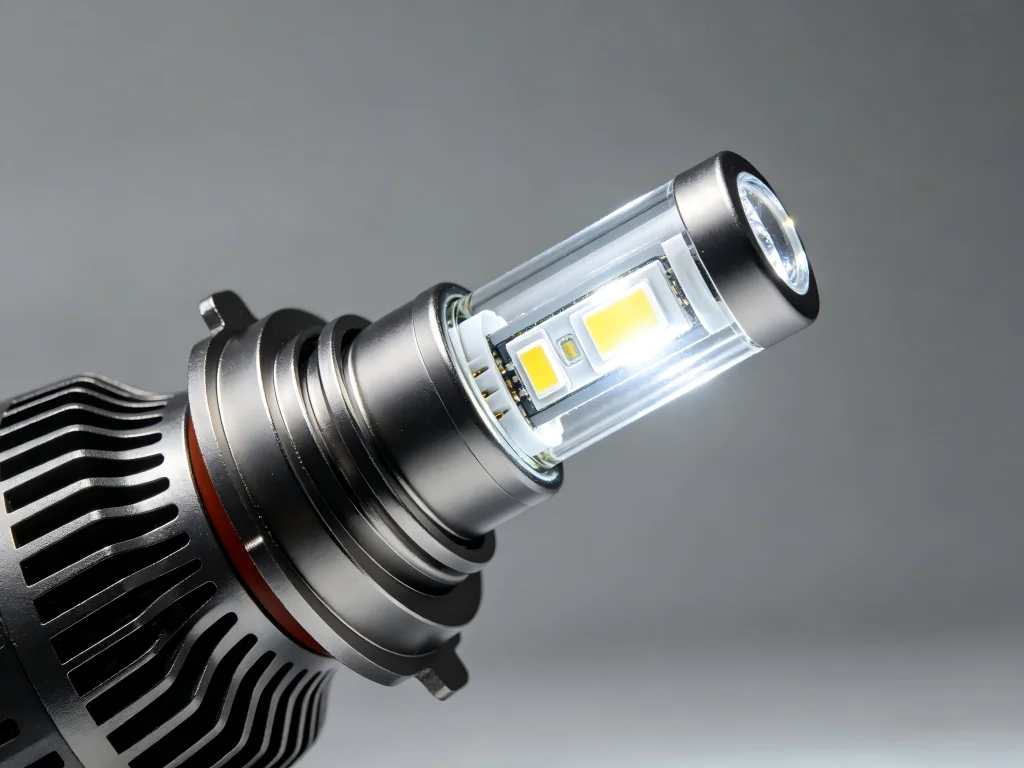
1. What Really Makes a Good LED Headlight Bulb?
Four factors determine LED headlight performance: emitter positioning, thermal management, electrical compatibility, and build quality. Everything else — lumens, color temperature, price — is secondary to these fundamentals.
Let's break down each factor so you can evaluate any LED headlight for car upgrade with confidence.
1.1. Emitter Positioning and Optical Geometry
This is the most important factor in LED headlight performance, and it's what most manufacturers get wrong. Your headlight housing — whether reflector or projector — was designed around a halogen filament positioned at a precise focal point. When you replace that filament with an LED emitter, the emitter must be positioned exactly in the same location and oriented the same way. Even a 1mm deviation disrupts the focal point and produces scattered light.
The gold standard for beam precision is the Philips ZES (Luxeon Z ES) chip, which measures 1.6mm by 2.0mm — approximating the width of a halogen filament. This chip produces sharp beam patterns with minimal scatter. CSP (Chip Scale Package) chips are more common in low-cost bulbs. They produce higher brightness per watt but have weaker bonds between the silicone layer and the chip substrate, making them more susceptible to thermal stress over time.
| Característica | Premium LED (GTR Ultra 3) | LED Econômico | Halogénio |
|---|---|---|---|
| Precisão de posicionamento do emissor | ±0,1mm da posição do filamento | ±2mm ou mais | N/A (o filamento é a referência) |
| Padrão do feixe | Corte nítido, dispersão mínima | Disperso, pontos escuros, ofuscamento | Especificação de fábrica, mas escuro |
| Brilho (lúmens por lâmpada) | 2.400–4.000 | 1.500–2.500 | 700–1.500 |
| Vida útil (horas) | 30.000–50.000 | 5.000–15.000 | 450–1.000 |
1.2. Gestão Térmica — O Assassino Silencioso do Desempenho
LEDs generate heat at the semiconductor level. If this heat is not efficiently dissipated, the lamp reduces its output to prevent damage — a process called thermal limiting. This means your new bright LED headlight bulbs will gradually dim over time, often within the first months of use.
Premium bulbs use a combination of:
- High-speed fans for active cooling
- Aviation-grade aluminum heat sinks for passive dissipation
- Copper-core heat pipes for maximum thermal transfer
Budget bulbs often rely solely on passive cooling — a small heat sink without a fan. This works for low-power LEDs but fails under the sustained heat of night driving. If a bulb lacks an active cooling fan, treat it as a red flag for any application beyond occasional use.
1.3. Electrical Design and CANbus Compatibility
Modern vehicles use CANbus networks to monitor bulb status. LEDs consume significantly less power than halogens — typically 15-20 watts versus 55 watts per bulb. The vehicle's computer interprets this lower power draw as a faulty bulb and responds by cutting power or triggering a dashboard warning.
A premium LED headlight conversion kit includes a driver that communicates correctly with the vehicle's CANbus system. This eliminates:
- Flickering and pulsing
- Error codes on the dashboard
- Hyper-flash (rapid blinking)
- Random shutdowns while driving
Some budget kits include external resistors or decoders that add complexity and failure points. A well-designed bulb integrates the driver into the bulb body — no extra boxes to mount or wires to splice.
1.4. Build Quality and Durability
Your LED headlights for car need to survive vibration, moisture, and extreme temperatures. Look for bulbs with:
- IP ratings for water and dust resistance
- Shock-resistant construction
- Corrosion-resistant connectors
- Sealed driver electronics to prevent moisture ingress
Premium manufacturers test their bulbs in real headlight housings under extreme conditions. Low-cost manufacturers often test only on a lab bench — a completely different environment from the engine bay of a daily-driven vehicle.
2. LED vs Halogen vs HID: Which upgrade makes sense?
If you are considering an LED headlight upgrade, you have probably also looked at HID (xenon) kits. Here is how they compare:
| Factor | LED | HID (xénon) | Halogénio |
|---|---|---|---|
| Brightness | High (2,400–4,000 lm) | Very high (~3,000 lm) | Low (700–1,500 lm) |
| Tempo de aquecimento | Instant full brightness | 10–30 seconds to full brightness | Instantâneo |
| Esperança de vida | 30,000–50,000 hours | 2,000–3,000 hours | 450–1,000 hours |
| Energy efficiency | Excellent (15–20W) | Good (35W) | Poor (55W) |
| Installation complexity | Plug-and-play (most vehicles) | Requires ballasts and wiring | Simple |
LED wins on all criteria except initial cost. The higher initial price is offset by a lifespan 30 to 50 times longer than halogen, and the instant-on capability is a significant safety advantage over the HID warm-up delay.
3. Real-World Performance: What Independent Tests Show
Independent tests confirm that not all LED headlight bulbs perform equally. The GTR Lighting Ultra 3, for example, delivered 1,498 lux in low beam in tests — a 302% increase over standard halogen. High beams performed even better, with a clean, focused beam and sharp cutoff lines.
Another independent test on a 2016-2021 Honda Civic showed the GTR Ultra 3 H11 delivering 920 max lux at the brightest point — 475% brighter than stock — while maintaining the sharp cutoff that the projector housing was designed to produce.
Forum discussions echo these results. One MG owner noted: “FWIW the GTR Ultra 3.0 is fantastic. I like the color, which looks even more reflective on road stripes than other LEDs I've used, the beam width is wider than the Morimoto's, I can't find dark spots in the illumination.”.
4. Common Mistakes When Buying LED Headlights
4.1. Mistake 1: Chasing Lumens
Higher lumens don't always mean better visibility. A 10,000-lumen bulb with a scattered beam pattern will illuminate less usable road than a 3,000-lumen bulb with a focused beam. Beam pattern integrity matters more than raw lumens.
4.2. Mistake 2: Ignoring Bulb Size
An H11 LED bulb has completely different engineering challenges than an H4 dual-beam bulb. The housing it goes into — reflector versus projector — changes which chip layout works best. Always check your vehicle's bulb size before buying any LED headlight conversion kit.
4.3. Mistake 3: Ignoring CANbus Compatibility
If your vehicle was manufactured after 2010, it almost certainly uses CANbus monitoring. A bulb without CANbus compatibility will flicker, show error codes, or shut off randomly. Some drivers spend more on resistors and decoders than they saved on the bulbs themselves.
4.4. Mistake 4: Ignoring Installation Fit
Many LED bulbs have large heat sinks or fan assemblies that won't fit through standard dust caps. Measure the available depth of your housing before buying, or choose a bulb specifically designed to fit through OEM dust caps.
5. Frequently Asked Questions About LED Headlights
5.1. Are LED headlights legal?
A legalidade depende do padrão de feixe e da certificação. Em muitas regiões, lâmpadas de farol de LED devem ser certificadas ECE ou DOT para uso em estrada. Na Malásia, os regulamentos JPJ proíbem modificações de faróis não originais que causem ofuscamento ou dispersão. Lâmpadas que mantêm um padrão de feixe adequado e corte nítido — como o GTR Ultra 3 — têm menos probabilidade de atrair atenção da fiscalização.
5.2. Como sei qual lâmpada de farol de LED se encaixa no meu carro?
Verifique o manual do seu veículo ou observe as marcações na lâmpada original. Os tamanhos comuns incluem H11 (farol baixo), 9005 (farol alto), H4 (duplo feixe) e 9006. Muitos fabricantes oferecem ferramentas online de verificação de compatibilidade com o veículo.
5.3. Os faróis de LED funcionam em clima frio?
Sim — melhor que os halógenos. Os LEDs produzem brilho total instantâneo, independentemente da temperatura, enquanto a saída dos halógenos pode cair em frio extremo.
5.4. Os faróis de LED podem ser reparados?
Geralmente não — são unidades seladas. Se uma lâmpada de farol de LED falhar, a lâmpada inteira deve ser substituída. É por isso que escolher uma lâmpada com longa vida útil e gerenciamento térmico robusto é crucial.
5.5. Por que alguns faróis de LED são tão caros?
Porque engenharia de precisão custa dinheiro. Lâmpadas premium usam chips de qualidade superior (Philips ZES vs. CSP de baixo custo), sistemas de resfriamento ativo, drivers compatíveis com CANbus e carcaças duráveis. O custo inicial mais alto é compensado por maior vida útil e melhor desempenho.
5.6. Qual é a diferença entre temperatura de cor de 6000K e 6500K?
6000K é uma luz branca pura; 6500K tem um leve tom azulado. Ambas estão dentro da faixa ideal de 5.500K–6.500K para faróis. A diferença é estética, não funcional — nenhuma oferece melhor visibilidade que a outra.
6. Fazendo a Escolha Certa para o Seu Veículo
Your faróis de LED A decisão deve ser baseada em quatro fatores: precisão óptica, gerenciamento térmico, compatibilidade com CANbus e qualidade de construção. Ignore alegações de marketing sobre lúmens e concentre-se nos fundamentos de engenharia. Leia avaliações independentes. Verifique discussões em fóruns de motoristas reais que instalaram as lâmpadas que você está considerando.
A série Ultra 3 da GTR Lighting está consistentemente entre os melhores desempenhos em testes independentes e uso real. Nossa equipe de engenharia passou anos refinando o posicionamento do emissor, o gerenciamento térmico e o design elétrico para entregar uma lâmpada que funciona dentro do alojamento do seu farol existente — não apenas em uma bancada de testes.
Visitar www.rhgtr.com para verificar o tamanho da lâmpada do seu veículo e explorar a linha GTR Ultra 3. Sua experiência de dirigir à noite nunca mais será a mesma.