
Nem todas as lâmpadas LED H4 são iguais. Uma lâmpada $20 de uma marca desconhecida e uma $100 de um fabricante estabelecido podem parecer idênticas na embalagem, mas na estrada, a diferença é como dia e noite.
After analyzing data from more than 50,000 real customer installations and consulting automotive lighting engineers, we identified exactly what separates a quality H4 LED bulb from a cheap imitation. This guide explains each critical specification, exposes marketing tricks, and provides the framework for you to make an informed purchase decision.
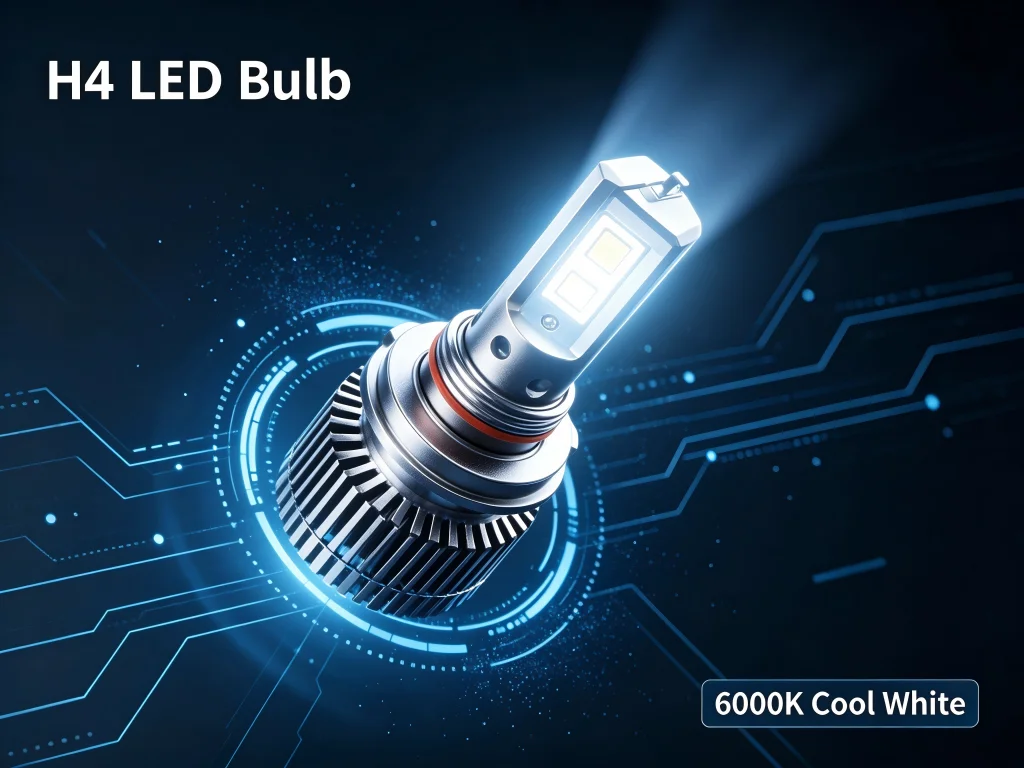
1. Understanding the H4 Platform: Why It Is Different from Other Bulb Sizes
An H4 bulb is a dual-beam unit. It contains low beam and high beam functions in a single bulb. This is fundamentally different from H7 (single low beam), H11 (single low beam), or 9005 (single high beam) bulbs.\r\n\r\nThe dual-beam design creates unique engineering challenges. The LED chips must replicate two filament positions—one for low beam and another for high beam—within a compact envelope. The reflector or projector optics of the housing must work for both beams. If the chip position is wrong, you lose the beam pattern in both low beam and high beam.
That's why H4 LED bulbs are harder to design than single-beam bulbs. And that's why most cheap H4 LED bulbs perform poorly.
2. Critical Factor #1: LED Chip Position and Beam Pattern Replication
The optics of your headlight housing—whether reflector or projector—were designed around the precise position of a halogen filament. The filament is a narrow, linear light source. The optics shape this light into a specific beam pattern.\r\n\r\nLED chips are flat and directional. If they are not exactly where the filament was, the beam pattern breaks. Light scatters. Glare increases. Useful light on the road decreases.
What to look for: Premium H4 LED bulbs use a 1:1 filament replication design. The LED chips are positioned precisely where the halogen filament was, in both low beam and high beam positions. Some manufacturers advertise “1:1 halogen size” but miss the critical chip position. Ask: does this bulb replicate the filament position, or just the overall size?\r\n\r\nA forum member summarized the challenge perfectly: “Modern, quality H4 replacement LED systems use emitters that are very close in size, shape, and position to the original filaments.”.
3. Critical Factor #2: LED Chip Quality and Type
The LED chip is the heart of the bulb. Not all chips are equal.
Philips ZES (Luxeon Z ES): The gold standard for beam precision. Each chip measures 1.6 mm x 2.0 mm—closely matching the halogen filament width. Low defect rate. Excellent color consistency at 6000K. Moderate brightness per watt, but the beam pattern is sharp.
CSP (Pacote em Escala de Chip): Higher brightness per watt than ZES. More compact. Cheaper to manufacture. New-generation CSP chips have significantly reduced the beam quality gap.
What to look for: Established brands disclose their chip supplier. Philips, Osram, and premium CSP chips from Seoul Semiconductor indicate quality. Generic “automotive-grade” chips without brand disclosure are a red flag.
4. Critical Factor #3: Thermal Management and Cooling System
LEDs generate significant heat. If this heat is not dissipated, the chips degrade. Brightness drops. Color shifts. Eventually, the lamp fails.\r\n\r\nThe cooling system is the most common failure point in H4 LED lamps. Cheap lamps use undersized heat sinks or low-quality, noisy fans that fail within months.
There are two cooling approaches:
| Tipo de arrefecimento | Advantages | Disadvantages | Best for |
|---|---|---|---|
| Active Cooling (Fan) | Supports higher wattages; most compact design possible | Moving parts can fail; fan noise; risk of dust ingress | High-lumen lamps; vehicles with limited space |
| Passive Cooling (No Fan) | No moving parts; silent operation; higher reliability | Requires larger heat sink; limited power capacity | Daily drivers; motorcyclists who value silence and reliability |
What to look for: Copper heat sinks (not aluminum—copper dissipates heat 60% better). High-quality fans from reputable manufacturers. Thermal management tested in real-world conditions, not just in the lab.
A forum member noted: “Massive copper heatsinks, quiet high-speed fans (nobody wants a buzzing lighthouse), or advanced passive cooling designs” are what to look for.
5. Critical Factor #4: CANBUS Compatibility and Electrical System Integration
Modern vehicles use computer systems to monitor bulb function. When you replace a 55W halogen with a 20W LED, the computer detects the lower power draw and assumes the bulb is burned out. This triggers dashboard warnings, flickering, or complete power cutoff.
There are three ways to solve this:
- Integrated CANBUS decoder. The bulb has integrated circuitry that mimics halogen resistance. Cleanest solution. No external components.
- External CANBUS adapter. A separate module that connects between the vehicle's wiring harness and the bulb. Adds complexity, but works.
- Resistor packs. Crude solution that adds resistance generating heat. Inefficient and can cause fire hazards. Avoid.
What to look for: Bulbs with built-in CANBUS compatibility. If the manufacturer mentions “error-free” or “flicker-free” and specifies CANBUS compatibility, that's a good sign. If there's no mention of CANBUS, assume you'll need an external adapter.
6. Critical Factor #5: Installation Design and Adjustability
H4 LED bulbs typically use a two-piece design: a mounting collar and a bulb body. The collar is installed first, secured by the factory spring clip. Then the bulb slides into the collar and twists to lock.
Some bulbs—like the Morimoto 2Stroke—have a compact enough design to install as a single piece. Others require the two-piece process.
What to look for: Adjustable mounting that allows rotating the bulb after installation to fine-tune chip orientation. Not all housings are identical. The ability to adjust chip alignment (left/right, 3 and 9 o'clock) is critical for proper beam pattern.
The mounting collar must have three tabs that correspond to the orientation of your original halogen bulb. If the collar doesn't fit, you'll have difficulty with installation and will likely get the orientation wrong.
7. Critical Factor #6: Real-World Brightness vs. Advertised Lumens
Lumen ratings in the LED bulb market are almost entirely unreliable. Manufacturers advertise raw emitter lumens—what the chip produces under ideal lab conditions—not what reaches the road.
A bulb advertised at 50,000 lumens may deliver only 2,000–4,000 usable lumens after optical losses. The housing, reflector condition, lens clarity, and beam pattern of the bulb affect how much light actually reaches the road.
What to look for: Ignore the lumen number. Look for real-world beam pattern photos and videos. Look for user reviews with the same vehicle as yours. Look for manufacturers that disclose both raw and effective lumens—an honest sign.
An experienced forum member explained: “Lumen ratings for LED are almost always a raw number associated with what the emitter can do… those numbers don't translate into usable light output in any way, because not all the light emitted by an emitter goes where it can actually be used.”.
8. Critical Factor #7: Color Temperature and Visibility
LED H4 bulbs typically come in 6000K (cool white) or 6500K (xenon white). This is the color temperature—not brightness.
6000K–6500K: Crisp white with a slight blue tint. Closest to daylight. Good for visibility and modern vehicle aesthetics. Can seem harsh in rain or fog.
4300K–5000K: Warmer white. Closer to halogen color. Better penetration in rain and fog. Less glare for oncoming drivers.
What to look for: If you frequently drive in rain or fog, consider warmer color temperatures. If you prioritize maximum visibility in clear conditions, 6000K works well. Consistent color temperature between the two bulbs is a mark of quality—cheap bulbs often have visible color differences between left and right.
9. Comparing Premium LED H4 Bulb Options
| Característica | Budget Brand ($20–40) | Mid-Range ($50–80) | Premium ($80–150) |
|---|---|---|---|
| Chip Type | Generic, undisclosed | Branded CSP | Philips ZES or premium CSP |
| Filament Replication | Approximate or none | Claimed 1:1 design | Verified 1:1 positioning |
| Cooling | Small aluminum heatsink; noisy fan | Copper heatsink; medium quality fan | Large copper heatsink; high-quality silent fan or advanced fanless |
| CANBUS | None or external resistor | Integrated decoder (uncertain) | Integrated decoder (verified in multiple vehicles) |
| Adjustable orientation | Fixo | Ajuste limitado | Ajuste completo de 360 graus |
| Padrão de feixe | Scattered, unpredictable | Decente em alguns alojamentos | Consistente em refletor e projetor |
| Garantia | 30–90 dias | 1 ano | 2–5 anos |
| Vida útil típica | 6–12 months | 2–3 years | 5+ anos |
10. Instalação de LED H4: Do Jeito Certo vs. Do Jeito Errado
Até o LED H4 mais caro tem desempenho inferior se instalado incorretamente. Veja como é a instalação correta:
- Remova o anel de montagem from the lamp body before installation. Trying to install the lamp as a single piece usually prevents the spring clip from locking.
- Insert and secure the ring into the headlight housing using the factory spring clip.
- Slide the lamp into the mounted ring and rotate to lock.
- Orient the LED chips horizontally—left and right (3 o'clock and 9 o'clock), not up and down.
- Check the beam pattern against a wall before reinstalling the protective covers. The cutoff should be sharp and horizontal. If light scatters upward, the orientation is wrong.
- Test the low and high beams before finalizing the installation.
The most common mistake: Installing the lamp with the chips facing up and down. This destroys the beam pattern, increases glare, and reduces useful light on the road.
11. GTR H4 LED Bulbs: Designed for Performance, Built to Last
At GTR, we don't compete on price. We compete on engineering integrity. Every GTR H4 LED bulb is designed by automotive lighting engineers who understand the physics of beam pattern, thermal management, and electrical system integration.
Our H4 LED bulbs feature:
- Precise 1:1 filament replication. Our engineering team measured the exact filament position in dozens of H4 housings. Our chips sit exactly where they should.
- High-quality LED chips. We use top-tier Philips and CSP chips with strict binning for consistent color temperature in every bulb.
- Advanced thermal management. Large copper heat sinks combined with silent, high-reliability cooling fans. No hum. No premature failure.
- Integrated CANBUS compatibility. No external resistors. No dashboard warnings. No flicker. Plug and play in 99% of vehicles.
- Adjustable 360-degree orientation. Fine-tune chip alignment for perfect beam focus in your specific vehicle.
- IP68 protection rating. Designed for real-world conditions—rain, snow, mud, and pressure washing.
Our recommendations are based on real customer feedback from tens of thousands of orders, not affiliate commissions. We have sold and supported LED conversion kits for over a decade. We know what works—and what doesn't.
12. Frequently Asked Questions About H4 LED Bulbs
12.1. Quais veículos usam lâmpadas H4?
O H4 é usado em inúmeros veículos, incluindo Toyota, Mazda, Subaru, Honda, Nissan e a maioria das motocicletas com faróis de duplo feixe. Consulte o manual do proprietário ou remova a lâmpada existente para confirmar a designação H4/9003/HB2.
12.2. Posso instalar lâmpadas de LED H4 eu mesmo?
Sim. A maioria das lâmpadas de LED H4 são plug and play e instalam em 15–30 minutos com ferramentas manuais básicas. O segredo é a orientação adequada dos chips de LED e a instalação correta do anel de montagem.
12.3. As lâmpadas de LED H4 causam ofuscamento para motoristas que vêm na direção oposta?
Lâmpadas bem projetadas com posicionamento e orientação corretos dos chips não causam ofuscamento excessivo. Lâmpadas mal projetadas ou instalação incorreta causam. A diferença está na lâmpada, não na tecnologia.
12.4. Vale a pena atualizar de halógena para lâmpadas de LED H4?
Sim—quando você escolhe uma lâmpada de qualidade. Um LED H4 premium entrega 2–4 vezes mais luz utilizável, dura 10 vezes mais e consome significativamente menos energia do que a halógena. A atualização é transformadora para a segurança ao dirigir à noite.
12.5. Como sei se meu veículo precisa de lâmpadas compatíveis com CANBUS?
A maioria dos veículos fabricados após 2010 possui sistemas de monitoramento de lâmpadas. Se você não tiver certeza, escolha lâmpadas com compatibilidade CANBUS integrada—funciona tanto em veículos mais novos quanto em mais antigos.
12.6. Qual é a diferença entre H4, 9003 e HB2?
Estes são nomes diferentes para a mesma base e conector de lâmpada. H4 é a designação europeia, 9003 é a designação dos EUA, e HB2 é outro padrão dos EUA. Eles são intercambiáveis.
12.7. Quanto tempo leva a instalação de uma lâmpada LED H4?
15–30 minutos por lado para a maioria dos veículos. Alguns veículos com acesso apertado podem levar mais tempo. O design de colar removível simplifica significativamente a instalação.
13. Faça a Escolha Certa para a Sua Segurança ao Dirigir à Noite
You are reading this guide because you want to make an informed decision. You don't want to waste money on a bulb that fails in six months. You don't want to blind oncoming traffic. You don't want to struggle with a beam pattern that makes night driving more dangerous, not less.
You want to see clearly. You want to be seen. You want a bulb that works with your vehicle's engineering, not against it.
GTR's H4 LED bulbs deliver exactly that. Precision engineering. Premium components. Real-world testing. And a beam pattern that puts usable light where it belongs—on the road ahead.
Visitar https://www.rhgtr.com to explore our line of H4 LED bulbs. Compare specifications. Read reviews. Then make the choice that puts safety first.