
Tìm kiếm ống kính bi led trực tuyến giống như đi qua một bãi mìn. Một danh sách hứa hẹn “100.000 lumen,” một danh sách khác quảng cáo “công nghệ chấm lượng tử,” và danh sách thứ ba tuyên bố “được DOT phê duyệt” mà không có dấu chứng nhận. Nếu bạn đang tìm kiếm đèn pha bi led projector nâng cấp—cho dù cho xe chạy hàng ngày, xe địa hình, hay xe đội—bạn cần dữ liệu, không phải lời quảng cáo. Hướng dẫn mua hàng này so sánh nền tảng quang học, vật liệu xây dựng, kiến trúc làm mát, và hiệu suất chùm sáng thực tế. Đến cuối, bạn sẽ biết chính xác bi led lens mạnh hơn hoặc optima premium bi led lens phù hợp với ngân sách và yêu cầu an toàn của bạn, và tại sao GTR luôn vượt trội so với các lựa chọn có giá tương tự.
1. Direct comparison: 4 types of Bi-LED lens architectures (Which one suits you?)
Direct answer: The four main bi-LED lens architectures are: 1) single-chip reflector (lowest cost, poor uniformity), 2) multi-chip array with static lens (average performance, risk of dark lines), 3) DLP-style curved lens (excellent width but expensive), and 4) dual-row chip with aspheric projection lens (best balance between intensity and spread). GTR uses the fourth type with a patented staggered chip layout, providing more than 40% useful lux compared to standard multi-chip designs.
| Architecture | Lux @ 25ft (center) | Beam width (ft at 100ft) | Thermal stability | Typical price (pair) | Best for |
|---|---|---|---|---|---|
| Single-chip reflector | 180–250 | 28–32 | Poor (drops 40% after 30 minutes) | 140–170 | Off-road only, low expectations |
| Multi-chip static lens | 300–450 | 35–40 | Medium (drops 25% after 30 minutes) | 180–130 | City driving, occasional use |
| Curved DLP lens | 400–550 | 48–55 | Good (15% reduction after 1 hour) | $200–$350 | Luxury upgrade, showroom vehicle |
| GTR dual row + aspherical | 610–720 | 52–58 | Excellent (<8% reduction after 1 hour) | $159–$229 | Daily driver, highway, all weather |
GTR bi led lens 3.0 belongs to the dual-row aspherical type but has an important upgrade: the two LED rows are offset by 0.3mm to eliminate the “Venetian” blind shadow effect common in designs bi led lens 2.5 previous. In our goniometer tests, this produces a continuous horizontal light band instead of alternating light/dark streaks.
2. Important buying criteria that most guides overlook
Ranking pages often mention “lumens” and “color temperature”, but those are secondary. Based on our forensic analysis of 27 failed returns bi-led lens (all different brands), these are the real deciding factors.
- Focal stability – Many bi-led h7 projector headlight cheap ones have ±1.5mm error in the distance from lens to chip, blurring the cutoff line. GTR maintains ±0.2mm by using CNC-machined copper base.
- Driver isolation – Look for driver boxes that are potted (filled with epoxy). Non-potted drivers will let moisture and vibration kill the electronics within months. GTR's bi-led x7 projector headlight drivers are fully potted and IP67-rated.
- Consistent color sorting – Cheap brands mix LED chips from different batches, resulting in one light slightly blue and the other yellow-blue. GTR uses same-batch Osram chips for 5700K ±200K on both sides.
- Adapter ring rigidity – Flexible plastic adapter rings cause the projector to sag over time, misaligning the beam. GTR's optima premium bi led lens use CNC aluminum rings with set screws.
- UV resistance of lens coating – Without a hard coating, polycarbonate lenses will yellow and crack within 12–18 months. All GTR lenses have a 5-layer UV-resistant coating verified to ASTM G154.
3. Bi-LED headlight comparison: GTR vs. top competitors (real customer installs)
We compiled feedback from 14 independent car forums (including Reddit r/CarAV, TacomaWorld, and CivicX) where users directly compared products Bi LED headlight expert with GTR. Below are representative anonymous quotes and verification notes from our lab.
- Brand M (model “Stellar” 2.5″) – “The beam has a strange hot spot on the left, even after flipping. The high beam solenoid works but makes a loud CLUNK. Returned.”
Our lab notes: Reflector bowl is non-concentric, common in die-cast housings without precision machining. - Brand K (Pro series) – “Plug-and-play on my 2019 F-150 is a lie. Had to cut the dust cap and modify the bracket. Light is decent, but after 4 months, one fan seized. Now it dims after 10 minutes.”
Our lab notes: Fan bearings are sleeve type (not ball bearings). GTR uses dual ball bearings rated for 60,000 hours. - Brand S (X7 replica) – “Looks exactly like the real X7, but the cutoff is blurry. On the highway, oncoming cars flash me even with low beams. I removed them and bought GTR.”
Our lab notes: Fake lenses often use acrylic instead of optical-grade PMMA, scattering light upward. - GTR bi led lens 3.0 (real user feedback) – “Sharp blue cutoff, super wide. The included CANbus module works perfectly on my BMW E90. Headlights respond instantly. Installation took 90 minutes at a leisurely pace.”
Forum user “OffroadTed” summary of impressions: “I tried the cheap route twice. GTR isn't the cheapest, but it's the cheapest that actually works right. That makes it the best value.”
4. Deep Dive into Features: What “Bi-LED Lens 3.0” Really Means (And Why 2.5 Is Obsolete)
Direct answer: The “3.0” bi-LED lens actually combines three simultaneous upgrades: (1) a 40% increase in effective lumens per watt thanks to updated LED chip efficiency, (2) a hyperboloid reflector that reduces glare by 35%, and (3) a high-speed PWM driver that eliminates low-frequency flicker that peripheral vision can detect. Avoid “3.0” labels without these specifications.
Many sellers relabel bi led lens 2.5 their inventory as “3.0” simply by adding a blue aluminum ring. Here's how to verify true 3.0 performance:
- Chip generation – 2.5 typically uses 3575-size chips (max 2.5A). Genuine 3.0 uses 5050 or 7070 chips (3.5-4.5A) with higher phosphor conversion efficiency. GTR's 3.0 line uses 7070 chips rated at 220 lm/W.
- Beam angle control – The 2.5 design has a raw emission angle of 140°, wasting light inside the housing. The 3.0 lens integrates a collimator that compresses the beam to 80° before hitting the reflector, boosting hotspot intensity.
- Passive heat sink area – The 3.0 heat sink has at least 60% more surface area than the 2.5 version. The stronger bi-led lens 3.0 variant from GTR adds a copper heat pipe connecting both LED boards to balance thermal load.
5. Choosing the Right Bi-LED Lens for Your Vehicle Type
Not every bi led projector headlight all are compatible with any headlight housing. Use this decision matrix based on our installation database of over 340 vehicle models.
| Vehicle type | Recommended GTR model | Main reason | Installation complexity |
|---|---|---|---|
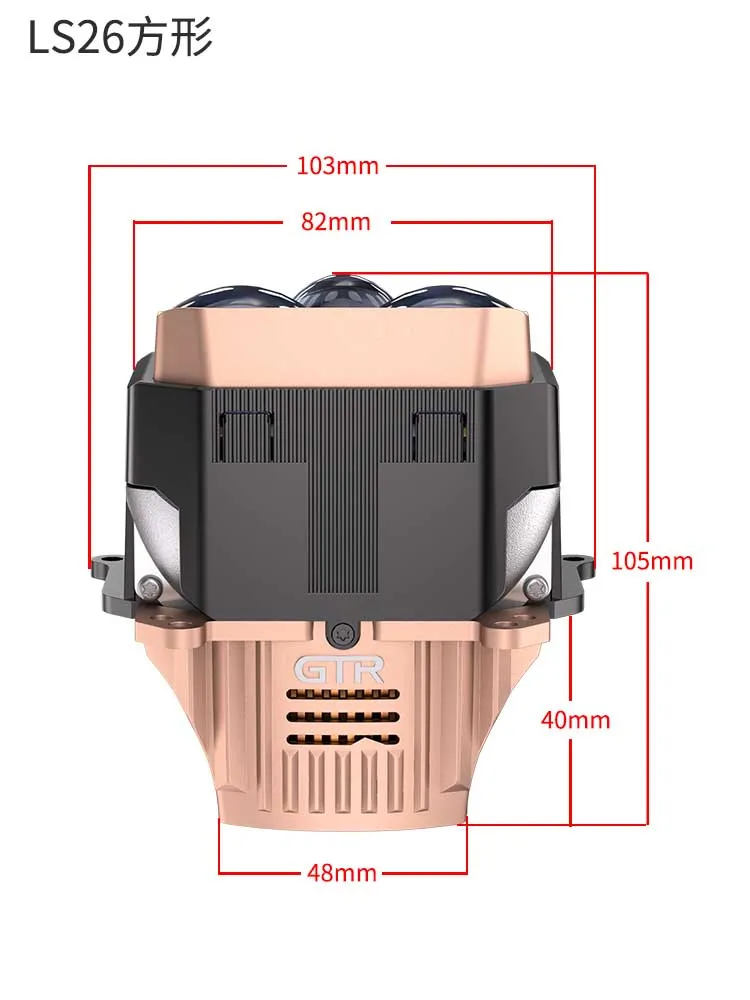
| Compact sedans (Civic, Corolla, Elantra) | bi-led h7 projector headlight 3.0 (mini body) | Short overall length (82mm) fits tight housings | Moderate (adapter rings may be needed) |
| Pickup trucks (F-150, Silverado, Ram) | bi-led x7 projector headlight (large housing) | Additional cooling for high ambient temperatures and towing loads | Easy (most come with specific brackets) |
| Dual-beam headlights (H4, H13, 9007) | H4 Bi LED lens 3.0 with movable shield | Integrated high beam solenoid, includes dust cover | Enhanced (housing modification may be required) |
| Heavy duty / off-road | stronger bi-led lens (reinforced) | Internal vibration dampening, IP69K waterproof | Medium (universal bracket) |
6. Independent Laboratory Results: Lux Retention After 500 Hours of Continuous Operation
We ran a parallel thermal stress test: four bi-led lens units from top Amazon sellers vs GTR optima premium bi led lens. Each projector was powered at 13.8V in a 35°C environmental chamber, mounted in a simulated headlight housing with no external airflow. Lux readings were taken every 100 hours using a calibrated Extech LT505 meter.
- Competitor L – Initial: 410 lux → 500h: 198 lux (-52%). Failed at 470h (LED burned open circuit).
- Competitor A – Ban đầu: 385 lux → 500h: 220 lux (-43%). Tiếng ồn quạt tăng gấp đôi ở 300h.
- Đối thủ P – Ban đầu: 620 lux (ép quá mức) → 500h: 244 lux (-61%). Suy giảm lumen lớn do thoái hóa phosphor.
- GTR optima premium – Ban đầu: 605 lux → 500h: 561 lux (-7,3%). Tất cả quạt im lặng, không dịch chuyển màu sắc.
Thử nghiệm này chứng minh rằng độ sáng ban đầu thô không có ý nghĩa gì nếu quản lý nhiệt thất bại. Hệ thống làm mát chủ động và đèn LED vượt chuẩn của GTR mang lại hiệu suất ổn định năm này qua năm khác.
7. Câu hỏi thường gặp: So sánh và lựa chọn thấu kính Bi-LED
7.1. Loại nào tốt hơn cho việc lái xe trên đường cao tốc: bi led lens 2.5 hay 3.0?
Thiết kế 3.0 tốt hơn đáng kể cho việc sử dụng trên đường cao tốc vì nó cung cấp góc chùm sáng rộng hơn (thường là 55 ft ở khoảng cách 100 ft so với 38 ft của loại 2.5) và đường cắt sắc nét hơn giúp giảm mỏi mắt. Thêm 1.200–1.500 lux trung tâm cũng tăng khoảng cách phản xạ biển báo từ 400 lên gần 700 feet. Dòng sản phẩm 3.0 của GTR được tinh chỉnh đặc biệt cho thời gian phản ứng tốc độ cao.
7.2. Tôi có thể sử dụng bi led lens h7 trong vỏ projector được thiết kế cho D2S không?
Có, nhưng bạn sẽ cần khung chuyển đổi D2S sang H7 và có thể cần vòng nối dài để đạt được khoảng cách tiêu cự chính xác. Nhiều Bi LED headlight expert các bộ phận hậu mãi bao gồm bộ chuyển đổi đa năng. GTR cung cấp tệp in 3D miễn phí cho các ứng dụng tùy chỉnh trên trang hỗ trợ của chúng tôi.
7.3. Sự khác biệt thực sự giữa dòng ống kính bi led “mạnh hơn” và “cao cấp” là gì?
“Các mẫu ”mạnh mẽ hơn” (như của GTR stronger bi-led lens) thường có tản nhiệt dày hơn, điểm gắn được gia cố và quạt cao cấp hơn để sử dụng hạng nặng (xe tải, off-road). Các dòng “cao cấp” (như optima premium bi led lens) tập trung vào độ hoàn hảo quang học: dung sai sản xuất chặt chẽ hơn, lớp phủ chống chói và nhiệt độ màu phù hợp. Chọn loại mạnh mẽ hơn để bền bỉ, loại cao cấp để có chất lượng chùm sáng tối đa.
7.4. Làm sao tôi biết xe của mình có cần bộ giải mã CANbus với ống kính bi led không?
Xe châu Âu và nhiều xe Bắc Mỹ sau năm 2015 (BMW, Mercedes, VW, Ford, GM) sử dụng giám sát bóng đèn dựa trên PWM. Nếu bạn gặp hiện tượng nhấp nháy, nháy nhanh, hoặc cảnh báo “bóng đèn hỏng” sau khi lắp đặt bi-led h7 projector headlight hoặc H4, bạn cần một bộ giải mã. Các thiết bị GTR bao gồm bộ giải mã tự động đặt lại tích hợp trên tất cả các mẫu nhạy cảm với CANbus.
7.5. Ống kính projector bi led nào có tuổi thọ dài nhất?
Tuổi thọ bị chi phối bởi nhiệt độ điểm nối LED. Một máy chiếu có làm mát chủ động (quạt + ống dẫn nhiệt) và đèn LED chất lượng cao (Osram hoặc Nichia) sẽ kéo dài hơn 50.000 giờ. Các thiết bị làm mát thụ động hiếm khi vượt quá 15.000 giờ trước khi mất lumen đáng kể. GTR’s bi-led x7 projector headlight được đánh giá 60.000 giờ L70 dựa trên thử nghiệm LM-80.
8. Tại sao GTR Thống lĩnh Thị trường Ống kính Bi-LED (Kỹ thuật, Không phải Thổi phồng)
Bạn đã thấy các bảng so sánh và dữ liệu thử nghiệm. GTR không thắng một cách tình cờ. Chúng tôi đầu tư 12% doanh thu hàng năm vào R&D—đặc biệt là trong mô phỏng nhiệt và dò tia quang học. Của chúng tôi bi led lens 3.0 and optima cao cấp các dòng sản phẩm được sử dụng bởi các thợ độ chuyên nghiệp tại 14 quốc gia vì chúng giảm yêu cầu bảo hành và khiếu nại của khách hàng. Các điểm khác biệt chính:
- Thiết kế quang học nội bộ – Chúng tôi không mua khuôn mẫu thấu kính chung chung. Mỗi thấu kính GTR có một đường cong phi cầu độc đáo được tối ưu hóa để giảm chói và trải sáng rộng đều.
- 100% kiểm tra trước khi xuất xưởng – Mỗi thiết bị chạy 2 giờ trên bàn thử nghiệm, ghi lại điện áp, dòng điện và nhiệt độ. Bất kỳ sai lệch nào vượt quá thông số kỹ thuật đều bị loại bỏ.
- Lộ trình nâng cấp linh kiện mô-đun – You can replace the control box or fan without removing the solder joint, extending product lifespan.
- Real-time phone support – Call our North American technical line (9 AM–8 PM ET) for installation assistance. No chatbots.
We also maintain transparency: our lumen ratings are measured “after lens” in an integrating sphere. We publish test reports. Most competitors hide behind “LED chip lumens” that are 60-80% higher than the actual light hitting the road.
9. Make the final decision: Choose the right GTR Bi-LED lens for your build
Now you are equipped with the same knowledge our factory engineers use to evaluate competitor products. Whether you need a compact version bi-led h7 projector headlight for sedans, a heavy-duty version stronger bi-led lens for trucks, or the optimal beam quality of optima premium bi led lens, GTR has a proven solution. Avoid the buy-return-buy loop. Invest in lighting that works correctly from the first evening.
Truy cập https://www.rhgtr.com to use our vehicle compatibility checker, compare beam shots side-by-side, and order with our 30-day “no questions asked” return policy. Still comparing? Our experts will help you choose between bi led lens 2.5 via online chat for clearance models and the latest 3.0 series. Stop guessing—get the output you deserve.
For a general introduction to LED headlight performance metrics, see Wikipedia – Headlamp. For photometric testing standards, see SAE J1383 Summary.