
Việc mua bóng đèn LED H3 trở nên khó khăn ngay khi bạn bắt đầu so sánh các sản phẩm. Một mẫu hứa hẹn độ sáng cực cao. Mẫu khác quảng cáo 100W. Mẫu thứ ba quảng bá ánh sáng vàng 3000K. Một số sử dụng quạt, số khác sử dụng tản nhiệt thụ động, và giá cả có thể chênh lệch nhiều lần.
Which specifications really matter?
For buyers who want performance rather than impressive packaging, the answer is surprisingly clear: evaluate the bulb as an optical and thermal system. Peak wattage and brightness are claimed afterward.
1. What is the best H3 LED bulb?
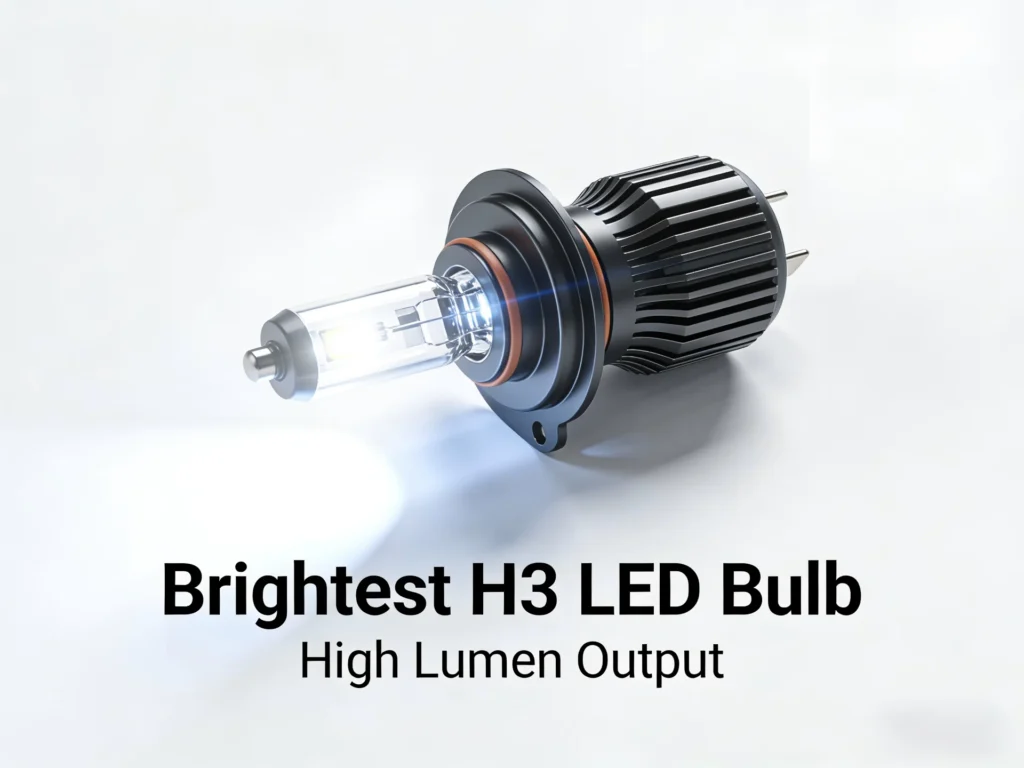
The best H3 LED bulb combines precise base fit, accurate LED chip positioning, controlled beam distribution, stable brightness during operation, efficient heat dissipation, and a reliable driver. The highest advertised wattage or brightness does not automatically provide the best visibility because the optics of the original lamp determine where the light ultimately goes.
That definition changes the purchasing process.
Instead of sorting products from highest to lowest brightness, professional buyers should compare them across multiple technical aspects.
| Purchasing factors | Cheap H3 LED | High-performance H3 LED | Professional/B2B priority |
|---|---|---|---|
| Chip positioning | Change | Tighter optical control | Rất cao |
| Advertised brightness | Often exaggerated | More useful when verified | Trung bình |
| Sustained output | Usually unclear | Designed for stability | Rất cao |
| Cooling | Basic | Designed thermal path | Rất cao |
| Controller | Simple | Stable current control | Cao |
| Physical size | Can be bulky | Application-focused | Cao |
| EMC/electrical design | Change | Better controlled | Cao |
| Manufacturing consistency | Unclear | Controlled | Important for distributors |
2. Lumens vs. Useful Road Light
Don't choose an H3 LED bulb based only on lumen count. Raw or theoretical LED power can differ significantly from the light produced after thermal stabilization, while even high actual lumen output offers limited benefit when the LED source is mispositioned inside the reflector or projector.
This is the first purchasing trap.
Consumers often compare:
8,000 lm vs. 12,000 lm vs. 20,000 lm.
Professional buyers should compare something else:
How much controlled light does the bulb put into the useful beam?
The original H3 halogen filament is compact. The lamp's reflector is designed around its position.
LED conversion bulbs attempt to reproduce that light source using semiconductor chips mounted on a PCB.
If the PCB and emitting surface are too thick, the effective light source shape changes. That can alter the focus.
So, a technically impressive LED chip can still produce a disappointing lamp.
2.1. Better evaluation method
When possible, compare bulbs inside the same lamp assembly rather than comparing bare bulbs.
Look for:
- beam shape;
- hot spot position;
- foreground brightness;
- lateral distribution;
- glare outside the intended pattern;
- power after extended operation.
That tells you much more than a product box.
3. H3 100W LED bulb vs. moderate power designs
Search demand around H3 100W LED bulb shows a common assumption:
100W will surely beat 50W.
Not exactly.
LED wattage describes power consumption. Increasing wattage can increase potential light output, but it also increases the thermal load the bulb must manage.
If cooling cannot keep up, junction temperature rises and the driver may reduce current.
That makes an important difference:
peak performance vs sustained performance.
| Characteristics | High power design | Efficient moderate power design |
|---|---|---|
| Potential initial output | Rất cao | Cao |
| Sinh nhiệt | Higher | Lower |
| Cooling requirements | Larger | Easier to manage |
| Housing clearance | May require more space | May be easier to package |
| Risk of thermal pulse reduction | More dependent on cooling system | Potentially easier to control |
| Best choice | Large applications, good ventilation | Compact everyday applications |
These categories should not be understood as universal rules. The quality of the overall design matters more than capacity alone.
4. Fan-cooled vs. fanless H3 LED bulbs
Fan-cooled H3 LED bulbs can support higher heat loads by forcing air through the heatsink, while fanless bulbs eliminate moving parts and can simplify packaging. The better design depends on available housing space, required wattage, operating environment, heat dissipation efficiency, and the quality of the cooling system.
4.1. Fan cooling
Advantages may include:
- greater cooling capacity in a compact structure;
- support for higher operating wattage;
- better temperature control when properly designed.
Disadvantages may include fan noise, dust accumulation, added mechanical complexity, and dependence on fan durability.
4.2. Fanless
Advantages may include fewer moving parts and silent operation.
However, passive cooling still requires sufficient surface area and airflow to transfer heat away from the LED system. “Fanless” should never be confused with “no cooling needed.”
5. H3 LED Bulbs White vs. Yellow
Color temperature should follow the application rather than fashion.
| Color range | Typical characteristics | Common application preferences |
|---|---|---|
| ~3000K | Yellow/warm | Fog, rain, adverse weather |
| ~4300K | Neutral white | Balanced road use |
| ~5000K-6000K | White/cool white | General LED upgrade, modern appearance |
| Very high color temperature | Blue-white appearance | Often follows design trends rather than lighting needs |
Search Yellow H3 LED bulb especially popular among buyers looking for fog light upgrades.
However, color temperature cannot fix a poor beam.
A well-focused white bulb can outperform a poorly-focused yellow bulb, and vice versa. Optical quality remains the foundation.
6. CSP vs COB vs Multi-SMD Design
Chip terminology is another area where buyers can get distracted.
6.1. CSP-Based Design
Compact LED packages can help engineers create a smaller light-emitting area. This can make it easier to approximate the position and size of a halogen filament.
This can be beneficial for optical control.
6.2. COB Design
Chip-on-board technology can create a large and powerful light-emitting surface. It can work well in suitable applications, but the size and position of that surface still need to match the optical system.
6.3. Multi-SMD Design
Multiple LEDs can be useful in applications requiring wide illumination. They are not automatically the ideal choice for lamps requiring a precisely positioned light source.
The takeaway?
Don't buy an acronym. Buy the beam it produces.
7. Installation: Specifications Buyers Forget
An LED can win every lab comparison but still be useless if the installer cannot close the dust cover.
Before ordering, check:
- H3 base dimensions;
- overall bulb length;
- rear heatsink diameter;
- driver dimensions;
- retaining clip compatibility;
- wiring routing;
- available housing depth;
- clearance for dust cover.
This is even more important for wholesalers.
If you sell the product as a universal replacement, an overlooked size difference can cause returns across multiple vehicle applications.
8. H3 LED Bulb AutoZone, NAPA or Advance Auto: What should you compare?
Someone is searching for H3 LED bulb AutoZone, H3 LED bulb NAPA, ,或 H3 LED Bulb Advance Auto thường là gần đến lúc mua hàng.
Bán lẻ tại địa phương có một lợi thế lớn: tốc độ.
Nếu bóng đèn của bạn hỏng hôm nay, sự sẵn có tại địa phương có thể quan trọng hơn việc có 20 lựa chọn kỹ thuật khác nhau.
Nhưng hãy sử dụng các quy tắc so sánh tương tự bất kể bạn mua sắm ở đâu.
Kiểm tra độ tương thích trước. Sau đó so sánh thiết kế sản phẩm thực tế.
Tên nhà bán lẻ không thay đổi các yêu cầu quang học của xe bạn.
9. Tìm kiếm Bóng đèn LED H3 Canadian Tire, NZ và Supercheap Auto
Các tìm kiếm theo khu vực cho chúng ta biết điều gì đó hữu ích về hành vi của người mua.
Bóng đèn LED H3 Canadian Tire thường đại diện cho ý định mua lẻ tại địa phương của Canada. Bóng đèn LED H3 Supercheap Auto and Bóng đèn LED H3 NZ cho thấy nhu cầu tương tự ở Úc và New Zealand.
For international distributors, this matters because product selection should not be identical in every market.
Climate, vehicle structure, tuning culture, regulations, customer price expectations, and preferred color temperature can all influence the ideal product portfolio.
A distributor serving tropical Southeast Asia may require a different product strategy than one serving Canada or New Zealand.
10. Retail vs. Sourcing from B2B Factory
This is where purchasing criteria change significantly.
Consumers buy one pair.
A distributor may buy 500, 2,000, or 10,000 pairs.
Consumers ask:
“Does it work?”
Professional buyers should ask:
“Will the next production batch work the same way?”
| Consumer buyer | Professional distributor |
|---|---|
| Brightness test | Brightness uniformity test |
| Check fit | Check application coverage |
| Check price | Check shipping costs and warranty risks |
| Read reviews | Evaluate supplier quality control |
| Buy existing packaging | May require private label/OEM |
| Replace a defective unit | Must manage batch defect risk |
That last point is crucial.
A low purchase price can become expensive if defect rates rise after thousands of units are in the field.
11. Professional H3 LED bulb supplier checklist
Based on our manufacturing experience, B2B buyers should look beyond the catalog spec sheet.
Before placing bulk orders, ask the supplier about:
- Supply and consistency of LED chips;
- driver architecture;
- thermal testing;
- operating voltage range;
- beam pattern testing;
- water and dust resistance if applicable;
- vibration durability;
- manufacturing quality control processes;
- OEM and ODM capabilities;
- packaging customization;
- warranty handling;
- batch traceability;
- regional certification requirements.
Regulatory requirements vary across markets and lighting applications. Buyers should verify the regulations applicable to the complete vehicle lighting system rather than assuming a replacement bulb is road-legal because it physically fits. Relevant international regulatory information can be reviewed through the UNECE World Forum for Harmonization of Vehicle Regulations.
12. Why GTR Focuses on Complete Lighting Systems
At GTR, we approach automotive LED lighting from a complete system perspective.
LED chips are critical.
But PCB, thermal pathways, housing, drivers, optics, and manufacturing tolerances matter just as much.
This becomes especially important for professional buyers because a distributor is not buying a spec sheet. A distributor is buying the customer experience created by thousands of physical products.
For B2B partners, GTR can support automotive parts programs that require product selection, OEM/ODM development, private label solutions, and market-specific configurations.
The goal is not simply to produce the highest number printed on the packaging.
The goal is to create lighting products that make commercial sense after installation.
13. H3 LED Bulb FAQ
13.1. What are H3 LED bulbs used for?
H3 bulbs are commonly used in fog lights, auxiliary lights, and some other automotive lighting applications. Always confirm the exact bulb position for your vehicle before purchasing.
13.2. What is the brightest H3 LED bulb?
There is no universally useful answer based solely on advertised lumens. The most effective bright solution depends on sustained power, optical focus, housing design, and thermal performance.
13.3. Are 100W H3 LED bulbs safe?
That depends on the actual electrical load, cooling system, wiring requirements, and housing environment of the product. Do not assume that a “100W” marketing label describes actual operating consumption.
13.4. Are yellow H3 LED bulbs better for fog?
Many drivers prefer warmer yellow light in bad weather, but color alone does not determine fog light performance. Beam shape, glare control, and lamp positioning remain critical.
13.5. Can I install H3 LED bulbs myself?
Many H3 replacement bulbs can be installed without major modification, but accessibility, retaining clips, wiring, drivers, and heat sinks vary by vehicle. Check installation requirements before purchasing.
13.6. Will H3 LED bulbs cause dashboard errors?
They can on vehicles that monitor bulb power draw. A properly designed decoder or compatible driver may be required in some applications.
13.7. How do I find H3 LED bulbs near me?
Search local automotive retailers using your year, make, model, and lamp location. Verify the existing bulb before purchasing because similar-looking automotive bulbs are not interchangeable.
13.8. How should wholesalers choose an H3 LED supplier?
Evaluate durability performance, manufacturing consistency, quality control processes, customization capabilities, warranty support, and technical knowledge. Unit price should be considered alongside expected returns and failure costs.
14. Choose Bulbs Your Customers Will Want to Buy Again
The cheapest H3 LED bulb is rarely the cheapest product after accounting for return shipping, complaints, replacement shipping, and lost dealer trust.
Similarly, the bulb with the highest lumen or wattage numbers is not necessarily the best-performing bulb.
A stronger purchasing strategy is to evaluate optical precision + durability performance + thermal control + electrical stability + fit + manufacturing consistency.
That formula matters whether you're upgrading a car or building an automotive lighting distribution business.
If you're sourcing H3 LED bulbs for wholesale, retrofit chains, auto accessory shops, or regional distribution, visit https://www.rhgtr.com. Share your target market, vehicle applications, expected order volumes, and positioning with GTR. Our team can help you build an H3 lighting program around products your installers can confidently recommend—and your customers will come back for more.
[1]: https://www.alibaba.com/product-insights/how-to-choose-the-best-h3-led-bulb-a-complete-buying-guide.html?utm_source=chatgpt.com “How to Choose the Best H3 LED Bulb: A Complete Buying Guide”