
Buying an H3 LED bulb becomes difficult the moment you start comparing products. One model promises extreme lumens. Another advertises 100W. A third promotes 3000K yellow light. Some use fans, others use passive heat sinks, and prices can differ several times over.
Which specifications actually matter?
For buyers who want performance rather than impressive packaging, the answer is surprisingly clear: evaluate the bulb as an optical and thermal system. Wattage and peak lumen claims come later.
1. What Is the Best H3 LED Bulb?
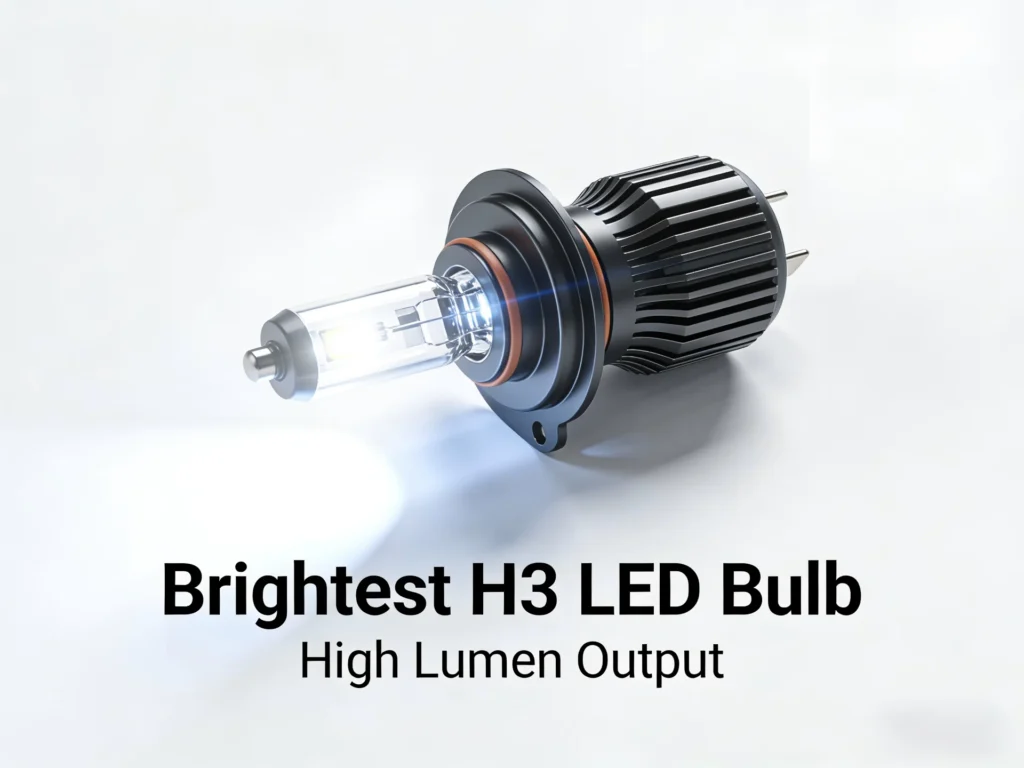
The best H3 LED bulb combines correct socket fit, accurate LED chip positioning, controlled beam distribution, stable operating lumens, efficient heat dissipation and a reliable driver. The highest advertised wattage or lumen figure does not automatically provide the best visibility because the original lamp optics determine where the light ultimately goes.
That definition changes the buying process.
Instead of sorting products from highest to lowest lumens, professional buyers should compare them across several engineering dimensions.
| Buying Factor | Budget H3 LED | Performance H3 LED | Professional/B2B Priority |
|---|---|---|---|
| Chip positioning | Variable | Closer optical control | بہت زیادہ |
| Advertised lumens | Often aggressive | More useful when verified | Medium |
| Sustained output | Often unclear | Designed for stability | بہت زیادہ |
| کولنگ | Basic | Engineered heat path | بہت زیادہ |
| Driver | Simple | Stable current control | High |
| Physical dimensions | May be bulky | Application-focused | High |
| EMC/electrical design | Variable | Better controlled | High |
| Production consistency | نامعلوم | Controlled | Critical for distributors |
2. Lumens vs. Usable Road Light
Do not select an H3 LED bulb from lumen numbers alone. Raw or theoretical LED output can differ significantly from the light produced after thermal stabilization, while even high actual lumen output provides limited benefit when the LED source is incorrectly positioned inside the reflector or projector.
This is the first purchasing trap.
Consumers often compare:
8,000 lm vs. 12,000 lm vs. 20,000 lm.
Professional buyers should compare something else:
How much controlled light does the lamp put into the useful beam?
The original H3 halogen filament is compact. The lamp’s reflector is engineered around its position.
LED conversion bulbs try to reproduce that light source using semiconductor chips mounted to a PCB.
If the PCB and emitting surfaces are too thick, the effective light-source geometry changes. That can alter focus.
So a technically impressive LED chip can still create a disappointing lamp.
2.1. The Better Evaluation Method
When possible, compare bulbs inside the same lamp assembly rather than comparing bare bulbs.
Look for:
- بیم کی شکل؛;
- hotspot position;
- foreground brightness;
- side distribution;
- glare outside the intended pattern;
- output after extended operation.
That tells you far more than a product box.
3. H3 LED Bulb 100W vs. Moderate-Power Designs
Search demand around H3 LED bulb 100W reveals a common assumption:
100W must beat 50W.
Not necessarily.
LED wattage describes electrical power consumption. Increasing power can increase potential light output, but it also increases the thermal load that the bulb must control.
If cooling cannot keep up, junction temperature rises and the driver may reduce current.
That creates an important distinction:
peak performance versus sustained performance.
| خصوصیاتی | High-Wattage Design | Efficient Moderate-Wattage Design |
|---|---|---|
| Potential initial output | Very high | High |
| Heat generation | Higher | کم |
| Cooling requirement | Greater | More manageable |
| Housing clearance | May require more space | Can be easier to package |
| Thermal throttling risk | Depends heavily on cooling | Potentially easier to control |
| Best choice | Large, well-ventilated applications | Compact everyday applications |
Do not interpret those categories as universal rules. The quality of the complete design matters more than wattage alone.
4. Fan-Cooled vs. Fanless H3 LED Bulbs
Fan-cooled H3 LEDs can support higher thermal loads by forcing air across the heat sink, while fanless bulbs eliminate a moving component and may offer simpler packaging. The better design depends on available housing space, required output, operating environment, heat-sink efficiency and the quality of the cooling system.
4.1. Fan-Cooled
Advantages may include:
- greater cooling capacity in a compact structure;
- support for higher operating power;
- better temperature control when properly engineered.
Possible disadvantages include fan noise, dust accumulation, additional mechanical complexity, and dependence on fan durability.
4.2. Fanless
Advantages may include fewer moving parts and silent operation.
However, passive cooling still needs enough surface area and airflow to move heat away from the LED system. “Fanless” should never be confused with “does not need cooling.”
5. White vs. Yellow H3 LED Bulb
Color temperature should follow the application rather than fashion.
| Color Range | Typical Character | Common Application Preference |
|---|---|---|
| ~3000K | Yellow/warm | Fog, rain, adverse weather |
| ~4300K | غیر جانبدار سفید | Balanced road use |
| ~5000K-6000K | White/cool white | General LED upgrades, modern appearance |
| Very high CCT | Blue-white appearance | Often style-driven rather than visibility-driven |
A search for H3 LED bulb yellow is especially common among buyers looking for fog-light upgrades.
Yet color temperature cannot correct a bad beam pattern.
A focused white bulb can outperform a poorly focused yellow bulb, and vice versa. Optical quality remains the foundation.
6. CSP vs. COB vs. Multi-SMD Designs
Chip terminology is another area where buyers can get distracted.
6.1. CSP-Based Designs
Compact LED packages can help engineers create a smaller emitting area. That may make it easier to approximate the location and dimensions of a halogen filament.
This can benefit optical control.
6.2. COB Designs
Chip-on-board technology can create a large, powerful emitting surface. It can work well in suitable applications, but the dimensions and placement of that surface still need to match the optical system.
6.3. Multi-SMD Designs
Multiple LEDs can be useful in applications where broad illumination is desired. They are not automatically the ideal choice for a lamp that requires a precisely located light source.
The takeaway?
Do not buy an acronym. Buy the resulting beam.
7. Fitment: The Specification Buyers Forget
An LED can win every laboratory comparison and still be useless if the installer cannot close the dust cover.
Before placing an order, check:
- H3 base dimensions;
- overall bulb length;
- rear heat-sink diameter;
- driver dimensions;
- retaining clip compatibility;
- wire routing;
- available housing depth;
- dust-cover clearance.
This matters even more for wholesalers.
If you sell a product as a broad replacement, one overlooked dimensional difference can generate returns across several vehicle applications.
8. H3 LED Bulb AutoZone, NAPA or Advance Auto: What Should You Compare?
Someone searching H3 LED bulb AutoZone, H3 LED bulb NAPA, ، یا H3 LED bulb Advance Auto is usually close to purchasing.
Local retail has a major advantage: speed.
If your bulb failed today, local availability may matter more than having 20 different technical options.
But use the same comparison rules regardless of where you shop.
Check fitment first. Then compare actual product design.
The retailer name does not change the optical requirements of your vehicle.
9. H3 LED Bulb Canadian Tire, NZ and Supercheap Auto Searches
Regional searches tell us something useful about buyer behavior.
H3 LED bulb Canadian Tire often represents Canadian local-retail intent. H3 LED bulb Supercheap Auto and H3 LED bulb NZ indicate similar demand in Australia and New Zealand.
For international distributors, this matters because product selection should not be identical in every market.
Climate, vehicle mix, modification culture, regulations, customer price expectations and preferred color temperatures can all influence the ideal assortment.
A distributor serving tropical Southeast Asia may require a different product strategy from a distributor serving Canada or New Zealand.
10. Retail Buying vs. B2B Factory Sourcing
This is where the buying criteria change dramatically.
A consumer buys one pair.
A distributor might buy 500, 2,000, or 10,000 pairs.
The consumer asks:
“Does it work?”
The professional buyer should ask:
“Will the next production batch work the same way?”
| Consumer Buyer | Professional Distributor |
|---|---|
| Checks brightness | Checks brightness consistency |
| Checks fit | Checks application coverage |
| Checks price | Checks landed cost and warranty risk |
| Reads reviews | Evaluates supplier quality control |
| Buys existing packaging | May require private label/OEM |
| Replaces one failed unit | Must manage batch-level failure risk |
That last point is crucial.
A low purchase price can become expensive if failure rates increase after thousands of units enter the market.
11. A Professional H3 LED Bulb Supplier Checklist
Based on our manufacturing experience, B2B buyers should move beyond the catalog specification sheet.
Before committing to a large order, ask the supplier about:
- LED chip sourcing and consistency;
- driver architecture;
- thermal testing;
- operating voltage range;
- beam testing;
- water and dust resistance where applicable;
- vibration durability;
- production QC procedures;
- OEM and ODM capability;
- packaging customization;
- warranty handling;
- batch traceability;
- regional certification requirements.
Regulatory requirements differ between markets and lamp applications. Buyers should verify the rules applicable to the complete vehicle lighting system rather than assuming that a replacement bulb is road legal because it physically fits. Relevant international regulatory information can be reviewed through the UNECE World Forum for Harmonization of Vehicle Regulations.
12. Why GTR Focuses on the Complete Lighting System
At GTR, we approach LED automotive lighting from the perspective of the complete system.
The LED chip matters.
But so do the PCB, thermal path, housing, driver, optics and manufacturing tolerances.
This becomes particularly important for professional buyers because a distributor is not buying a specification sheet. The distributor is buying the customer experience created by thousands of physical products.
For B2B partners, GTR can support automotive aftermarket programs requiring product selection, OEM/ODM development, private-label solutions and market-specific configurations.
The goal is not simply to build the highest number printed on a package.
The goal is to create lighting products that make commercial sense after installation.
13. H3 LED Bulb FAQ
13.1. What is an H3 LED bulb used for?
H3 bulbs are commonly found in fog lamps, auxiliary driving lamps and certain other automotive lighting applications. Always confirm the exact bulb position for your vehicle before purchasing.
13.2. What is the brightest H3 LED bulb?
There is no useful universal answer based only on advertised lumens. The brightest effective solution depends on sustained output, optical focus, housing design and thermal performance.
13.3. Is an H3 LED bulb 100W safe?
It depends on the product’s actual electrical load, cooling system, wiring requirements and housing environment. Do not assume that a “100W” marketing label describes actual operating consumption.
13.4. Is a yellow H3 LED bulb better for fog?
Many drivers prefer warmer yellow output in poor weather, but color alone does not determine fog-light performance. Beam shape, glare control and lamp position remain critical.
13.5. Can I install an H3 LED bulb myself?
Many H3 replacements can be installed without major modification, but access, retaining clips, wiring, drivers and heat sinks vary by vehicle. Check the installation requirements before purchase.
13.6. Will H3 LED bulbs cause dashboard errors?
They may on vehicles that monitor bulb electrical load. An appropriately engineered decoder or compatible driver may be required in some applications.
13.7. How do I find an H3 LED bulb nearby?
Search local automotive retailers using your vehicle year, make, model and lamp position. Verify the existing bulb before purchase because similar-looking automotive bulb types are not interchangeable.
13.8. How should wholesalers choose an H3 LED supplier?
Evaluate sustained performance, manufacturing consistency, QC procedures, customization capability, warranty support and technical knowledge. Unit price should be considered alongside expected return and failure costs.
14. Choose the Bulb Your Customers Will Want Again
The cheapest H3 LED is rarely the cheapest product after returns, complaints, replacement shipping and lost dealer confidence are included.
Likewise, the bulb with the biggest lumen or wattage number is not necessarily the best performer.
The stronger purchasing strategy is to evaluate optical accuracy + sustained output + thermal control + electrical stability + fitment + production consistency.
That formula matters whether you are upgrading one vehicle or building an automotive lighting distribution business.
If you are sourcing H3 LED bulbs for wholesale, retrofit chains, automotive accessory stores or regional distribution, visit https://www.rhgtr.com. Share your target market, vehicle applications, expected order volume and positioning with GTR. Our team can help you build an H3 lighting program around products your installers can confidently recommend—and your customers will come back to buy again.
[1]: https://www.alibaba.com/product-insights/how-to-choose-the-best-h3-led-bulb-a-complete-buying-guide.html?utm_source=chatgpt.com “How To Choose The Best H3 LED Bulb: A Complete Buying Guide”