
You’re not shopping for flashy accessories. You’re making a procurement decision that affects safety, compliance, maintenance budgets, and driver satisfaction. Choosing the right LED lights for your trucks isn’t about picking the brightest option—it’s about understanding the engineering trade-offs that separate professional-grade solutions from consumer-grade disappointments.
This guide cuts through the marketing hype. We’ll compare LED against halogen, break down the critical specifications that actually matter, and give you a decision framework that protects your investment.
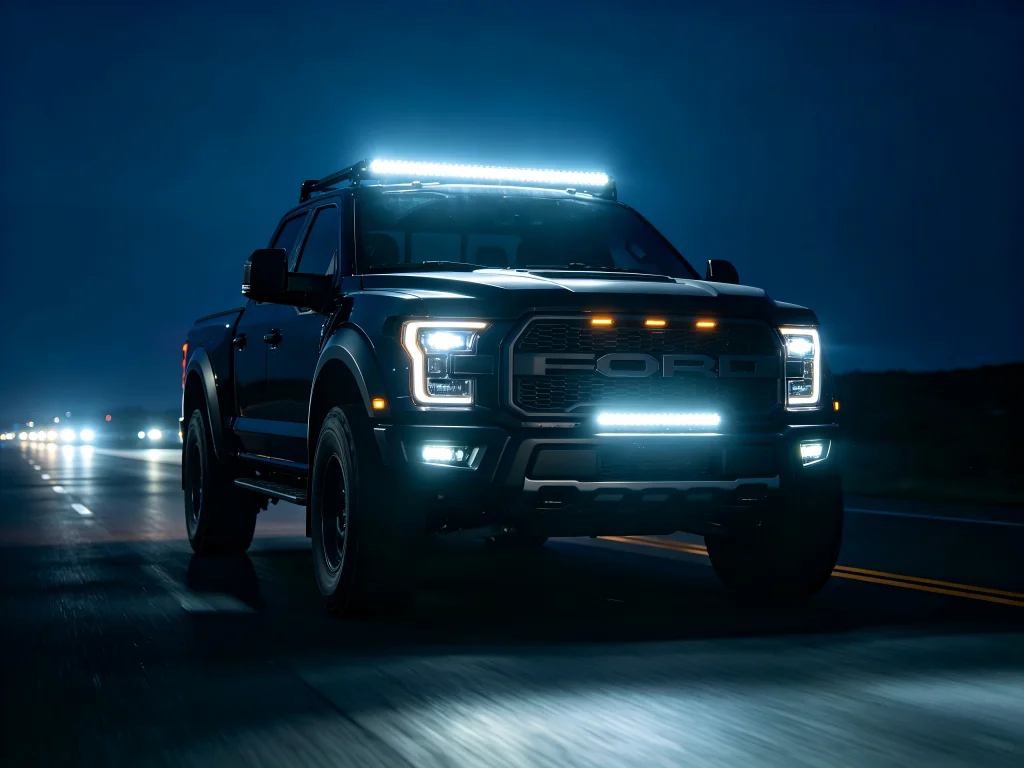
1. LED vs. Halogen: The Real Cost Comparison
For commercial applications, LED lighting delivers a lower total cost of ownership despite higher upfront pricing. The break-even point typically occurs within 12 to 18 months of operation.
| Yếu tố | Halogen | LED |
|---|---|---|
| Tuổi thọ | 500–1,500 hours | 25,000–50,000+ hours |
| Power draw per bulb | ~55–65 watts | ~11–30 watts |
| Light degradation | 25% loss after 160 hours | Minimal over lifespan |
| Replacement frequency | Every 6–18 months | Every 5–10 years |
| Upfront cost per unit | $10–$40 | $120–$350 |
That upfront premium on LED seems steep until you calculate the maintenance math. A fleet of 50 trucks replacing halogen bulbs twice per year at $30 each plus labor spends roughly $3,000 annually just on bulbs—before factoring in roadside service calls and downtime.
LEDs, properly engineered, eliminate that recurring expense. The lower power draw also reduces alternator load and extends battery life—secondary savings that compound over time.
2. Critical Specifications That Separate Quality from Junk
Not all LEDs are created equal. Here’s what actually matters when evaluating products:
2.1. Color Temperature (Kelvin Rating)
Optimal truck lighting lives in the 5,000K to 6,000K range. This matches natural daylight, enhances road contrast, and reduces eye strain during long hauls.
Below 4,000K, the light appears yellow and fatiguing. Above 6,500K, it shifts into blue territory that actually reduces visibility in rain and fog while irritating oncoming drivers. If a product doesn’t specify its Kelvin rating, move on.
2.2. IP Waterproof Rating
Exterior truck lights must withstand rain, snow, mud, and pressure washing. IP67 is the minimum acceptable rating for commercial truck lighting applications.
IP67 means the unit is dust-tight and can withstand immersion in water up to 1 meter for 30 minutes. Some premium units offer IP69K for high-temperature, high-pressure washdown environments—ideal for trucks operating in food processing or heavy industrial settings.
2.3. Thermal Management
Heat kills LEDs. Period. Quality units use:
- Làm mát chủ động: Integrated fans that dissipate heat from the diode junction
- Passive cooling: Aircraft-grade aluminum housings with finned heat sinks
- Thermal derating: Built-in circuitry that reduces output at extreme temperatures to protect the diodes
Cheap LEDs skip all three. They run hot, degrade fast, and fail within months. You can’t see thermal management in a product photo, but you’ll feel it in your maintenance budget.
2.4. Beam Pattern and Optics
This is where most aftermarket LEDs fail. A bright bulb with a scattered beam pattern is worse than a dim bulb with focused light. Look for:
- Sharp cutoff lines that keep light on the road, not in oncoming traffic
- Even distribution without hot spots or dark zones
- DOT compliance or ECE approval for on-road legality
GTR’s Carbide Series, for example, achieves 580 maximum Lux with a beam pattern that keeps the cutoff line crisp and horizontal. That’s engineering, not just brightness.
2.5. CAN-bus Compatibility
Modern trucks use CAN-bus (Controller Area Network) systems to monitor electrical loads. LEDs draw less current than halogens, which can trigger:
- Dashboard error codes
- Flickering lights
- Rapid blinking turn signals
- Complete system shutdowns
CAN-bus compatible LEDs include built-in resistors or decoding circuitry that fools the truck’s computer into seeing a normal load. If a product doesn’t explicitly state CAN-bus compatibility, assume it will cause problems.
3. Light Bar vs. Pod vs. Housing: What’s Right for Your Application?
Understanding the different form factors helps you spec the right solution for each application:
3.1. Light Bars
Long, linear arrays ideal for roof mounting, grille mounting, or bumper placement. Available in lengths from 10 inches to 52 inches. Best for broad flood illumination or long-range spot beams. Curved bars follow the contour of modern truck grilles for a factory-integrated look.
3.2. LED Pods
Compact, square or round units that mount individually or in pairs. Ideal for A-pillar mounting, bumper corners, or reverse light applications. More flexible for tight spaces and custom installations.
3.3. Complete Headlight Housings
Full replacement assemblies that include integrated optics, housings, and often daytime running lights. These offer the best beam control and factory-like appearance. Higher upfront cost but superior performance and durability.
4. Common Failure Points and How to Avoid Them
Based on our engineering testing and field data, here are the top reasons LED truck lights fail—and how quality products prevent each one:
- Moisture ingress: Cheap seals fail, letting water into the housing. Premium units use double-gasketed construction and IP67 or higher ratings.
- Thermal runaway: Poor heat dissipation causes diodes to overheat and fail. Quality units use active or passive thermal management with thermal derating protection.
- Voltage spikes: Truck electrical systems are notoriously noisy. Quality units include surge protection and wide voltage tolerance (typically 9–32V).
- Vibration damage: Heavy trucks shake constantly. Premium units use potted electronics and robust mounting systems that absorb vibration.
- CAN-bus incompatibility: As discussed above, this causes flickering, errors, and system confusion.
When one diode fails in a cheap LED array, it can take an entire section of the light with it. Premium designs use circuitry that compensates instantly when a diode reaches end-of-life—no flicker, no visible change.
5. What the Market Actually Offers: A Reality Check
Walk into any truck stop or browse Amazon, and you’ll find LED lights at every price point. Here’s what those price tiers actually get you:
$20–$50 range: Generic diodes, minimal thermal management, questionable waterproofing, no CAN-bus compatibility. Expect flickering, short lifespan, and eventual frustration. These are hobbyist products, not commercial solutions.
$50–$150 range: Better diodes, basic heat sinks, IP67 sometimes claimed but rarely tested, partial CAN-bus compatibility. Acceptable for light-duty use. Will work but may require resistors or load equalizers.
$150+ range: Premium diodes, active thermal management, verified IP ratings, full CAN-bus compatibility, precision optics, documented performance specs. These are professional-grade products engineered for commercial duty cycles.
GTR positions firmly in the premium tier because that’s what commercial applications require. Our Ultra Series and Carbide Series products undergo rigorous testing across temperature extremes, vibration profiles, and voltage conditions that simulate real-world truck operation.
6. Câu hỏi thường gặp
6.1. Are LED truck lights worth the extra cost for fleets?
Yes. The total cost of ownership for LED is significantly lower than halogen when you factor in lifespan, energy efficiency, and reduced maintenance labor. Most fleets recover the premium within 12 to 18 months.
6.2. What’s the difference between 12V and 24V LED truck lights?
Trucks typically use 12V systems (light-duty) or 24V systems (heavy-duty commercial). Some premium lights are rated for 10–30V DC, making them compatible with both. Always verify voltage compatibility before purchase.
6.3. Do I need load resistors with LED lights?
Only if your LEDs aren’t CAN-bus compatible. Load resistors simulate the electrical load of halogen bulbs to prevent hyper-flashing and error codes. Quality LEDs integrate this functionality internally.
6.4. How do I prevent LED lights from blinding other drivers?
Choose products with proper optics and sharp cutoff lines. The issue isn’t brightness—it’s beam control. A well-designed LED throws light where it belongs: on the road, not into oncoming traffic.
6.5. What’s the best color temperature for truck LED headlights?
5,000K to 6,000K provides the best balance of visibility and driver comfort. This range matches daylight and enhances contrast without the blue glare that causes eye fatigue.
6.6. Can I mix LED and halogen lights on the same truck?
Technically yes, but not recommended. Different light temperatures and beam patterns create inconsistent visibility. For optimal performance, convert all exterior lighting to LED simultaneously.
6.7. How often should I inspect LED truck lights?
Inspect monthly for cracked lenses, water ingress, loose wiring, dimming, or flickering. Replace immediately if you detect any issues—especially critical for safety lighting.
7. Your Next Step: Spec the Right Solution for Your Fleet
You now have the framework to evaluate LED truck lighting like a professional. You understand the specifications that matter, the failure points to avoid, and the total cost of ownership calculus that makes LED the smarter investment.
The difference between a lighting upgrade that saves money and one that costs money comes down to engineering. Choose products with verified specs, documented performance, and proven durability.
GTR Lighting builds every product to commercial-grade standards. Our Ultra and Carbide Series deliver the beam control, thermal management, and CAN-bus compatibility that fleets require. We back everything with a 2-year warranty because we know our engineering holds up.
Ghé thăm www.rhgtr.com to browse our full product line, check fitment for your specific truck models, and request fleet pricing. Your drivers deserve better visibility. Your maintenance budget deserves better economics. Make the switch that works for both.