
If you only compare lumens and price, you will almost certainly make the wrong decision when purchasing a projector bi LED lens. What actually determines real-world performance is beam pattern quality, thermal engineering, optical materials, mounting compatibility, and post-purchase support — five factors most buyers never evaluate until it is too late. This guide explains exactly what to look for in each of these areas and how to spot marketing claims that do not hold up on the road.
1. Why Most Projector Bi LED Lens Reviews Are Misleading
Spend an hour searching for projector bi LED lens information and you will encounter the same pattern: top-10 lists that rank products by lumen count, reviews written by people who installed the unit three days ago, and comparison tables that treat wattage as a proxy for brightness. None of this helps you make a sound decision.
The lumen problem is particularly widespread. Brands advertise 20,000, 26,000, even 30,000 lumens for a single pair of projectors. These numbers are raw chip output measured at the LED source under laboratory conditions. They have almost no relationship to the amount of usable light that reaches the road surface 100 feet ahead of your vehicle. Optical losses through the reflector, shutter, and lens typically consume 25-40% of the raw output. Thermal droop under real operating conditions shaves off another 10-20% within the first 30 minutes of use. A projector that advertises 20,000 lumens may deliver less than 8,000 lumens of actual road-usable output — and even that number says nothing about whether the light is distributed evenly or focused into a useless 10-foot-wide tunnel.
The metric that matters is lux — luminous flux per unit area — measured at specific distances in the beam hotspot. A projector that produces 120 lux at 50 meters will let you see far more than one that produces 200 lux at 25 meters but drops to 40 lux at distance. Quality manufacturers publish photometric data including iso-lux diagrams and distance measurements. If a brand only quotes lumens and wattage, they are either hiding their optical performance or have never measured it[reference:14].
2. Factor 1: Beam Pattern — The Single Greatest Differentiator
A projector bi led lens lives or dies by its beam pattern. A bad pattern creates dangerous dark spots in your field of view and sends blinding glare into oncoming traffic. A good pattern is extremely wide side-to-side, has a razor-sharp cutoff line that stays perfectly flat, and concentrates a bright hotspot directly beneath that cutoff for long-distance visibility.
On an optical test wall, you can identify projector quality in under 60 seconds. Point the projector at a flat white wall from 25 feet away and examine the low beam pattern. The cutoff line should be distinct enough that you could draw it with a pencil. There should be a defined step on the right side (for left-hand drive vehicles) — this step rises slightly to illuminate roadside signage without creating glare for oncoming drivers. Above the cutoff, the wall should be nearly dark, with only a faint residual glow. Any significant light bleeding above the cutoff indicates a poorly positioned or imprecisely manufactured shutter.
Below the cutoff, examine the light distribution. Quality projectors produce a smooth, even spread without visible dark spots, rings, or blotches. The hotspot — the brightest zone — should sit centered just below the cutoff line. This is what gives you distance vision. The beam should spread wide enough to illuminate both road shoulders at 50 feet, which means a beam width of roughly 35-40 feet measured at that distance. A narrow beam creates tunnel vision. A wide beam reveals hazards on the shoulders and in peripheral areas.
Cheap projectors fail these tests in predictable ways. The cutoff may look sharp when the unit is cold but soften as thermal expansion shifts the shutter position. The hotspot may be too low, limiting distance vision to 150 feet. Dark bands or uneven illumination often appear where the reflector geometry was not properly matched to the LED chip placement. Side-by-side testing between quality and budget units reveals differences that are immediately obvious even to untrained observers[reference:15].
| Tính năng | Quality Projector Bi LED Lens | Budget Projector Bi LED Lens |
|---|---|---|
| Cutoff sharpness | Razor-sharp, stays crisp hot or cold | Acceptable when cold, softens with heat |
| Beam width at 50 ft | 35-40+ feet, both shoulders visible | 25-30 feet, tunnel-like |
| Light distribution | Smooth, even, no dark spots | Blotchy, visible dark rings or bands |
| Hotspot position | Centered just below cutoff | Weak, diffuse, or misaligned |
| Glare above cutoff | Minimal to none | Noticeable bleed, blinds oncoming traffic |
| Chromatic aberration | Thin, consistent blue band at cutoff | Thick, uneven, or absent |
3. Factor 2: Real Brightness — Lux vs. Lumens and Why Most Specs Lie
The automotive lighting industry has a lumen inflation problem. A projector listed at “20,000 lumens” may deliver less usable forward light than a properly engineered 6,000-lumen unit from a reputable manufacturer. Understanding why requires a quick dive into measurement methodology.
Lumens measure total light output at the source — the LED chip itself — in an integrating sphere under controlled temperature conditions. This number ignores every optical loss in the system. Lux measures the amount of light actually reaching a specific surface area at a specific distance. For automotive lighting, lux readings taken at 25 meters (82 feet) and 50 meters (164 feet) in the beam hotspot are the practical metrics that correlate with real-world visibility.
The optical efficiency of a projector — how much of the raw LED output actually makes it through the reflector, past the shutter, and out the lens — typically ranges from 55% to 75%. Budget projectors sit at the low end of that range because their reflectors use lower-grade coatings, their lenses have lower transmissivity, and their shutter mechanisms block more light than necessary. A 20,000-lumen projector at 55% efficiency delivers 11,000 usable lumens. A 12,000-lumen projector at 70% efficiency delivers 8,400 usable lumens — a gap far smaller than the raw numbers suggest.
Then there is thermal performance. Lux readings drop as the LED junction temperature rises. A quality thermal management system limits this drop to 5-10% after 30 minutes. A poorly cooled projector may lose 25-30% of its output in the same period. That 20,000-lumen monster you bought might be performing at 7,000 lumens by the time you reach the highway, while the “weaker” projector with good cooling is still delivering 8,000 lumens consistently.
What you should look for: lux specifications at 25 meters and 50 meters. A quality 3-inch Bi-LED projector should deliver at minimum 100+ lux at 50 meters in the hotspot on low beam. High-performance units reach 150-200 lux at that distance. If a manufacturer cannot or will not provide these measurements, assume the optical performance has not been validated.
4. Factor 3: Thermal Management — The Difference Between 5 Years and 5 Months
LED chips degrade with heat. The failure is not always dramatic. More often, it is gradual: the light output slowly dims, the color temperature shifts toward blue or yellow, and one day you realize you are squinting at night again even though the lights still turn on. This is thermal degradation in action, and it happens far faster in poorly cooled projectors.
The thermal design of a projector bi led lens involves multiple components working in sequence. The LED chip mounts to a thermally conductive substrate, which bonds to a heatsink body, which dissipates heat either passively (through fins) or actively (via a cooling fan). The quality gap shows up in every link of this chain.
Budget projectors cut costs at the heatsink first. Instead of a finned aluminum body with high surface area, they use a smaller heatsink with minimal surface area. Instead of a dual ball-bearing fan rated for 50,000+ hours, they use a sleeve-bearing fan that will get louder and eventually seize within 12-18 months. The difference becomes a severe risk point: a low-quality fan is the fastest way to destroy a good Bi-LED projector[reference:16].
Quality manufacturers approach thermal design as a core engineering problem. They use copper-core PCBs for better heat spreading from the LED junction, direct thermal path design to minimize thermal resistance between the chip and the heatsink, fin geometries optimized through computational fluid dynamics simulation, and dual ball-bearing fans with sealed motors that resist dust and moisture ingress. Some premium units incorporate intelligent thermal management systems that monitor real-time chip temperature and adjust driver current to maintain safe operating conditions[reference:17].
When evaluating a projector, ask these questions: What is the heatsink material and weight? What type of fan bearing does it use, and what is the rated fan lifespan? Does the driver incorporate thermal protection circuitry? What is the specified operating temperature range? A range of -40°C to +85°C is standard for quality units. If these specifications are not published, request them directly before purchasing.
5. Factor 4: Size, Mounting, and Vehicle Compatibility
The most optically brilliant projector is useless if it does not physically fit your headlight housing. Size compatibility and mounting method are make-or-break factors that first-time buyers often overlook until the unit is in their hands and the return window has closed.
Projector lens sizes break down into several common categories. The 3.0-inch is the most popular form factor and offers the best balance of optical performance, mounting flexibility, and vehicle compatibility. These units typically fit vehicles with larger headlight housings — trucks, SUVs, full-size sedans, and many modern crossovers[reference:18]. The 2.5-inch size works well for compact cars, motorcycles, and medium-sized housings where depth clearance is limited. The 2.0-inch and 1.8-inch mini variants serve specialized applications: fog lights, auxiliary high beams, motorcycles with very compact headlight buckets, and custom fabrication projects.
Mounting method is equally important. Threaded-shaft designs use the existing bulb opening, threading directly into H4, H7, 9005, or 9006 reflector bases. This is the simplest installation path and can be completely non-destructive if the projector dimensions fit within the housing. Bracket-mount designs use custom or universal brackets to secure the projector to the reflector bowl or housing frame. This method offers more precise alignment control and a larger range of fitment options but requires more fabrication effort and may be irreversible if drilling is required.
Before ordering, take three critical measurements of your headlight housing: total internal depth from the lens face to the back of the housing, the diameter of the existing bulb opening, and the available width to accommodate the projector body and shroud. Compare these against the projector’s published dimensional drawings — not the approximate dimensions in the product title, but the actual mechanical drawings or specification sheets. A 10mm interference will stop an installation just as thoroughly as a 50mm interference.
- 3.0-inch projectors: Best for trucks, SUVs, full-size sedans; require approx. 150-170mm depth clearance; typically use threaded-shaft or bracket mounting
- 2.5-inch projectors: Best for compact cars, motorcycles, tighter housings; require approx. 130-150mm depth; often threaded-shaft for non-destructive install
- 2.0-inch and 1.8-inch mini projectors: Best for fog lights, auxiliary applications, custom retrofits; require approx. 100-120mm depth; flexible mounting options
6. Factor 5: Build Materials, Certifications, and Long-Term Reliability
The materials inside a projector bi led lens determine how long it lasts and how well it performs over its lifespan. These are not visible in product photos. You need to read specifications carefully and ask questions.
The lens itself — the front optical element — is typically made from either glass or polycarbonate. High-quality glass lenses offer superior optical clarity, scratch resistance, and UV stability. They maintain transmissivity over decades without yellowing. The trade-off is weight and impact vulnerability. Polycarbonate lenses are lighter and more impact-resistant but require UV-stabilized coatings to prevent yellowing over time. Quality polycarbonate with proper UV treatment can perform well; cheap polycarbonate without treatment will yellow and haze within 2-3 years, reducing light output by 20% or more.
The reflector bowl coating matters enormously for optical efficiency and longevity. Vacuum-metalized aluminum coatings on quality units achieve reflectivity above 90% and resist oxidation. Lower-grade coatings may start at 85% reflectivity and degrade further as the reflective surface oxidizes from heat exposure. Some premium manufacturers use multi-layer dielectric coatings that push reflectivity above 95% while adding thermal resistance.
Housing materials separate serious products from disposable ones. Quality projectors use die-cast aluminum or high-temperature engineering plastics for the main body. The lens bezel and mounting components should withstand operating temperatures without warping, which for LED projectors can reach 100°C at the heatsink surface. Budget units using low-grade ABS plastic may deform under sustained heat, causing optical misalignment that worsens over time.
Certifications provide a baseline quality filter. DOT compliance indicates the beam pattern meets US federal photometric requirements and the construction meets durability standards[reference:19]. CE and RoHS certifications indicate compliance with European safety and environmental regulations. IP65 or higher waterproof ratings mean the projector can withstand heavy rain and pressure washing without internal moisture ingress. A product that lists none of these certifications should be treated with skepticism regardless of its advertised specifications.
| Component | Quality Manufacturing | Budget Manufacturing |
|---|---|---|
| Projector lens | Optical glass or UV-stabilized polycarbonate | Untreated polycarbonate, yellows over time |
| Reflector coating | Vacuum-metalized aluminum, 90%+ reflectivity | Lower-grade coating, oxidizes with heat |
| Main housing | Die-cast aluminum or high-temp engineering plastic | Low-grade ABS, may warp under sustained heat |
| Cooling fan | Dual ball-bearing, 50,000+ hour rating | Sleeve-bearing, 10,000-20,000 hour rating |
| Cutoff shield | Precision-stamped steel, CNC-positioned | Stamped steel with looser tolerances |
| Waterproofing | IP65+, multi-point sealed | Basic gaskets, prone to condensation |
| Certifications | DOT, CE, RoHS, IP rating published | Vague claims, no certification numbers |
7. Bi-LED vs. Bi-LED Laser vs. Bi-Xenon: Choosing the Right Technology
Buyers at the bottom of the purchase funnel often face a technology decision beyond just brand selection. The three main projector technologies — Bi-LED, Bi-LED laser, and Bi-Xenon HID — each serve different use cases, and understanding the trade-offs prevents expensive mistakes.
Bi-LED projectors are the mainstream choice for good reason. They offer instant full-brightness startup with no warm-up period, a compact all-in-one form factor with built-in drivers, high electrical efficiency, and long LED lifespan. The 6000K color temperature provides excellent contrast and road sign visibility. The primary limitation is that LED output drops with rising junction temperature, making thermal management critical. Bi-LED projectors typically deliver 6,000-12,000 usable lumens depending on design quality, with 50-70W per pair being the common power range for high-performance units.
Bi-LED laser projectors add a laser diode to supplement the standard LED high beam. The laser excites a phosphor element to produce an extremely focused pencil beam that can extend visibility to 600+ meters — roughly double what a standard Bi-LED high beam achieves. Total output in the 70-80W range per pair is common, with the laser contributing additional intensity to the long-distance hotspot. This technology suits drivers who frequently travel unlit highways or rural roads at higher speeds where maximum throw distance matters. The trade-off is higher cost, more complex electronics, and larger physical size due to the additional laser module. For most drivers, a quality standard Bi-LED projector provides more than adequate high-beam range. Laser is a specialized option for maximum distance performance.
Bi-Xenon HID projectors represent the older technology that Bi-LED is largely replacing. They offer high peak output, customizable color temperature through bulb selection (4300K to 6000K), and relatively simple bulb replacement if the light source fails. However, they require external ballasts, have a 5-15 second warm-up period to reach full brightness during which output is reduced, and the bulbs degrade noticeably after 2-3 years. For new retrofits, Bi-LED has become the more practical choice for most applications due to simpler installation and longer maintenance-free lifespan. Bi-Xenon remains relevant mainly for builders who want specific color temperature options or who already have HID infrastructure in place.
8. Professional Installer Tips: What the Forums Won't Tell You
After years of retrofitting experience spanning hundreds of installations, certain lessons have been learned the hard way. These insights are rarely captured in product reviews but make a significant difference in installation success and long-term satisfaction.
Bench-test before sealing. Before permanently sealing the headlight housing, power up the projectors and aim them at a wall. Verify the cutoff is level, the beam patterns match between left and right units, and the color temperature is consistent. A color mismatch between left and right projectors — one slightly blue, one slightly yellow — can happen even with quality units and is far easier to address before the housing is sealed. This step catches the vast majority of alignment and quality issues while they are still easy to fix[reference:20].
Budget for proper aiming. The best projector in the world is dangerous if aimed incorrectly. Low beams aimed too high create glare for oncoming traffic and may attract law enforcement attention. Low beams aimed too low limit your own visibility. Professional aiming using an optical headlight aimer or a measured wall setup is worth the time and expense. Mark your adjustment points and verify aim after the first week of driving, as new mounting hardware may settle slightly.
Plan for the wiring. Bi-LED projectors with internal drivers typically use a simple three-wire connection: ground, low beam trigger, and high beam trigger. However, some vehicles use pulse-width modulation or CANbus systems that may require additional resistors or decoders to function properly. Research your specific vehicle’s electrical architecture before ordering. A projector that works flawlessly on one car may flicker or throw error codes on another with different electrical specifications.
Do not cheap out on sealant. If you are opening and resealing headlight housings, use only proper butyl rubber sealant. Silicone and generic adhesives may off-gas inside the sealed housing, creating an internal film on the lens that is nearly impossible to clean without reopening everything. Butyl sealant stays pliable, creates a reliable moisture barrier, and can be reopened if future servicing is needed.
9. Frequently Asked Questions for Serious Buyers
9.1. What's the real difference between a 2.5-inch and 3-inch projector bi led lens?
The 3-inch projector typically offers 15-25% more optical efficiency and a wider beam pattern because the larger lens captures more light from the reflector and projects it with less chromatic aberration at the edges. The hotspot is generally brighter at distance because more total light is being focused. However, the 2.5-inch format can produce excellent results in a properly designed optical system and has the major advantage of fitting into tighter housings where a 3-inch unit simply will not clear the lens or internal structures. The best choice is always the largest projector that fits properly in your housing, not the largest one available.
9.2. Should I buy a projector with a threaded shaft or bracket mount?
Threaded-shaft projectors thread directly into existing bulb openings and are the simplest path for DIY installers. They work well when the projector body fits within the housing and the bulb opening is perpendicular to the desired beam direction. Bracket-mounted projectors offer more flexibility for custom alignment and are preferred for complex retrofits, housings with odd angles, or when you need precise rotational adjustment of the cutoff. For most first-time retrofitters, a threaded-shaft design compatible with the vehicle’s bulb type is the more practical starting point.
9.3. How important is the LED chip brand inside the projector?
LED chip quality matters but is not the whole story. Chips from established semiconductor manufacturers tend to offer better efficiency, tighter color binning, and more predictable degradation curves than generic alternatives. However, an excellent chip in a poorly designed optical system will still produce poor results. The chip brand is one data point among many. It should not be the primary factor in your decision, but a projector that uses unnamed or unidentifiable LED sources while competitors specify their chip suppliers should prompt additional scrutiny.
9.4. Can I use a Bi-LED projector lens as a fog light?
Yes, 2.0-inch and 2.5-inch Bi-LED projectors are increasingly popular for fog light applications. For fog-specific use, color temperature between 3000K and 5500K provides better performance in mist and rain by reducing glare backscatter compared to the 6000K+ used in headlight applications. Some manufacturers offer dual-color units that switch between white for general use and selective yellow for severe weather, providing versatility for changing conditions. Ensure the projector carries an adequate waterproof rating (IP67 or IP68 is recommended for fog light positions, which are more exposed to water spray than headlight locations)[reference:21].
10. Why Professional Buyers Choose GTR for Projector Bi LED Lens Solutions
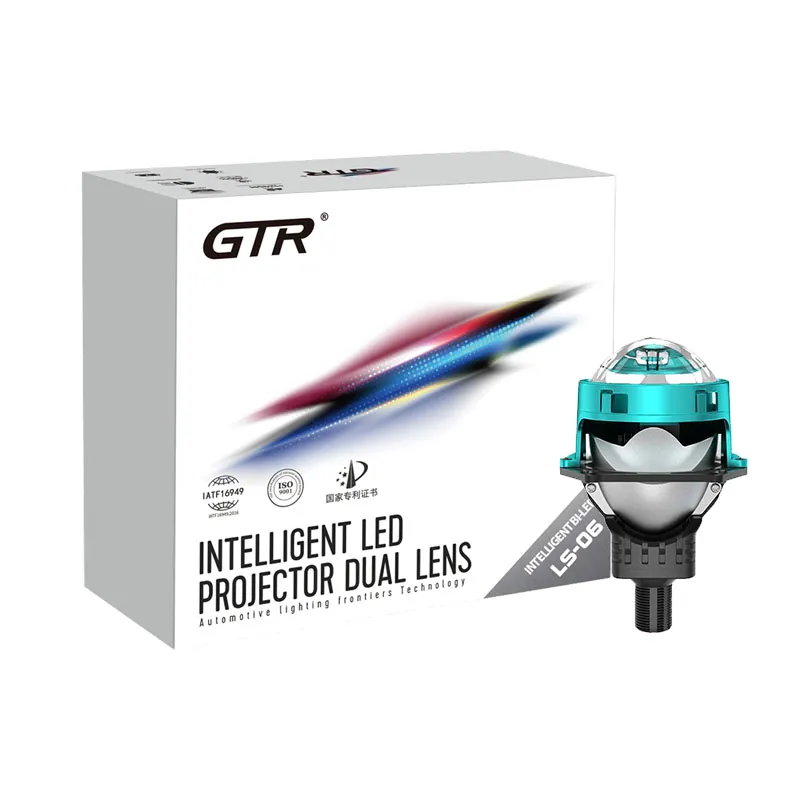
Through years of serving the automotive aftermarket, GTR has developed a projector bi LED lens lineup that addresses every factor discussed in this guide. The approach is straightforward: specify quality components, validate through rigorous testing, and support customers with genuine technical expertise.
GTR’s optical design prioritizes beam width and cutoff sharpness over inflated lumen numbers. The dual-reflector architecture efficiently captures LED output and directs it through a precision-ground lens, producing the wide, even beam pattern that real-world driving demands. The cutoff is crisp and consistent, staying sharp through thermal cycles that cause budget projectors to lose definition.
On the thermal side, GTR integrates intelligent temperature control with high-quality active cooling. The system monitors LED chip temperature continuously and adjusts driver output to prevent the thermal runaway that silently destroys poorly engineered projectors. This is not marketing language — it is measurable in consistent lux readings after extended operation, which any optical test bench can verify.
For commercial buyers — distributors, brand owners, and professional retrofit shops — GTR offers a complete partnership package. Custom packaging and branding support help build brand identity in competitive markets. Detailed technical documentation and installation resources reduce support burden and return rates. An 18-month warranty backed by responsive service provides confidence for customers and end users alike[reference:22]. Consistent manufacturing quality means SKU-to-SKU reliability that online marketplace resellers cannot match.
Whether you are upgrading your own vehicle’s lighting or sourcing products for commercial distribution, the choice of projector bi led lens manufacturer matters. The knowledge to evaluate beam patterns, thermal engineering, materials, and certifications — combined with the discipline to verify these factors before purchasing — is the difference between a lighting upgrade that performs for years and one that disappoints within months.
Explore the complete GTR projector bi led lens range at https://www.rhgtr.com. For commercial inquiries, bulk orders, or technical consultation, contact our team directly through the website — we provide detailed photometric data, dimensional drawings, and application-specific recommendations to ensure the right product selection for every project.