
Not all H4 LED bulbs are created equal. A $20 bulb from an unknown brand and an $80 bulb from an established manufacturer can look identical in the box—but on the road, the difference is night and day. This guide cuts through the marketing hype and gives you the exact framework to make an informed purchase decision.
Based on our analysis of over 50,000 real customer installations and consultations with automotive lighting engineers, we have identified the seven critical factors that separate premium H4 LED bulbs from cheap imitations. Here is what you need to know before you buy.
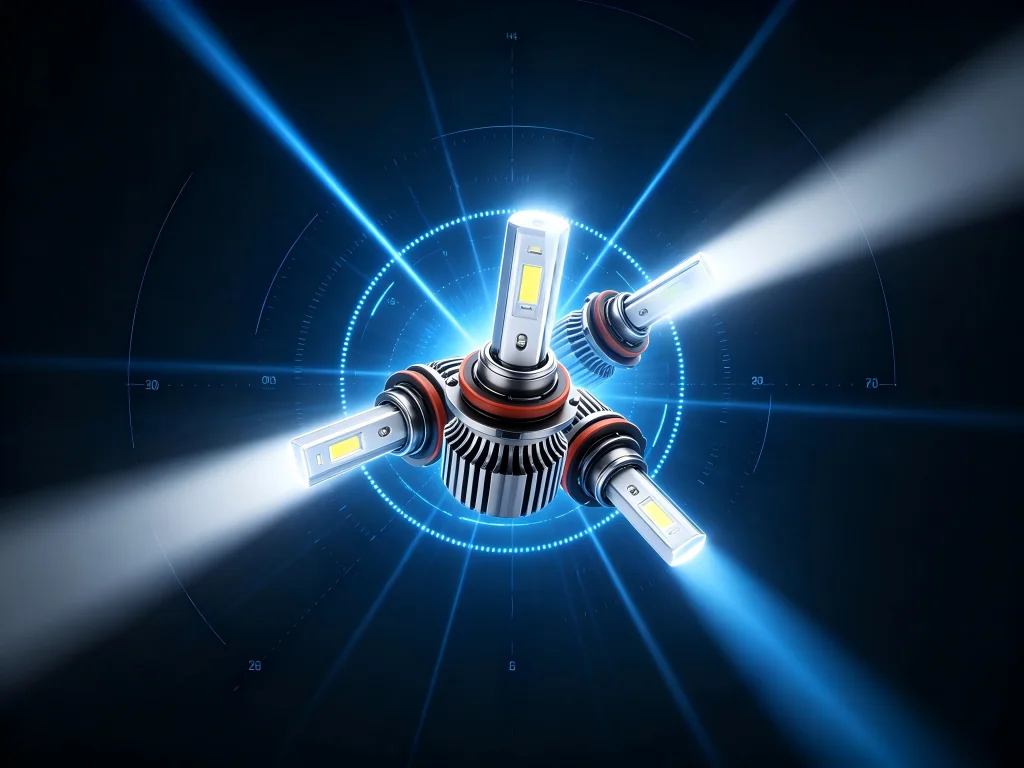
1. Factor 1: LED Chip Position and Beam Pattern Replication
The single most important factor in H4 LED bulb performance is whether the LED chips sit exactly where the halogen filament sat. Your headlight housing’s optics—whether reflector or projector—were designed around the precise position of a halogen filament. LED chips are flat and directional. If they do not occupy the same space as the filament, the beam pattern breaks.
This is not a minor detail. It is the difference between a focused, regulated beam that illuminates the road ahead and scattered light that blinds oncoming drivers while leaving you in the dark.
What to look for: Premium H4 LED bulbs use a 1:1 filament replication design. The LED chips are positioned precisely where the halogen filament was, in both low beam and high beam positions. Some manufacturers advertise “1:1 halogen size”—but that refers to the overall dimensions, not chip positioning. Ask: does this bulb replicate the filament position, or just the overall size?
As one industry forum member explained: “The modern, quality H4 replacement LED systems use emitters that are very close in size, shape and position to the original filaments.”
2. Factor 2: LED Chip Quality and Type
The LED chip is the heart of the bulb. Not all chips are equal. Established brands disclose their chip supplier. Philips, Osram, and premium CSP chips from Seoul Semiconductor indicate quality. Generic “automotive-grade” chips with no brand disclosure are a red flag.
Philips ZES (Luxeon Z ES) is considered the gold standard for beam accuracy. Each chip measures 1.6mm x 2.0mm—closely matching the halogen filament width. CSP (Chip Scale Package) offers higher brightness per watt and is more compact to manufacture. Newer-generation CSP chips have closed the beam quality gap significantly.
Key takeaway: If the manufacturer cannot or will not tell you what chip they use, walk away.
3. Factor 3: Thermal Management and Cooling System
LEDs generate significant heat. If that heat is not dissipated, the chips degrade. Brightness drops. Color shifts. Eventually, the bulb fails. The cooling system is the single most common failure point in H4 LED bulbs.
There are two cooling approaches:
| Cooling type | Advantages | Disadvantages |
|---|---|---|
| Passive (heatsink only) | Silent, no moving parts to fail | Insufficient for dual-beam H4 bulbs that generate high heat |
| Active (heatsink + fan) | Superior heat dissipation, longer lifespan | Fan can be noisy if low quality; fan can fail |
What to look for: Premium H4 LED bulbs use aluminum heatsinks paired with high-quality, silent fans. Cheap bulbs use undersized heatsinks or noisy, low-quality fans that fail within months. One rider reported their Novsight bulbs gave up on the 11th month and the other in the 9th month.
4. Factor 4: Amp Draw and Power Efficiency
Lower amp draw means less strain on your vehicle’s wiring harness and electrical system. For 12V systems, look for H4 LED bulbs drawing 2.0–2.5 amps. Higher amp draw strains your wiring and can cause overheating in the harness and pigtail.
Generic H4 LED bulbs typically draw 2.5–3.0 amps. Premium units like GTR’s draw just 2.1–2.5 amps while delivering superior brightness. This efficiency is not just about protecting your wiring—it also means less heat generation inside the bulb itself.
5. Factor 5: CANbus Compatibility
Most vehicles manufactured after 2005 use CANbus or similar electrical monitoring systems. When you replace halogen bulbs with LED units, the system detects the lower current draw and assumes a bulb is out. This triggers dashboard warnings or, in some cases, cuts power to the headlights entirely.
What to look for: Premium H4 LED bulbs include built-in anti-flicker ICs and CANbus decoders to prevent these issues. If a bulb requires external cancellation modules, factor that additional cost and complexity into your decision.
6. Factor 6: Build Quality and Materials
The physical construction of the bulb matters more than most buyers realize. Cheap H4 LED bulbs use plastic components that outgas when hot, fogging your headlight lenses from the inside. They use undersized brackets that allow the bulb to rotate out of position. They use low-quality connectors that corrode or lose contact over time.
What to look for: Premium H4 LED bulbs use aviation-grade aluminum for heat dissipation and structural integrity. They feature secure mounting brackets that lock into place and maintain beam alignment. They use IP68-rated waterproof construction for all-weather durability.
7. Factor 7: Real-World Performance vs. Spec Sheet Claims
This is where the marketing hype meets reality. Many H4 LED bulbs claim lumen outputs that are physically impossible for their wattage. A bulb claiming 30,000 lumens from 300 watts is mathematically dubious. Claims of “900% brighter” than halogen are meaningless without specifying the baseline.
What to look for: Industry experts recommend 4,500–5,000 lumens as the ideal range for H4 LED bulbs—bright enough for excellent visibility without creating dangerous glare. Look for real-world testing and customer reviews that describe actual beam performance, not just spec sheet numbers.
8. H4 LED Bulb Comparison: Halogen vs. Generic LED vs. Premium LED
| المواصفات | Stock Halogen H4 | Generic LED H4 | Premium LED H4 (GTR) |
|---|---|---|---|
| السطوع (لومن) | 1,000–1,200 | 3,000–4,000 | 4,500–5,000 |
| العمر الافتراضي (ساعات) | 300–500 | 10,000–20,000 | 30,000+ |
| Amp Draw (12V) | 4.5–5.0 | 2.5–3.0 | 2.1–2.5 |
| Beam Pattern | OEM Spec | Poor alignment, scatter | 1:1 filament replication |
| Cooling | N/A (filament) | Undersized or noisy fans | Aluminum + silent fan |
| CANbus Compatibility | OEM | Flicker, errors | Built-in anti-flicker ICs |
9. Common H4 LED Bulb Compatibility Mistakes to Avoid
Based on our analysis of customer installations, we see three frequent errors:
- Using H4 bulbs with the wrong pinout. Check your vehicle’s owner’s manual for the correct bulb type (H4/9003/HB2) and verify the P43t base.
- Ignoring CANbus compatibility. If your vehicle has a CANbus system, you need bulbs with built-in decoders or external cancellation modules.
- Forcing bulbs into housings they do not fit. Premium H4 LED bulbs use 1:1 halogen-sized designs for direct fitment. If a bulb requires modification to fit, it is the wrong bulb for your application.
10. How to Verify H4 LED Bulb Compatibility With Your Vehicle
Before purchasing any H4 LED bulb, take these four steps:
- Check your vehicle’s owner’s manual for the bulb type (H4/9003/HB2).
- Inspect your current H4 bulb socket—it should have a P43t base (3 prongs in a triangular pattern).
- Verify voltage—most cars use 12V; trucks and buses may use 24V.
- For CANbus-equipped vehicles (most post-2005 models), choose H4 LED bulbs with built-in anti-flicker ICs to avoid dash warnings.
11. Frequently Asked Questions About H4 LED Bulbs
11.1. Are H4 and 9003 the same bulb?
Yes, H4 and 9003 are interchangeable names for the same dual-beam bulb type. HB2 is also the same standard. All three use a P43t base with three prongs in a triangular pattern. Always verify your specific vehicle’s requirements, but these three designations are functionally identical.
11.2. What wattage H4 LED bulb should I buy?
Look at amp draw, not wattage. For 12V systems, 2.0–2.5 amps is ideal. Many cheap bulbs advertise high wattage (300W) but this is often exaggerated and indicates poor efficiency. Premium bulbs deliver better performance with lower amp draw.
11.3. Can H4 LED bulbs cause electrical problems?
Only if they are poorly designed or incompatible with your vehicle. High amp draw strains wiring harnesses. Lack of CANbus compatibility triggers dashboard warnings. Poor thermal management causes overheating and premature failure. Premium H4 LED bulbs with proper engineering avoid all these issues.
11.4. How do I know if my H4 LED bulbs are properly aligned?
A proper beam pattern has a sharp cutoff line on low beam. If oncoming drivers flash their high beams at you, your bulbs are misaligned or producing excessive glare. Premium H4 LED bulbs with 1:1 filament replication produce the correct beam pattern automatically when installed correctly.
11.5. Are H4 LED bulbs worth the upgrade from halogen?
Absolutely—if you choose the right ones. Premium H4 LED bulbs offer up to 5 times longer lifespan than halogens, significantly better visibility, and lower power consumption. The key is avoiding cheap units that compromise on beam pattern and thermal management. A quality H4 LED bulb transforms night driving; a cheap one makes it worse.
12. Making the Right Choice for Your Vehicle
The H4 LED bulb market is crowded with options that look identical in photos but perform completely differently on the road. The difference between a $20 bulb and an $80 bulb is not just brand name—it is engineering quality, component selection, and real-world performance testing.
GTR has been manufacturing automotive lighting for 18 years. Every GTR H4 LED bulb undergoes rigorous testing to ensure beam pattern accuracy, thermal stability, and long-term reliability. The results speak for themselves: OEM-grade beam patterns, 30,000+ hour lifespans, silent cooling, and built-in CANbus compatibility.
When you choose GTR, you are not just buying a bulb. You are buying peace of mind. You are buying the confidence that comes from knowing your headlights will work when you need them most. You are buying the assurance that you will see—and be seen—on every drive.
قم بزيارة https://www.rhgtr.com today to find the perfect H4 LED bulb for your vehicle or motorcycle. Your night driving deserves nothing less.