
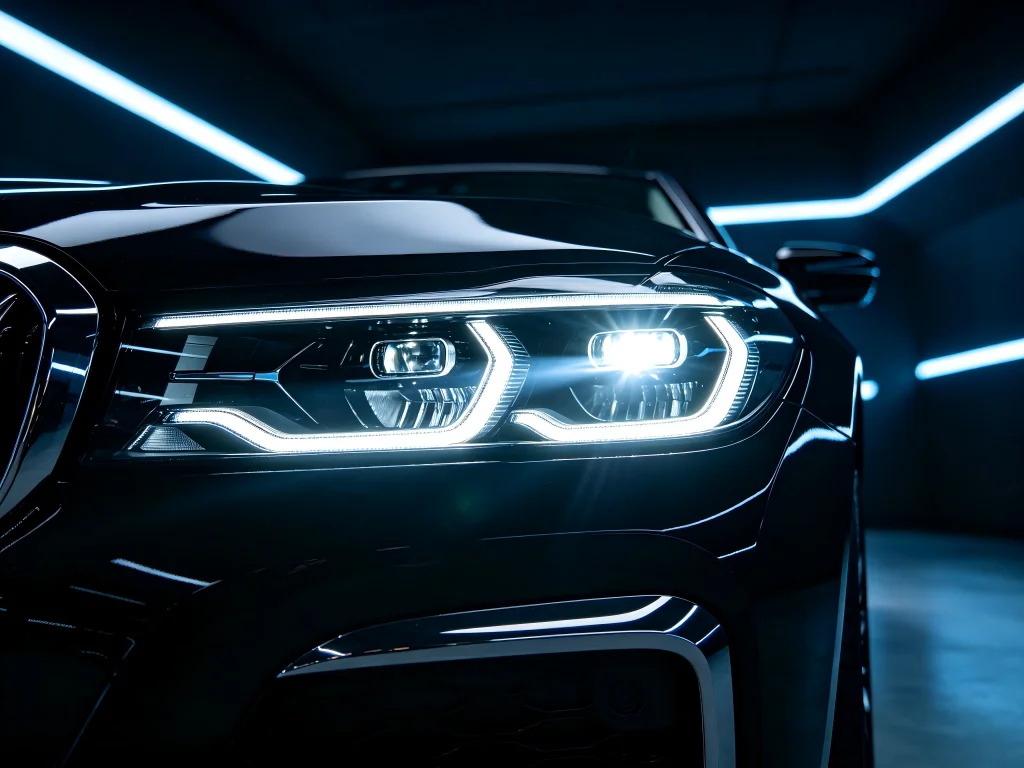
Every brand claims to have the brightest led lights for cars headlights. Every product page uses the same stock photos. Every “review” site recommends whatever pays the highest affiliate commission. This guide takes a different approach — one based on engineering principles, independent testing, and real driver feedback. Here’s what actually separates a $70 LED kit that lasts 5 years from a $15 kit that dies in 6 months.
1. What Actually Makes a Good LED Headlight Bulb
إجابة مباشرة: Four things determine whether an LED headlight bulb performs well in your vehicle: optical alignment (beam pattern), thermal management, LED chip quality, and electrical integration (CANBUS compatibility). Ignore any one of these, and your “upgrade” will underperform — or fail entirely.
Most buyers focus on lumens and price. That’s like buying a car based solely on horsepower and ignoring steering, braking, and safety. Let’s break down what actually matters.
1.1. Optical Alignment: The Beam Pattern Test
Your headlight housing is an optical system designed around a specific light source position. Halogen bulbs emit light 360 degrees from a single filament point. LED chips are flat surfaces emitting directional light. If the LED chips aren’t positioned exactly where the halogen filament would be, the beam pattern becomes distorted.
The results of poor beam geometry:
- Dark spots appear directly in your path of travel
- Light scatters above the cutoff line, blinding oncoming drivers
- The projected pattern becomes patchy and inconsistent
Testing has shown that cheap LED bulbs can create beam patterns that are “worse than stock halogen”. In extreme cases, reviewers have reported bulbs where “there is no high/low beam, just high beam all the time, and the alignment is terrible”.
1.2. Thermal Management: The Hidden Performance Killer
LEDs generate heat at the semiconductor junction. If that heat isn’t dissipated efficiently, the bulb derates — meaning it reduces output as it gets hotter. You might buy a 4,000-lumen bulb, but after 10 minutes of operation, you’re actually getting 2,500 lumens.
Active Cooling vs. Passive Cooling:
| Feature | Active Cooling (Fan) | Passive Cooling (Fanless) |
|---|---|---|
| Heat dissipation | Up to 51% more efficient | Less efficient per square inch |
| Sustained brightness | Maintains output under heat | May derate under load |
| Failure risk | Fan can fail over time | No moving parts |
| Best for | تطبيقات عالية الإخراج | Low-wattage, low-heat setups |
The engineering reality: active cooling allows the bulb to sustain higher brightness for longer periods without thermal derating. Passive cooling relies entirely on surface area to radiate heat naturally, which means the bulb may dim as temperatures rise.
1.3. LED Chip Quality: What You're Actually Paying For
The chip is the heart of any LED bulb. Here’s what the three main types deliver:
| نوع الرقاقة | Beam Accuracy | Brightness per Watt | المتانة | الأفضل لـ |
|---|---|---|---|---|
| Philips ZES | Excellent (1.6mm x 2.0mm matches halogen filament) | Moderate | High (low defect rate) | حاويات الإسقاط |
| CSP (Chip Scale Package) | Good (newer generations have closed the gap) | Higher than ZES | Moderate (thermal stress risk) | هياكل العاكس |
| Cree XHP/XPG | Poor (larger package disrupts focus) | Very high | Excellent | Off-road / specialty use |
The Philips ZES chip is widely considered the gold standard for beam accuracy because its dimensions closely match the halogen filament width. If you have projector housings, prioritize ZES chips. If you have reflectors and want maximum raw output, CSP can work — but only with proper thermal management.
1.4. CANBUS Integration: No More Error Codes
Upgrading to LED headlights often leads to frustrating dashboard warnings or flickering lights. These issues stem from a fundamental electrical incompatibility between LED technology and your vehicle’s CANBUS monitoring system.
Common CANBUS problems:
- Power draw mismatch — LEDs draw less power than halogens, so the computer thinks the bulb is burned out
- Diagnostic pulse interference — The vehicle’s diagnostic pulses cause LEDs to flicker
- PWM signal complications — Pulse-width modulation for DRLs can create noticeable flickering
Quality LED bulbs include integrated CANBUS decoders that simulate the power draw of a halogen bulb. No external resistors. No dashboard warnings. No flickering.
2. LED vs. Halogen vs. HID: The Head-to-Head Comparison
If you’re still deciding which technology to choose, here’s the data:
| Feature | Halogen | HID (Xenon) | Basic LED | Premium LED |
|---|---|---|---|---|
| العمر الافتراضي (ساعات) | 450-1,000 | 2,000-3,000 | 15,000-25,000 | 30,000-50,000+ |
| السطوع (لومن) | 700-1,200 | 3,000-4,000 | 3,000-5,000 | 4,000-6,000+ |
| Power draw | 55 واط | 35 watts | 30-50W | 16-25W |
| Beam quality | Factory baseline | Good (factory) | Often inconsistent | Precision matched |
| CANBUS compatible | Yes (factory) | Requires ballast | يتطلب وحدة فك ترميز خارجية | Integrated solution |
Premium LED options deliver dramatically better performance than both halogen and budget LED alternatives. However, beam quality and compatibility vary significantly even within the premium category.
3. الأخطاء الشائعة التي تكلفك المال
3.1. Mistake #1: Chasing Lumens
Most buyers focus entirely on lumen output while completely ignoring beam pattern quality. A brighter bulb with poor focus delivers less usable light than a moderately bright bulb with perfect beam geometry. Raw lumen numbers mean nothing if the light isn’t going where you need it.
3.2. Mistake #2: Believing Wattage Claims
Those “300W” LED bulbs you see on Amazon? They’re not drawing 300 watts. That’s marketing inflation — usually the “equivalent” wattage, not actual power draw. Check the real specifications. A quality LED headlight bulb typically draws 16-25W per bulb.
3.3. Mistake #3: Ignoring Housing Compatibility
Not all LEDs work well in all housings. Projector housings demand precise chip positioning for a sharp cutoff. Reflector housings benefit from wider light distribution. One industry analysis noted that “a good LED H11 produces 3,000-6,000 lumens … lasts 30,000+ hours, and draws less power than even the stock H11 halogen”. But only if the bulb is designed for your specific housing type.
3.4. Mistake #4: Skipping the Beam Pattern Check
After installing any LED retrofit, do a beam pattern check at night against a wall or garage door at 25 feet. A proper pattern has a sharp, 15-degree angled step-up at the center. Diffuse scatter means something is wrong.
4. What the Industry Leaders Are Saying
HID Nation — with over 25 years in automotive lighting and more than 50,000 orders shipped — names the GTR Lighting Ultra 3 as the premium performance choice for H11 applications. The Morimoto 2Stroke 4.0 is recommended for best value, but the GTR Ultra 3 is considered the performance leader.
Why? Because GTR doesn’t cut corners. Genuine Philips ZES chips with higher heat-resistance ratings than standard alternatives. Precision positioning that replicates the traditional filament location. Integrated CANBUS that eliminates error codes. Active cooling that sustains brightness under load.
5. Real Driver Feedback
“I’ve installed dozens of LED kits over the years. The GTR Ultra 3 is the first one where the beam pattern actually looked correct out of the box. No adjustment needed. No glare. Just perfect light.”
“Tried SEALIGHT, tried AUXITO, tried FAHREN. All of them had issues — flickering, poor beam pattern, or both. The GTRs were more expensive but worth every penny. They just work.”
6. FAQ: Your Buying Questions Answered
6.1. What bulb size do I need?
Check your vehicle owner’s manual or use a bulb finder tool. Common sizes include H11 (most common low beam), 9005/HB3 (high beam), 9006/HB4, H7, and H4/9003 (dual-beam).
6.2. How many lumens do I actually need?
A quality LED headlight bulb delivers 3,000-6,000 lumens per pair. More importantly, the beam pattern must be precise. 6,000 lumens with poor focus is worse than 3,000 lumens with perfect focus.
6.3. Are 6000K LEDs legal?
Color temperature alone doesn’t determine legality. In the U.S., aftermarket LED replacement bulbs in halogen housings are generally not federally compliant with FMVSS 108. Many drivers use them successfully, but check your local regulations. Always prioritize safety over aesthetics.
6.4. What's the difference between 1:1 design and standard?
1:1 design means the LED bulb replicates the exact physical dimensions and light source position of the factory halogen bulb. This ensures proper beam pattern and fitment. Non-1:1 bulbs may not fit correctly or may scatter light.
6.5. Do I need CANBUS-compatible LEDs?
If your vehicle has a bulb-out monitoring system (most modern cars do), yes. CANBUS-compatible LEDs prevent error codes and flickering.
6.6. How do I adjust LED headlight beam pattern?
Park 25 feet from a flat wall on level ground. Use the vertical adjustment screw under the hood to raise or lower the beam until the cutoff line aligns with your tape mark. For horizontal adjustment, rotate the bulb so LED chips sit at 9 and 3 o’clock positions.
6.7. Can I use LED headlights in fog or rain?
Yes, but choose the right color temperature. 4300K-5000K warm white cuts through fog and rain better than 6000K+ blue-white. Pure white or bluish light scatters more in adverse weather.
6.8. Why do some LED headlights cost $150 while others cost $15?
The $15 kit uses cheap chips, poor thermal management, and no CANBUS integration. It will flicker, scatter light, and likely fail within months. The $150 kit uses premium chips like Philips ZES, active cooling, integrated CANBUS, and precision engineering — delivering consistent performance for years.
7. Make the Smart Investment in Your Night Driving
You have two choices. You can buy the $15 Amazon special, deal with flickering and glare, replace it in six months, and still not see properly at night. Or you can invest in a premium LED system that delivers precise beam patterns, consistent brightness, and years of reliable service.
GTR Lighting engineered the Ultra 3 series for drivers who refuse to compromise. Genuine Philips ZES chips. Active cooling. Integrated CANBUS. Precision optical alignment. Everything the cheap kits leave out.
Don’t let marketing hype cost you your night vision. Don’t let cheap engineering compromise your safety.
Choose performance. Choose precision. Choose GTR.
View the full GTR Lighting Ultra 3 lineup at https://www.rhgtr.com and experience what properly engineered LED headlights can do.