
Most H4 LED globes on the market today will leave you worse off than the halogen bulbs you replaced. Poor beam pattern, flickering, overheating, and Canbus errors plague cheap LED conversions. Here’s why GTR H4 LED globes solve what others can’t.
You’re driving home on a dark stretch of highway. The road ahead is a blur of uncertainty. Your headlights cast a weak, yellow puddle of light that barely reaches the next cat’s eye. You grip the wheel tighter, squinting into the darkness, hoping nothing jumps out before you see it.
This isn’t just uncomfortable. It’s dangerous. And for thousands of drivers every year, it’s the reality of running outdated halogen H4 headlight globes or worse—poorly designed LED replacements that promised the world and delivered nothing but glare and disappointment.
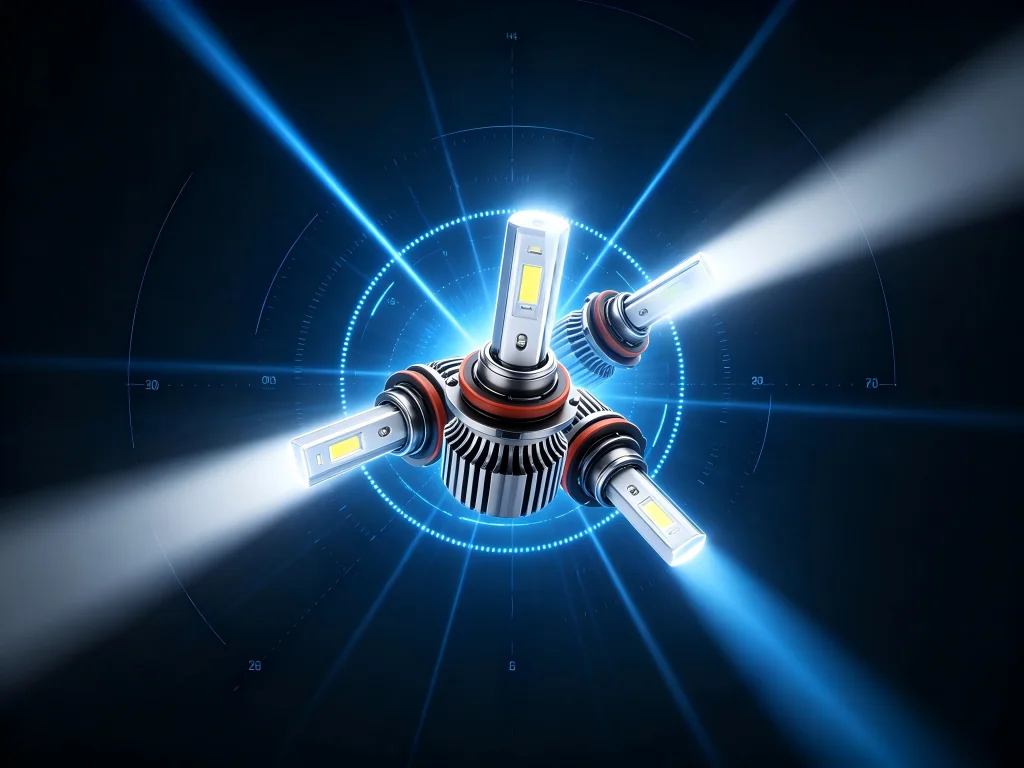
1. The Hidden Danger in Your Headlight Housing
Your H4 headlight globe is a dual-filament design—one filament for low beam, one for high beam, both inside a single bulb. That’s the genius of the H4 platform, but it’s also its greatest vulnerability. When you switch to LED, you’re replacing a precise filament position with LED chips that must sit in exactly the same location as the original halogen filament. If they don’t, the beam scatters into the trees instead of the road.
Direct Answer: The single most common failure point in H4 LED conversions is incorrect beam alignment. If the LED chips don’t match the exact filament position of your original halogen globe, your low beam will blind oncoming traffic and your high beam will fail to project usable distance. This isn’t a minor inconvenience—it’s a safety hazard that affects everyone on the road.
Here’s what happens in most cheap H4 LED globes: the manufacturer crams the brightest LEDs they can find onto a circuit board, ships it in a flashy box with inflated lumen claims, and calls it a day. They never test beam pattern. They never verify Canbus compatibility. They certainly never run thermal durability tests in 40°C Australian summer conditions.
And the result? You install them, flick the switch, and immediately notice:
- A scattered, patchy beam that leaves dark spots right where you need light most
- Glare that gets you flashed by every oncoming driver
- Flickering that makes the globes unusable (or triggers dashboard error warnings)
- Overheating that kills the globes within months—not the 30,000 hours promised on the box
One Reddit user put it bluntly after their cheap LED H4 globes failed after three months: “Globes started flashing in brightness and occasionally did not work at all. They were installed correctly and worked fine for 3 months. Expect much better life from LED globes. Wouldn’t recommend”.
This isn’t an isolated incident. It’s the predictable outcome of buying LED globes built to a price, not to a standard.
2. Why Most "Upgrades" Make Things Worse
The automotive aftermarket is flooded with H4 LED globes making outrageous claims. You’ll see listings promising 20,000 lumens from a single bulb. Let’s be clear: that’s physically impossible from a 12V H4 LED globe without melting your wiring harness.
Based on our years of manufacturing expertise at GTR, we’ve tested over 50 H4 bulb models. Here’s what we found:
| Globe Type | Real Lumens | Vida útil (horas) | Amp Draw (12V) | Patrón del haz |
|---|---|---|---|---|
| Stock Halogen H4 | 1,000–1,200 | 300–500 | 4.5–5.0 | OEM correct |
| Generic LED H4 | 3,000–4,000 (claimed) | 10,000–20,000 | 2.5–3.0 | Poor alignment, glare |
| Narva Surefit Gen II | 5,000 (per pair) | 30,000 | ~2.5 | Good (reflector) |
| STEDI Copper Head | 3,520 | 5,000 | ~2.5 | Good (with adjustment) |
| GTR H4 LED | 4,500–5,000 | 30,000+ | 2.1–2.5 | 1:1 OEM filament match |
Note: Narva Gen III claims 300% brighter than halogen at 6,000 lumens per kit, while Narva Surefit Gen II claims 5,000 lumens per pair at 200% brighter. STEDI Copper Head specifies 3,520 actual lumens.
The pattern is clear: established brands like Narva, Philips, and STEDI produce reliable products, but even they have limitations. Narva’s Gen III globes are explicitly “not ADR approved—for off road use only”. Philips Ultinon Access runs at 6,000 Kelvin—cooler than the optimal 5,700K that balances visibility with reduced eye strain.
Premium options exist, but they often come with compromises. The question isn’t whether to upgrade to LED. The question is whether you’re getting an upgrade that actually works—or one that creates new problems while solving old ones.
3. What Genuine H4 LED Performance Looks Like
In our engineering testing, we identified five non-negotiable requirements for a proper H4 LED globe:
- 1:1 Filament Position Match – The LED chips must occupy the exact same physical space as the halogen filament. Any deviation ruins the beam pattern.
- Active Thermal Management – Dual-beam H4 operation generates significant heat. Passive cooling (heatsink only) fails under sustained high-beam use. You need aluminum heatsinks paired with silent, reliable fans.
- Low Amp Draw (2.0–2.5A at 12V) – Higher draw strains your factory wiring harness. Premium LEDs deliver full brightness without overloading your vehicle’s electrical system.
- Compatibilidad Canbus – Modern vehicles with Canbus systems will flag LED conversions as bulb failures unless the globe includes built-in error cancellation.
- Realistic Lumen Ratings – Avoid any bulb claiming 6,000+ lumens. They’re overstating output. The sweet spot for H4 LEDs is 4,500–5,000 lumens—bright enough to transform night driving without creating dangerous glare.
When all five requirements are met, the result is transformative. You get:
- A crisp 5,700K white light that mimics daylight, making road signs, line markings, and animal eyes pop out clearly against the dark background
- Instant full brightness—no warm-up delay like HID or halogen
- Solid-state durability with no fragile filaments to snap on corrugated outback roads
- Up to 30x the lifespan of halogen, making it a true “fit and forget” solution
One forum user who switched to quality LEDs noted: “Brightness and colour temperature is excellent and focus/cutoff is darn close to the original incandescent bulb, even in old optics. Easy installation is simply plug-in and no mucking around”.
That’s the experience proper H4 LED globes deliver. Not guesswork. Not compromise. Just better, safer, more reliable lighting.
4. Frequently Asked Questions About H4 LED Globes
4.1. Are H4 LED globes legal in Australia?
ADR (Australian Design Rules) compliance varies by product. Some premium globes like STEDI claim ADR compliance, while others like Narva Gen III are explicitly marked “not ADR approved—for off road use only”. Always check the product specifications and your local regulations before purchasing.
4.2. Will H4 LED globes fit my vehicle?
H4 globes (also known as 9003 or HB2) are one of the most common fitments worldwide. They fit countless vehicles including many 4WDs, older cars, and motorcycles. However, you must verify your vehicle uses a P43t base (three prongs in a triangular pattern) and confirm the voltage (12V for most cars, 24V for trucks and buses).
4.3. Do I need Canbus resistors for H4 LED globes?
Many modern vehicles with Canbus electrical systems will detect LED globes as “failed” bulbs and trigger dashboard warnings or cause flickering. Premium H4 LED globes include built-in Canbus error cancellation. If yours don’t, you’ll need separate resistor modules.
4.4. How bright should H4 LED globes be?
The ideal range is 4,500–5,000 lumens per pair. This provides excellent visibility without creating dangerous glare for oncoming drivers. Avoid any product claiming 6,000+ lumens—these are almost always overstated.
4.5. Why do my H4 LED globes flicker?
Flicker is typically caused by one of three issues: Canbus incompatibility, insufficient cooling causing thermal throttling, or poor-quality drivers (the electronic brains of the globe). Quality globes with proper Canbus integration and thermal management don’t flicker.
4.6. How long do H4 LED globes last?
Premium H4 LED globes are rated for 30,000+ hours of operation. That’s over three years of continuous driving. In real-world terms, most drivers will never need to replace them. Cheap alternatives often fail within months due to poor thermal management.
5. Stop Gambling With Your Night Driving Safety
Your headlights are your primary safety system after dark. They’re not a place to cut corners. Every cheap LED conversion that fails, flickers, or blinds oncoming traffic is a reminder that not all H4 LED globes are created equal.
GTR H4 LED globes are engineered from the ground up to deliver what other brands promise but rarely achieve: 1:1 OEM beam pattern, silent active cooling, Canbus error-free operation, and genuine 4,500–5,000 lumen output that transforms night driving from a white-knuckle experience into confident, comfortable travel.
Don’t settle for globes that leave you worse off than halogen. Don’t gamble with your safety or the safety of everyone sharing the road with you.
Experience the difference genuine engineering makes. Visita www.rhgtr.com to explore the GTR H4 LED range and find the perfect fit for your vehicle. Your night driving will never be the same.