
Entrez dans n’importe quel magasin de pièces automobiles ou parcourez Amazon, et vous trouverez des ampoules LED automobiles pour $30, $40 ou $50. Les annonces crient ” 50 000 lumens ” et ” 800% plus lumineux “. Elles ont des milliers d’avis. Elles semblent être une bonne affaire.
These are not a good deal. They are a gamble on your safety.
This guide cuts through the marketing hype. Based on our years of expertise in automotive LED lighting manufacturing, we break down exactly what separates a $70 LED kit that lasts 5 years from a $15 kit that dies in 6 months.
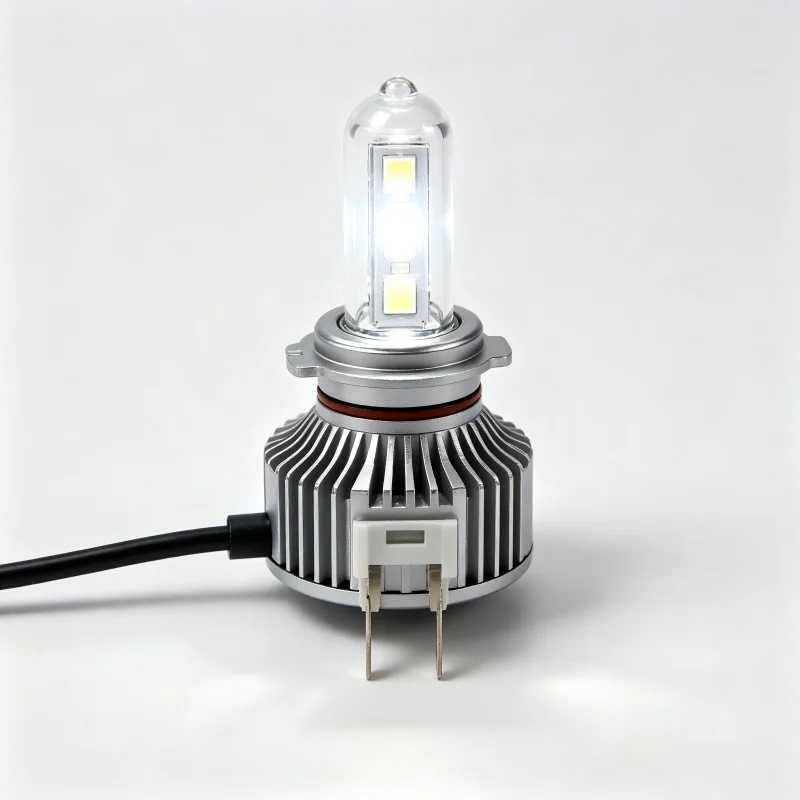
1. Why most articles about "best LEDs" are wrong
Every article about the ”best automotive LED bulbs” on the internet is written by someone who has never installed a headlight bulb. They rank Amazon products by affiliate commission, not performance. They treat all automotive LED bulbs as a single category. That's like writing ”best tires” without mentioning tire size.
An H11 LED bulb has completely different engineering challenges than an H4 dual-beam bulb. The housing it goes into — reflector or projector — changes the chip layout that works best. The vehicle's electrical system determines whether you need CANbus compatibility or not.
Here's what really matters when choosing automotive LED bulbs.
2. The four things that really matter
2.1. LED chip type and placement
The LED chip determines brightness, beam pattern, and how well the bulb mimics the halogen filament position — which is critical for a sharp cutoff in projector housings and correct light distribution in reflectors.
The three chip types you will see in 2026:
| Chip Type | Best for | Advantages | Disadvantages |
|---|---|---|---|
| Philips ZES (Luxeon Z ES) | Projector housings | Gold standard for beam precision. Low defect rate. Excellent color consistency at 6000K | Moderate brightness per watt |
| CSP (chip-scale package) | Reflector housings | Higher brightness per watt than ZES. More compact. Cheaper to manufacture | More sensitive to thermal stress over time |
| Cree XHP / XPG | High-power applications | Exceptional durability | A larger housing makes filament position alignment more difficult |
But the chip type is only half the story. The chip's position matters just as much, if not more. The closer LED emitters mimic the position of the original halogen filament, the better your housing can control the beam. Better positioning usually means a sharper cutoff, more powerful distance lighting, and less glare.
2.2. Thermal Management
LEDs run cooler at the beam, but the chip and driver still generate heat. The best bulbs manage this heat with quality heat sinks, active fans, or a well-designed passive cooling system. Cheap kits often cut corners here, which can shorten lifespan or reduce output after extended use.
About 70-80% of the electrical energy entering an LED is converted into heat. Poor heat dissipation can lead to an increase in junction temperature, which significantly reduces the lifespan of LEDs.
What to look for:
- Thermal Separation — Quality automotive LED bulbs place the LED chip on a thermal plane separate from the driver circuit
- Heat Sink Design — A larger surface area means better passive cooling
- Fanned or Fanless — Fan-cooled bulbs dissipate more heat, but some fans become noisy over time or fail prematurely. Fanless bulbs are simpler, but not all designs dissipate heat well enough for high-power applications.
- Constant Current Driver — Accepts any input voltage, smooths and regulates it
2.3. CANbus Compatibility
Modern vehicles use CANbus systems that monitor bulb status by measuring resistance. Automotive LED bulbs consume much less power than halogens. The system interprets this as a burnt-out bulb and triggers error codes or flickering.
Your options:
- Integrated CANbus compatibility — The bulb has an integrated circuit that communicates correctly with the vehicle's computer. Plug and play. No additional parts. This is the ideal solution.
- External resistors — Increase power consumption to trick the CANbus system. Inexpensive and almost always functional, but they generate heat, require splicing into the original wiring, and can fail over time.
- External CANbus decoders — Plug-and-play modules that balance the circuit. More expensive than resistors but cleaner to install.
If your vehicle is known for CANbus issues, choose automotive LED bulbs with built-in compatibility. This saves time, money, and frustration.
2.4. Fitment and physical dimensions
This is where many buyers get fooled. Even if the bulb base is technically correct, the overall body size, driver housing, wiring length, and fan depth may not fit your original housing. Trucks and older cars sometimes have more space. Modern compact housings often do not. A vehicle-specific fitment check saves time and avoids buying a kit that ends up returned.
Check before buying:
- Will the dust cover close over the bulb?
- Will the cooling fan or heat sink clear the housing?
- Is the wiring long enough to reach the connector?
- Does the locking mechanism match your housing?
3. LED vs Halogène vs HID : La comparaison tête-à-tête
| Fonctionnalité | Halogen | LED | HID (xénon) |
|---|---|---|---|
| Luminosité (lumens) | 1 000 – 1 500 | 4 000 – 6 000 | 3 000 – 4 000 |
| Consommation électrique | 55W | 25 – 50W | 35 W |
| Durée de vie (réaliste) | < 1 000 heures | 15 000 – 30 000 heures | 2 000 – 3 000 heures |
| Coût par kit | $10 – $30 | $40 – $80 | $50 – $150 |
| Installation | Simple | Simple à modérée | Nécessite souvent une installation professionnelle |
| Faisceau lumineux dans un boîtier halogène | Optimal (conçu pour cela) | Varies greatly — depends on chip placement | Poor — HID bulbs scatter light in halogen reflectors |
| Warm-up time | Instantané | Instantané | Several seconds |
For most drivers switching from halogen, LED offers the best combination of brightness, lifespan, and simplicity. But not all automotive LED bulbs are created equal. The difference between a great LED bulb and a bad one comes down to the four factors above.
4. Common pitfalls to avoid when buying automotive LED bulbs
4.1. Pitfall #1: Chasing raw lumen numbers
Many automotive LED bulbs promise huge lumen numbers, but that doesn't guarantee better night driving. Beam pattern matters more than big promises. If the bulb doesn't place light in the housing the way the original halogen filament did, you can end up with a bright foreground, dark distance, and plenty of glare for oncoming traffic.
4.2. Pitfall #2: Ignoring color temperature trade-offs
Most drivers want that clean white LED look, and the sweet spot is around 5000K to 6500K. If you go too blue, the light can look aggressive, but usable visibility in rain or fog may suffer. White isn't always better when road conditions deteriorate.
4.3. Pitfall #3: Assuming "plug and play" means no compatibility issues
”Plug and play” means the connector fits. It doesn't mean the bulb will work with your vehicle's CANbus system, fit behind your dust cap, or produce a correct beam pattern. Always check CANbus compatibility, physical dimensions, and housing type before buying.
4.4. Pitfall #4: Buying the cheapest option
A $15 set of automotive LED bulbs might save you money upfront. But when they fail after six months — or worse, when they cause an accident because you can't see the road — those ”savings” quickly disappear. Quality automotive LED bulbs cost more upfront but save you money in the long run through longer lifespan and better performance.
5. What industry experts recommend
HID Nation, with over 25 years of experience in automotive lighting, recommends the GTR Lighting Ultra 3 for premium H11 performance. Their March 2026 guide — based on real customer feedback from over 50,000 orders — places GTR at the top of the premium category.
Sanvicar's January 2026 headlight comparison test found that GTR Lighting Ultra 2 H11 bulbs outperformed all other sets tested. They praised the aluminum housing and engineering quality.
Independent reviews confirm the results. BulbFacts rated the Ultra 3 as ”bright, well-built, performing in a reflector housing, very good in a projector, and it has the kind of overall balance that is hard to find in the world of LED headlights.”
6. Frequently asked questions about automotive LED bulbs
6.1. What is the difference between 5000K and 6000K automotive LED bulbs?
5000K produces a neutral white light often called ”natural white.“ 6000K produces a slightly cooler, crisper white light that mimics noon sunlight. The human eye perceives 6000K as brighter, but both temperatures are equally bright in terms of lumens. The choice is largely personal preference, although some drivers find 5000K more comfortable for extended night driving.
6.2. Do I need CANbus-compatible automotive LED bulbs?
If your vehicle was manufactured after approximately 2005, it likely uses a CANbus or similar computer-controlled electrical system. These systems monitor bulb resistance and will trigger errors or flickering with standard LED bulbs. Choose automotive LED bulbs with built-in CANbus compatibility to avoid these issues.
6.3. Will automotive LED bulbs work in my reflector headlights?
Yes, but only if the LED chips are positioned correctly. Reflector housings are designed for a specific filament position. If the LED chips are offset by a few millimeters, the beam degrades. Look for bulbs that advertise ”1:1 filament replica positioning” or similar technical claims.
6.4. How many lumens do I actually need?
Original halogen bulbs produce about 1,000 to 1,500 lumens in low beam. Quality automotive LED bulbs typically produce 4,000 to 6,000 lumens. More lumens is not always better – a well-focused 4,000-lumen beam is more useful than a diffuse 10,000-lumen beam. Focus on beam quality, not raw lumen numbers.
6.5. Are expensive automotive LED bulbs worth the extra cost?
In most cases, yes. Cheap automotive LED bulbs cut corners on chip quality, thermal management, and driver circuits. They may dim over time, fail prematurely, or produce poor beams. Quality bulbs like the GTR Ultra series use premium components, proper thermal design, and precise chip positioning. They cost more upfront but offer better performance and longer lifespan.
6.6. How do I know what bulb size my vehicle requires?
Consult your vehicle's owner's manual, look at the base of the existing bulb, or use an online bulb finder tool. Common sizes include H11 (low beam), 9005 (high beam), H7 (European vehicles), and H4 (dual beam). Always confirm the exact size before purchasing.
6.7. Can I install automotive LED bulbs myself?
Most automotive LED bulbs are designed for DIY installation. However, some vehicles have cramped engine bays or complex headlight assemblies that make installation more difficult. Watch installation videos for your specific vehicle model before starting. If you're unsure, professional installation is always an option.
7. Your next step: choose automotive LED bulbs that deliver performance
You now know what sets a great automotive LED bulb apart from a bad one. You understand the importance of chip placement, thermal management, CANbus compatibility, and fitment. You've seen the numbers, comparisons, and expert recommendations.
Now it's time to make a choice. You can continue to gamble on cheap automotive LED bulbs that flicker, glare at other drivers, and fail within months. Or you can choose the bulbs recommended by industry experts—bulbs designed to work with your vehicle, not against it.
GTR Lighting offers the engineering, performance, and reliability that cheap bulbs can't match. Visit GTR Lighting today and upgrade to automotive LED bulbs that actually work.
Discover GTR Lighting's Ultra series—the automotive LED bulbs trusted by professionals.