
Searching for h11 led headlight bulbs should be straightforward. Instead, you are drowning in conflicting specs, outrageous lumen claims, and reviews that range from “life-changing” to “died in three months.” This guide cuts through the noise. Drawing on years of manufacturing expertise and real-world testing, we break down exactly what separates a $20 bulb from a $150 bulb — and why the difference matters more than you think.
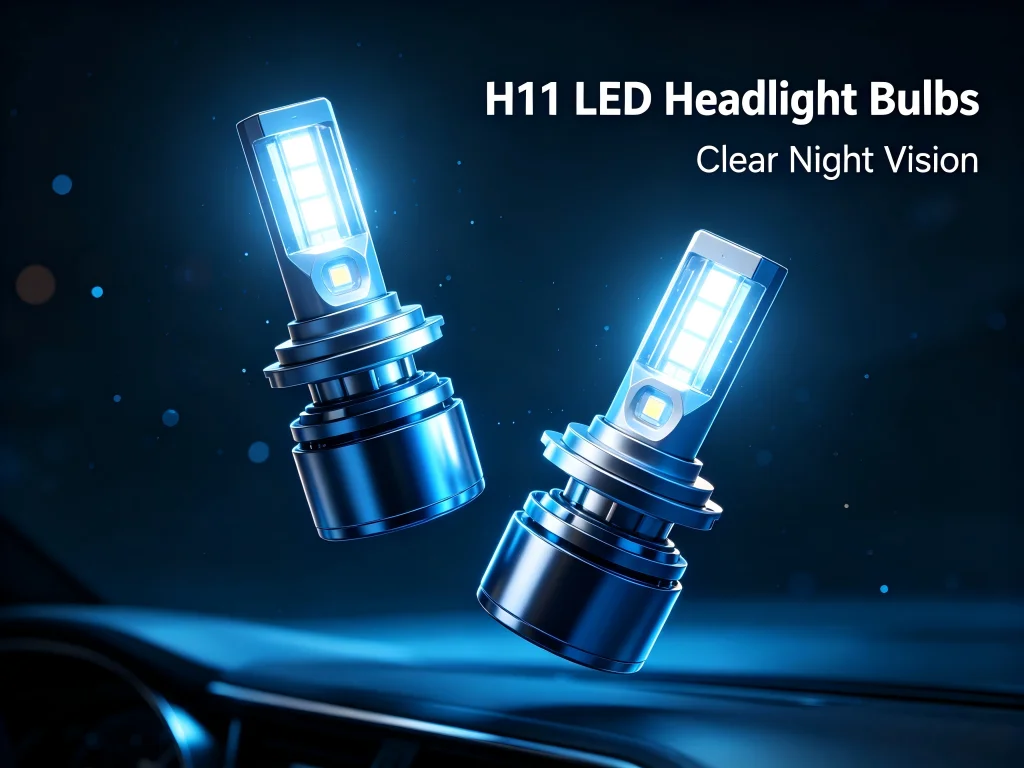
1. What You Actually Need to Know About H11 LED Headlight Bulbs
H11 LED headlight bulbs are direct replacements for halogen H11 bulbs, commonly used for low beams and fog lights in thousands of vehicle models. The best ones deliver 300% to 500% more usable light than halogens while lasting 30 to 50 times longer. But “usable” is the operative word — and that is where most bulbs fail.
The H11 designation refers to the bulb’s base type and electrical specification. Any bulb with an H11 base will physically plug into your vehicle. But physical fitment is only the beginning. The real questions are: Will it fit inside your housing? Will it produce a legal beam pattern? Will it work with your vehicle’s computer? And will it last longer than your next oil change?
2. The 5 Critical Factors That Separate Premium H11 LED Headlight Bulbs From Junk
Industry experts agree on exactly four things that matter when evaluating h11 led headlight bulbs. We have expanded that to five — because we have seen too many drivers overlook the fifth and regret it.
2.1. Tipo e posizionamento del chip LED
The LED chip determines brightness, beam pattern, and how well the bulb mimics the halogen filament position. This is critical for a clean cutoff in projector housings and proper light distribution in reflectors.
Three chip types dominate the market in 2026:
- Philips ZES (Luxeon Z ES): The gold standard for beam accuracy. Each chip measures 1.6mm x 2.0mm, closely matching the halogen filament width. Excellent color consistency at 6000K. The beam pattern is razor-sharp — ideal for projector housings.
- CSP (Chip Scale Package): Higher brightness per watt than ZES and more compact. Newer-generation CSP chips have closed the beam quality gap significantly. Best for reflector housings where raw output matters more than pinpoint precision.
- Generic flip-chip: Cheap to manufacture. Poor color consistency. High failure rates. Found in virtually every sub-$30 H11 LED bulb on the market.
The takeaway: If a bulb does not specify its chip type, assume it is using the cheapest available. Premium h11 led headlight bulbs use Philips ZES or advanced CSP chips and position them to exactly match the halogen filament location.
2.2. Thermal Management — The Silent Killer
LEDs generate heat. Heat degrades performance and shortens lifespan. The best h11 led headlight bulbs use either active cooling (a fan) or passive cooling (a heat sink) — or both.
Here is what the data shows:
| Cooling type | Durata della vita | Ideale per |
|---|---|---|
| Active fan + aluminum heat sink | Oltre 50.000 ore | All vehicles, especially high-output bulbs |
| Passive heat sink only | 30.000 ore | Tight housings with limited space |
| No cooling or minimal cooling | 3-6 months | Nothing — avoid at all costs |
GTR Lighting’s Ultra 3 uses thermal separation technology that places the LED die on a separate thermal plane from the driver circuit. This is a significant engineering advancement that keeps the bulb running cooler than competitors drawing the same wattage. The result: consistent performance over years of use, not months.
One reviewer who learned this lesson the hard way noted that their mechanic warned them their bulbs “will burn very fast because is only a ordinary high beam light, has no cooling device”. That is not a risk worth taking.
2.3. Compatibilità CANBUS
Modern vehicles use CANBUS systems that monitor bulb resistance. Halogen bulbs draw about 55 watts. LEDs draw far less. The car’s computer sees the lower draw and assumes the bulb has burned out — triggering flickering, error codes, or complete shutdown.
There are three ways manufacturers address this:
- Built-in CANBUS driver: The bulb’s internal electronics mimic the resistance of a halogen bulb. Clean, safe, and reliable. This is what premium h11 led headlight bulbs use.
- External resistor/decoder: A separate box or harness that adds resistance. Generates significant heat. Can melt plastic wiring if installed improperly. A workaround, not a solution.
- Nothing: The bulb flickers, throws error codes, or simply does not work. Found in the cheapest bulbs.
The takeaway: If you drive a vehicle built after 2010, CANBUS compatibility is non-negotiable. Choose h11 led headlight bulbs with built-in CANBUS drivers — not external decoders that create new problems while solving one.
2.4. Physical Fitment and Housing Clearance
LED bulbs are often larger than halogens due to cooling fans, heat sinks, or external drivers. Your headlight housing may have limited space — especially in modern vehicles with sealed assemblies or tight dust covers.
Before purchasing h11 led headlight bulbs, check:
- The bulb’s full length (including fan and connector)
- The diameter of the heat sink or fan housing
- Whether the dust cover can be reinstalled after installation
Some manufacturers now offer compact, all-in-one designs that integrate the driver into the bulb base. These are ideal for tight housings. Others use separate drivers that take up additional space — sometimes making installation impossible without modification.
One Amazon reviewer described their frustration: “Ended up filing the socket to make it larger so can push thru the bulb, still can’t lock in the bulb as it is slightly longer at base for the locking mechanism to work”. Do not be that person. Check fitment before you buy.
2.5. Beam Pattern — Projector vs. Reflector Housings
This is the factor that most buyers ignore — and the one that makes the biggest difference in real-world performance.
Projector housings use a lens to focus light into a precise beam with a sharp cutoff. They are demanding: the LED chip must be positioned exactly where the halogen filament was, or the cutoff blurs and light scatters. Premium h11 led headlight bulbs with Philips ZES chips excel in projector housings.
Reflector housings use a curved mirror surface to distribute light. They are more forgiving but still require proper LED placement to avoid dark spots or glare. Newer CSP chips work well in reflector housings.
As one expert explained: “The optical design of a reflector headlamp is very different from that of a projector-based headlight. Designing LED headlight conversion useful on both platforms is a balancing act full of compromises”.
The takeaway: Choose h11 led headlight bulbs designed for your housing type. Bulbs that claim to work “perfectly” in both are usually compromised in both. GTR bulbs are engineered for precision in projector housings and strong performance in reflectors — a rare combination achieved through advanced chip positioning.
3. H11 vs. 9005 vs. H4 — Why Bulb Size Matters More Than You Think
Many drivers confuse H11 with other common sizes. Here is the distinction:
- H11: Low beams and fog lights. Single-filament. Most common passenger car low-beam size.
- 9005: High beams. Single-filament. Brighter than H11 but not designed for low-beam use.
- H4: Dual-beam (high and low in one bulb). Common in older vehicles and motorcycles.
Do not buy 9005 bulbs for your low beams. Do not buy H4 bulbs unless your vehicle specifically requires them. And always verify your vehicle’s bulb size before purchasing h11 led headlight bulbs — because installing the wrong size “will simply not work”.
4. Color Temperature: What 6000K Actually Means
Color temperature is measured in Kelvin (K) and determines the appearance of the light. Most h11 led headlight bulbs come in 6000K to 6500K, producing a bright white light that mimics daylight.
Here is what the numbers mean in practice:
- 4300K: Warm white. Closest to OEM halogen. Minimal glare. Best for fog lights and all-weather driving.
- 5000K-6000K: Pure white. Maximum visibility. Modern appearance. The sweet spot for most drivers.
- 6500K+: Cool white with blue tint. Harsher on the eyes. More glare. Often used for “style” over substance.
GTR bulbs deliver a crisp 6000K white light that mimics daylight without blue or yellow tints. This is the ideal balance of visibility, safety, and aesthetics.
5. Reading Between the Lines: How to Spot Misleading H11 LED Headlight Bulb Listings
The LED headlight market is flooded with inflated claims. Here is how to separate fact from fiction:
Lumen claims are largely unregulated. A $20 bulb can claim 20,000 lumens. A $150 bulb might claim 4,700 lumens. The $150 bulb is almost certainly brighter on the road because its beam is focused — not scattered.
“600% brighter than halogen” is marketing math. These claims are based on theoretical maximum output, not real-world performance. A 300% increase in usable light is excellent. Anything above that is usually exaggeration.
“Lifetime warranty” on a $30 bulb is suspicious. The company may not exist in six months. Premium brands with established reputations — like GTR Lighting — stand behind their products because they engineer them to last.
As HID Nation bluntly states: “Every ‘best LED headlights’ article on the internet is written by someone who has never installed a headlight bulb. They rank Amazon products by affiliate commission, not performance”.
6. Real-World Test Results: What Independent Reviews Actually Show
Independent testing tells a clear story. In a headlight shootout, GTR Lighting’s Ultra 2 h11 led headlight bulbs “outperformed every other set of LEDs”. The Ultra 3 delivered 920 max lux at the brightest point on the wall — 475% brighter than stock halogens.
BulbFacts rated the Ultra 3 as “one of the better LED headlight kits we have tested” with “very good projector performance, clean 5100K color” and “the kind of overall balance that is hard to find in the LED headlight world”.
HID Nation, with over 50,000 LED kits shipped and 25 years in the industry, concluded: “The GTR Ultra 3 is the best H11 LED headlight on the market right now”.
These are not marketing claims. These are results from real testing by experienced professionals.
7. Frequently Asked Questions About H11 LED Headlight Bulbs
7.1. What is the difference between H11 and 9005 LED bulbs?
H11 is primarily used for low beams and fog lights. 9005 is used for high beams. They have different bases and electrical specifications. Installing the wrong type will not work — and could damage your vehicle’s electrical system.
7.2. How many lumens do I need for H11 LED headlight bulbs?
For optimal visibility, choose h11 led headlight bulbs with at least 10,000 lumens per pair. But focus on beam pattern and focus — a well-focused 4,700-lumen bulb often outperforms a scattered 20,000-lumen bulb on the road.
7.3. Will H11 LED headlight bulbs work in my car?
H11 is one of the most common bulb sizes and fits thousands of vehicle models. However, physical fitment depends on your specific housing. Check your owner’s manual or use an online bulb finder to confirm compatibility before purchasing.
7.4. Do H11 LED headlight bulbs need a CANBUS decoder?
They need CANBUS compatibility. The best h11 led headlight bulbs have CANBUS drivers built in. External decoders are a workaround that can generate dangerous heat and should be avoided when possible.
7.5. Quanto durano le lampadine LED H11 per fari?
Quality h11 led headlight bulbs with proper thermal management last 30,000 to 50,000 hours. Cheap bulbs without adequate cooling often fail within 3 to 6 months. The difference is entirely in the engineering.
7.6. Are brighter H11 LED headlight bulbs always better?
No. Brighter is not always better. A poorly focused beam can blind oncoming traffic and reduce your own visibility due to light scatter. The best h11 led headlight bulbs balance brightness with precision beam control.
7.7. Can I install H11 LED headlight bulbs myself?
Most h11 led headlight bulbs are plug-and-play and can be installed in 10 to 15 minutes. However, some vehicles have tight housings that require compact bulb designs. Always check fitment before purchasing.
8. Make the Smart Choice for Your H11 LED Headlight Bulbs
You now know what separates a $20 bulb from a $150 bulb. You know why thermal management matters, why CANBUS compatibility is non-negotiable, and why beam pattern determines whether your upgrade improves safety — or creates new hazards.
GTR Lighting’s h11 led headlight bulbs check every box: precision Philips-grade chips, advanced thermal separation technology, built-in CANBUS drivers, and a beam pattern that works in both projector and reflector housings. Industry experts recommend them. Independent tests confirm their performance. Real drivers trust them.
Do not gamble with your safety or your wallet. Choose h11 led headlight bulbs engineered to last — and drive with confidence every night.
Explore GTR’s H11 LED headlight bulb collection at www.rhgtr.com — and upgrade to lighting that actually works..