
検索 H7 LEDバルブ and you will find thousands of choices. One promises 20,000 lumens. Another advertises 60,000. Some promote CANbus compatibility, aviation aluminum, turbo fans, miniature housings, or 6000K white light.
Which specification actually predicts a good headlight?
For professional buyers, the answer matters. Choosing the wrong product can create returns, installation complaints, unstable beams, dashboard errors, and damaged brand reputation.
This guide takes a different approach. Instead of ranking bulbs by marketing claims, we will rank the engineering factors that determine whether an H7 LED product is worth buying.
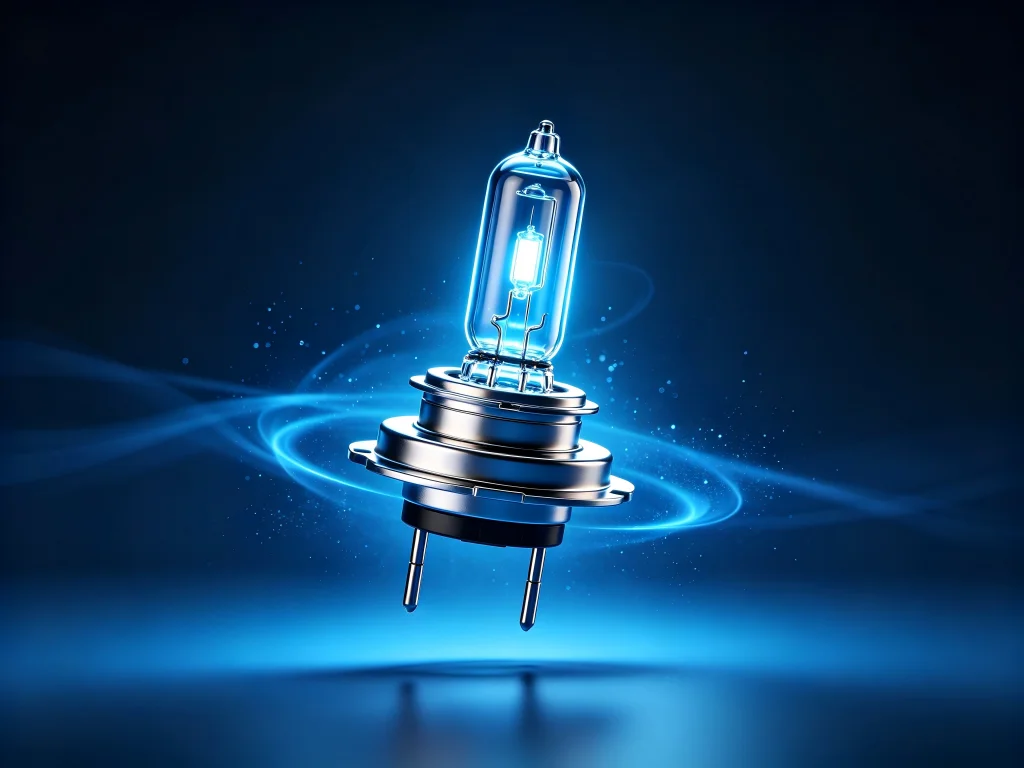
1. What Should You Look for When Buying H7 LED Bulbs?
The best H7 LED bulbs should combine accurate light-source geometry, controlled beam distribution, stable thermal performance, suitable electrical compatibility, compact installation dimensions, and consistent manufacturing. Do not select a bulb by claimed lumens alone. Headlamp compatibility and usable beam performance should carry more weight than maximum advertised brightness.
If you remember only one rule from this guide, make it this:
Buy the beam, not the lumen number.
2. H7 Halogen vs H7 LED: What Actually Changes?
The H7 is a single-beam bulb format commonly used for low or high beam applications. A conventional H7 halogen bulb commonly uses a 12V, 55W configuration; Halfords describes typical H7 halogens at roughly 1,200–1,500 lumens with a PX26-style base.
An LED replacement changes the light source completely.
| 決定要因 | H7 Halogen | Well-Designed H7 LED | Low-Cost Generic LED Risk |
|---|---|---|---|
| 光の色 | Warm/yellow-white | Clean white | May be excessively blue |
| Power demand | Relatively high | Potentially lower | Electrical claims may be inaccurate |
| Optical source | Precise filament | Compact LED emitter | Oversized emitting area |
| 熱管理 | Heat primarily from filament | Heat sink/fan system | Weak thermal path |
| Electronics | シンプル | Electronic LED driver | Unstable driver |
| CANbus behavior | OEM electrical load | Can be engineered for compatibility | Errors or flicker possible |
| インストール | OEM fit | Can approach OEM dimensions | Large fan/driver may interfere |
3. Buying Factor #1: LED Chip Position Beats Chip Brand
LED chip position is one of the most important H7 buying criteria because the headlamp optics were designed around a specific light-source location. If the LED emitting surfaces are too large or incorrectly positioned, more lumens may create more glare instead of better distance visibility.
Many listings emphasize the chip manufacturer.
That can matter, but it is not enough.
A premium LED chip installed in poor optical geometry can still produce a poor beam.
3.1. Look at the Light-Emitting Surface
The original halogen filament is compact.
A replacement LED should therefore attempt to place its emitting surfaces close to the optical location expected by the headlamp.
When evaluating samples, compare:
- LED board thickness
- chip-to-chip distance
- vertical chip position
- distance from mounting flange to emitter
- orientation after locking the bulb into place
These measurements often tell a professional buyer more than the lumen figure printed on the carton.
4. Buying Factor #2: Projector vs Reflector Compatibility
H7 LED bulbs for projector headlights deserve separate evaluation from reflector applications.
4.1. プロジェクターヘッドライト
A projector uses a reflector bowl, cutoff shield, and lens to form the beam.
Small changes at the focal point can create large changes on the road.
A bulb that performs well in one projector may perform poorly in another.
4.2. リフレクターヘッドライト
A reflector distributes light directly through its reflective surfaces and lens structure.
Here too, LED source geometry strongly affects the final beam.
For B2B buyers, this means one universal “H7 fits all” claim should be treated cautiously.
5. Buying Factor #3: Lumens vs Lux
Lumens measure total luminous flux.
Lux measures illuminance on a surface.
Customers care about what they can see on the road, so beam distribution and measured illumination at relevant points can provide more useful information than raw bulb lumens alone.
5.1. The Marketplace Trap
Consider two hypothetical products:
| 仕様 | Bulb A | Bulb B |
|---|---|---|
| Advertised output | 40,000 lm | Lower stated output |
| エミッタの形状 | Large | Compact |
| ビームの集束 | Scattered | Controlled |
| Hotspot | Weak | 強い |
| グレア制御 | 不良 | Better |
| Thermal stability | Unknown | Tested |
Which would you rather sell?
For a professional lighting brand, Bulb B may be the stronger product even though its marketing number is smaller.
6. Buying Factor #4: 4300K vs 5000K vs 6000K vs 6500K
Color temperature changes the appearance of the beam, but it should not be confused with brightness.
| Color temperature | Appearance | Typical Buyer Preference |
|---|---|---|
| 4300K | Warm-neutral white | OEM-style users |
| 5000K | Neutral white | Visibility-focused upgrades |
| 5500K–6000K | Crisp white | Popular aftermarket appearance |
| 6500K or higher | Cooler white | Style-oriented buyers |
Very cool color temperatures may look striking in product photos, but professional buyers should consider road conditions and customer preferences rather than assuming “bluer means brighter.”
7. Buying Factor #5: Fan Cooling vs Passive Cooling
7.1. Active Fan Cooling
A fan can move more air across a compact heat sink. This may allow a smaller overall bulb while supporting higher power.
However, the fan becomes another component that must survive dust, heat, vibration, and long operating cycles.
7.2. Passive Cooling
Fanless systems remove the mechanical fan but may require larger heat sinks or flexible thermal structures.
That can create packaging challenges.
| Cooling Type | Advantages | Trade-Offs |
|---|---|---|
| Fan cooling | Compact, strong heat dissipation potential | The quality of the fan becomes important |
| Passive heat sink | No moving fan | May require more space |
| Flexible heat dissipation | Adaptable installation | Installation consistency matters |
8. Buying Factor #6: CANbus Compatibility
検索中 H7 LED bulbs CANbus error free is common among owners of European vehicles.
But “error free” is often oversimplified.
A vehicle may check bulb status using electrical load detection or other monitoring strategies. Since LEDs can draw less power than halogen bulbs, the car may interpret the new load as a failed lamp. Philips notes that CANbus adapters can help address false bulb warnings in some LED applications.
8.1. Questions B2B Buyers Should Ask
- Which vehicles were tested?
- Was testing performed with the engine running?
- Were cold and warm bulb checks tested?
- Was flicker tested?
- Does the system need an external resistor?
- How hot does the decoder become?
- Is PWM compatibility verified?
A supplier that simply prints “CANbus 100% error free” without application data may be giving you marketing rather than engineering evidence.
9. Buying Factor #7: Size and Adapter Compatibility
This is one of the most underestimated purchasing criteria.
A standard H7 base does not guarantee a simple installation in every car.
Vehicle manufacturers may use proprietary retainers, mounting collars, wiring arrangements, or tight dust covers. Philips compatibility documentation itself lists model-specific adapter rings and CANbus accessories for some H7 LED applications.
Before placing a wholesale order, measure:
- total bulb length
- rear heat-sink diameter
- distance behind mounting flange
- driver-box dimensions
- connector size
- adapter requirements
10. Buying Factor #8: Road Legality and Market-Specific Compliance
Never treat “road legal” as a global product specification.
Approval can depend on the country, vehicle, headlamp, bulb, and installation configuration.
10.1. What About H7 LED Bulbs Road Legal UK?
For Great Britain, the current MOT inspection guidance states that existing halogen headlamp units on vehicles first used on or after 1 April 1986 must not be converted to use HID or LED bulbs. A mismatch between the lamp and light source is a major defect.
The manual distinguishes these conversions from complete replacement headlamp units manufactured for LED or HID light sources.
Check the current GOV.UK MOT inspection requirements before making road-use claims.
11. Philips vs Marketplace H7 LEDs vs Specialist Manufacturers
Buyers searching for H7 LED bulbs Philips, H7 LED bulbs Amazon, or H7 LED bulbs Halfords may actually represent three different purchasing intents.
11.1. Philips-Type Premium Retail Products
Established global brands offer strong brand recognition, structured compatibility information, and mature retail distribution.
The trade-off for B2B customers may be reduced freedom in private labeling, product customization, packaging, market positioning, or channel strategy.
11.2. Marketplace Products
Large marketplaces offer enormous choice and fast price comparison.
However, products from different sellers can vary significantly in specifications, manufacturing control, warranty support, and long-term availability.
11.3. Specialist Automotive Lighting Manufacturers
For wholesalers and regional brands, working directly with a specialist manufacturer can offer another route.
The key advantage is not simply price.
It is control.
Depending on the supplier, professional buyers may be able to develop product specifications, packaging, branding, application coverage, and channel positioning around their own market.
12. A Better H7 LED Supplier Scorecard
| Criterion | Weight | What to Verify |
|---|---|---|
| Beam performance | 25% | Cutoff, hotspot, distribution |
| Thermal stability | 20% | Output after extended operation |
| Vehicle compatibility | 15% | Adapters, housing space, CANbus |
| Electrical design | 15% | Driver stability, PWM, protection |
| Production consistency | 10% | Batch-to-batch quality |
| Customization | 10% | OEM/ODM, packaging, branding |
| Marketing claims | 5% | Evidence behind specifications |
Notice what receives only 5%?
Marketing claims.
That is intentional.
13. How We Would Test an H7 LED Sample Before a Bulk Order
For a distributor, importing a container based on a specification sheet is unnecessary risk.
A more professional sample-validation process could look like this:
- Measure physical dimensions. Confirm the sample matches drawings and fits target applications.
- Inspect LED source geometry. Compare chip placement against the optical target.
- Run beam tests. Evaluate cutoff, hotspot, spread, and glare.
- Run thermal tests. Measure performance after the system reaches thermal equilibrium.
- Test voltage behavior. Check operation across the intended vehicle voltage range.
- Evaluate CANbus applications. Test target vehicles rather than trusting a universal claim.
- Perform repeated cycling. Check startup consistency and driver behavior.
- Compare multiple production samples. One perfect engineering sample does not prove mass-production consistency.
14. プロのバイヤーがGTRと取引する理由
GTR approaches automotive lighting from the needs of the aftermarket channel.
That means looking beyond a single bulb specification.
Wholesalers and retrofit businesses need products that can be installed consistently, explained clearly to customers, supported after sale, and positioned competitively in their local markets.
Based on our manufacturing experience, we focus product evaluation on optical performance, thermal behavior, driver electronics, installation structure, and application requirements rather than relying on exaggerated brightness claims.
For B2B partners, direct manufacturer cooperation may also support:
- OEM and ODM development
- private-label programs
- custom packaging
- product specification development
- regional product planning
- aftermarket lighting solutions
- wholesale and distribution support
15. H7 LED Bulbs FAQ
15.1. What is the best H7 LED bulb?
The best option is the one that matches the target headlamp and vehicle while delivering a controlled beam, stable thermal performance, suitable electrical compatibility, and reliable fitment. There is no universal H7 LED that is automatically best for every vehicle.
15.2. Are expensive H7 LED bulbs always better?
No. Price can reflect better engineering, components, distribution, warranty, or branding, but buyers should still verify beam pattern, thermal stability, fitment, and electrical performance.
15.3. Do H7 LED bulbs need CANbus?
Not every vehicle does. Some vehicles may require additional electronics to prevent warning lights or flicker. Compatibility should be checked by vehicle application.
15.4. Which H7 LED bulbs work best in projector headlights?
Projector applications tend to benefit from accurate emitter positioning, compact chip geometry, stable orientation, and proven hotspot and cutoff performance in the specific projector.
15.5. Can I buy H7 LED bulbs nearby?
Yes. Searches for H7 LED bulbs nearby あるいは H7 LED bulbs near me can locate local automotive retailers and installers. Buyers should still confirm fitment and road-use requirements.
15.6. Does Halfords sell H7 bulbs?
Yes. Halfords offers H7 replacement bulbs and vehicle-based bulb selection services in the UK. Its H7 range includes conventional replacement options and fitting guidance.
15.7. Should I buy H7 LED bulbs from Amazon?
Marketplace shopping can provide wide selection and competitive pricing, but evaluate the manufacturer, specifications, warranty, beam evidence, customer feedback, and vehicle compatibility rather than choosing by reviews or lumen claims alone.
15.8. Are Philips H7 LED bulbs road legal?
Approval is market- and application-specific. Philips publishes compatibility lists showing approved vehicle/headlamp combinations and required accessories for certain products and markets. That does not mean every Philips H7 LED is approved for every vehicle or country.
16. The Cheapest H7 LED Can Become Your Most Expensive Product
For an individual driver, a poor bulb means buying another pair.
For a distributor, the consequences multiply.
One weak product can generate hundreds of installation questions, returns, warranty claims, poor reviews, and complaints from dealers.
That changes the buying equation.
You are not really buying an LED bulb.
You are buying optical performance, installation consistency, electrical stability, manufacturing repeatability, and your customer’s experience with your brand.
If you are building an H7 LED product line for wholesalers, automotive lighting stores, retrofit chains, or regional distributors, do not start with the question “Who has the lowest price?” Start with the target vehicles and the beam performance your market expects. Visit www.rhgtr.com and discuss your H7 application requirements with GTR before committing to your next bulk lighting program.。