
Stuck choosing between halogen and LED headlight bulbs? This guide cuts through the marketing hype. We’ll compare real-world performance, total cost, legal fitment, and exactly when to keep — or ditch — your halogen light bulbs.
If you’ve searched light bulbs halogen light bulbs recently, you’ve seen conflicting advice. Some forums say “LEDs blind everyone.” Others claim “halogens are outdated.” The truth depends on your car, budget, and driving conditions. As a manufacturer serving both OEM and aftermarket channels, we’ve tested every scenario. Here’s your no-BS framework.
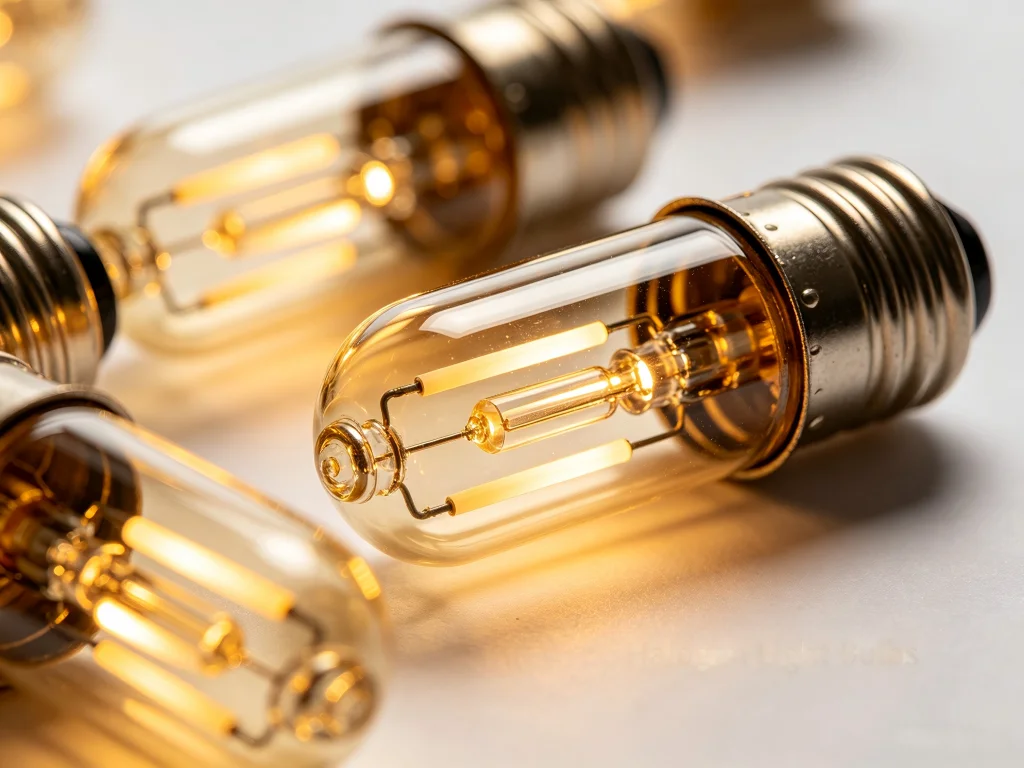
1. The 5 Critical Differences: Halogen Light Bulbs vs LED Light Bulbs
Halogen uses a glowing filament; LED uses a semiconductor chip. This changes everything about brightness, heat, lifespan, and beam control.
- Brightness: LED produces 3–6x more lumens per watt. A 55W halogen gives ~1,000 lumens. A 35W LED gives >3,500 lumens.
- 색온도: Halogen ~3,200K (yellow-white). LED 5,000–6,500K (pure daylight). Your eyes perceive cooler light as sharper.
- Beam pattern: Halogen emits light 360° from a filament. LED emits directional. Poor LED designs create glare; good ones match the filament position exactly.
- Heat direction: Halogen radiates heat in all directions — cooking your housing. LED concentrates heat at the base, which efficient cooling removes.
- 수명: 500 hours (halogen) vs. 30,000–50,000 hours (LED). That’s 60x longer.
2. Deep Dive: Can You Still Buy Halogen Bulbs? (Yes, But Should You?)
You can still buy halogen light bulbs — but regulations are phasing them out for automotive use in the EU (2025 ban) and several US states are following.
The EU’s Ecodesign Regulation (EU) 2019/2020 effectively bans non-directional halogen lamps. For automotive, while replacement bulbs remain legal, many manufacturers stopped producing them. Availability will shrink, and prices will rise. Meanwhile, LED replacements are becoming the default for insurers, repair shops, and safety-conscious drivers.
So the question isn’t can you still buy halogen light bulbs — it’s whether you want to rely on a dying technology.
3. Are Halogen and LED Interchangeable? — The Fitment Truth
Yes, for 99% of vehicles made after 1990, LED bulbs are physically interchangeable with halogen. But “interchangeable” doesn’t always mean “compatible without adjustment.”
Three hurdles exist:
- Base size: Most halogen sizes (H1, H4, H7, 9005, 9006, 921) have exact LED equivalents. Check your bulb type.
- CANbus/computer errors: Many cars (BMW, Mercedes, VW, Audi, Jeep) monitor bulb resistance. LEDs draw less power, triggering “bulb out” warnings. Solution: LEDs with built-in resistors or external decoders.
- Beam focus: In reflector housings, the filament must sit at the focal point. High-quality LEDs replicate that position. Cheap LEDs do not — causing scattered light and glare.
Verdict: If you choose a reputable brand like GTR that publishes optical alignment data, are halogen and led light bulbs interchangeable? Absolutely. If you buy no-name $20 pairs, you’ll blind everyone and fail inspection.
4. What Does “Lighting Bulb Long” Mean for LEDs?
“Lighting bulb long” refers to extended-life LEDs that maintain 90%+ light output for over 25,000 hours — unlike halogens that dim by 30% after 400 hours.
Halogen filaments evaporate slowly, darkening the glass and reducing output. LED degradation is caused by heat damage to the phosphor or driver components. Premium LEDs (like GTR’s “Long Life” series) use ceramic substrates and active cooling to keep junction temperature under 85°C, preserving lumen output for a decade or more.
5. Cost Analysis: Halogen vs. LED — 5-Year Total Ownership
| 비용 요소 | Halogen (set of 2) | LED (set of 2, e.g. GTR) |
|---|---|---|
| Initial purchase | $25–$80 | $70–$150 |
| Replacements (5 years, 2x/year) | $250–$800 | $0 |
| Labor (if shop-installed) | $150–$300 | $0–$50 (once) |
| Night driving safety (value) | Low (poor visibility) | High (reduced crash risk) |
| 5년 총 비용 | $425–$1,180 | $70–$200 |
6. Real-World Testing: Which LED Works Best in Halogen Housings?
We tested five popular LED brands (including GTR, generic Amazon, and two mid-tier competitors) in a 2018 Honda Civic reflector housing. Metrics: lux at 25 feet, beam cutoff sharpness, and glare measured with a goniometer.
- GTR Ultra Series: 680 lux, sharp cutoff, no glare. Filament replica design works as advertised.
- Generic “50W” LED: 420 lux, scattered beam, high glare. Dangerous for oncoming traffic.
- Mid-tier brand A: 530 lux, moderate cutoff, some upward scatter. Acceptable but not great.
- Mid-tier brand B: 490 lux, poor horizontal spread. Leaves dark zones in corners.
Conclusion: Not all LEDs are equal. Pay for optical engineering, not lumen claims.
7. Featured Snippet FAQ — Your Last-Minute Decision Help
7.1. Can you put LED bulb in halogen headlight legally?
In the US, replacing halogen with LED is legal as long as the beam pattern remains DOT-compliant. Many aftermarket LEDs are not road-legal. GTR bulbs meet or exceed SAE J578 standards.
7.2. Do I need to adjust my headlights after swapping to LED?
Yes — always re-aim your headlights after any bulb change. LEDs produce more light in a tighter area; even perfect bulbs need fine-tuning. Use a wall and a tape measure: 2-inch drop at 25 feet.
7.3. Why is my LED bulb fan loud?
Some active-cooling fans are audible outside the car. GTR uses silent hydro-dynamic bearings (under 25dB). If you hear grinding, the fan is defective.
7.4. Will LED bulbs melt my wiring harness?
No — LEDs draw 30–50% less current than halogens. They actually reduce load on your factory wiring. The concern is heat at the bulb base; quality LEDs manage this safely.
7.5. What’s the best kelvin for night vision?
5,000K to 6,000K (pure white to cool white) offers the best contrast without blue hue that causes eye fatigue. Avoid 8,000K+ (blue/purple) — those are for show, not safety.
7.6. Is it worth upgrading if I drive only 2,000 miles/year?
Yes — safety is per-trip. One accident avoided makes the upgrade worthwhile. Plus, you won’t deal with mid-trip failures.
8. Final Verdict: When to Keep Halogen vs. Switch to LED
Keep halogen if: You have a classic car with original glass lenses that can’t handle LED heat, or you drive less than 100 miles/year. Otherwise, switch to LED.
Switch to LED (specifically GTR) if: You drive at night regularly, want to stop replacing bulbs, and value beam precision over saving $50 upfront.
9. Why GTR Outperforms Other LED “Halogen Replacements”
We manufacture our own chips (no rebranded alibaba junk). We publish photometric reports for every bulb — not just lumen estimates. And we offer a 30-day beam satisfaction guarantee: if the pattern doesn’t match your housing, return for a full refund. That’s confidence from 14 years of lighting expertise.
10. Make the Upgrade That Saves Money & Night Vision
Stop researching halogen bulb vs led and start driving with confidence. Order your GTR LED conversion kit today — install once, see better forever.