
If you‘re still installing LED bulbs in reflector housings for customers, you’re delivering half the performance and creating dangerous glare. A true 3.0 inch bi led projector lens solves what plug-and-play bulbs never can: precise beam control without blinding oncoming traffic.
Here‘s what every installer and shop owner needs to know before recommending another LED bulb “upgrade.”
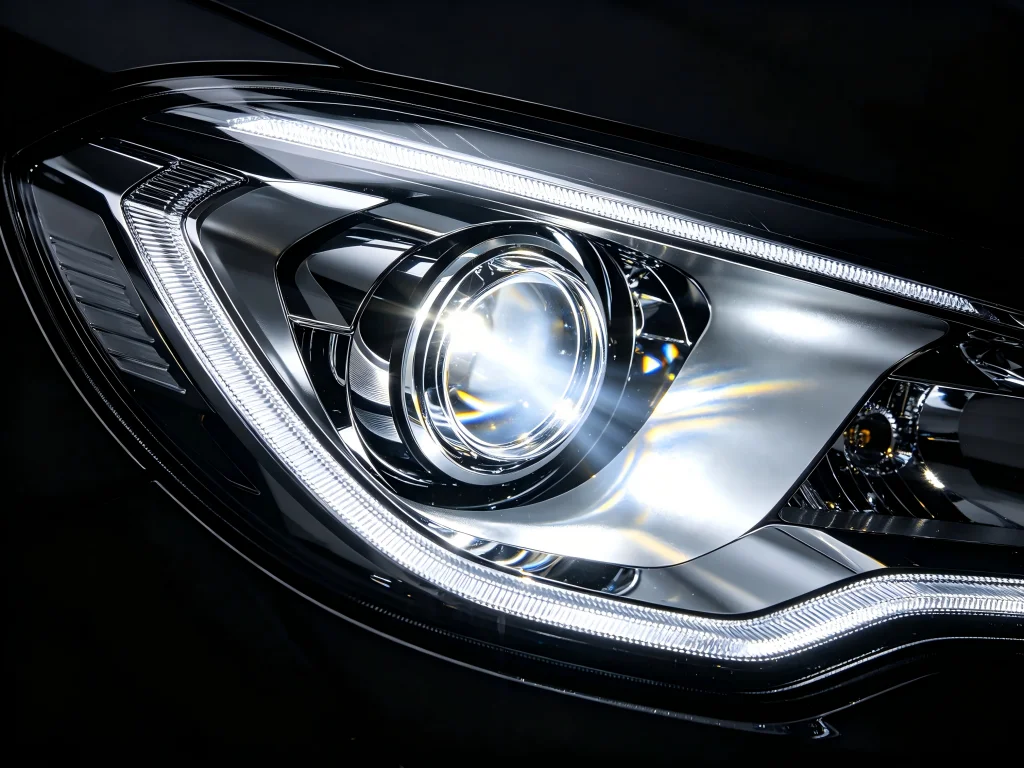
1. Problem: The LED Bulb Glare Epidemic
LED bulbs in reflector housings create dangerous glare 80% of the time. The reason is simple physics. Reflector bowls were engineered for halogen filaments that emit light in nearly 360 degrees from a tiny, precise focal point. The bowl captures and redirects that omnidirectional light.
LED bulbs use flat chips mounted on circuit boards. No matter how well they’re designed, they can‘t perfectly mimic a filament’s spherical light source. The reflector cannot reshape LED output the way a projector lens can. The result: scattered light escapes above the intended beam boundary—into trees, road signs, and the eyes of oncoming drivers.
Your customers might see bright foreground illumination and think the upgrade worked. But distance visibility suffers, and the glare they‘re creating puts everyone at risk.
2. Agitation: What Glare Really Means for Your Business
That glare isn’t just annoying. It‘s a growing regulatory and liability concern. Authorities worldwide are tightening enforcement on aftermarket lighting. In the United States, FMVSS 108 sets specific limits on candela output. European ECE regulations are even more stringent.
For your shop, recommending LED bulb “upgrades” that create glare carries real exposure:
- Customer complaints about being flashed by other drivers
- Failed vehicle inspections that come back to you
- Potential liability if a customer’s lights cause an accident
- Wasted labor when customers return demanding a real fix
Stop selling a compromise. Start installing the solution.
3. Solution: Why the 3.0 Inch Bi LED Projector Lens Fixes Everything
A Bi-LED projector lens is an integrated optical system—not a bulb replacement. The LED emitter, reflector cup, physical shield, and projection lens are factory-aligned with microscopic accuracy. The entire unit is engineered as a single optical system, eliminating the geometry mismatch that causes glare in bulb swaps.
3.1. The Internal Shield That Changes Everything
Inside every quality Bi-LED projector sits a precision metal cutoff shield positioned between the LED light source and the projection lens. This shield physically blocks the upper portion of the light beam before it ever exits the housing. Only the lower half of the beam passes through the lens and onto the road surface.
The result is a razor-sharp cut-off line—a crisp boundary between light and darkness. This cut-off line prevents light from entering the eyes of oncoming drivers while concentrating illumination exactly where drivers need it: on the road ahead.
3.2. How the Dual-Beam Mechanism Works
The “Bi” in Bi-LED stands for bi-functional—both high and low beams from the same unit. Here‘s how it works:
- Low-beam mode: The solenoid valve controls the internal baffle to block part of the light, forming a clear cut-off line that avoids irradiating oncoming vehicles.
- High-beam mode: An electromagnetic solenoid pulls the shield downward, exposing the full output of the LED emitter for maximum forward projection.
- The transition happens instantly within the same optical system—no compromise in low-beam alignment, no secondary bulb required.
This design maintains glare protection in low beam while delivering powerful distance illumination in high beam.
4. What to Look For in a Quality Bi-LED Projector
4.1. Cutoff Line Clarity
The low-beam cutoff line must be sharp and perfectly horizontal with a slight upward kick on the passenger side. This pattern is legally required for LHD vehicles. Poor-quality projectors produce fuzzy cutoff lines or inconsistent patterns—test every unit before shipping.
4.2. Chip Configuration and Power Management
Quality manufacturers use multi-chip configurations. Mid-range units typically run 40-50W low beam / 60-70W high beam with 6 low-beam chips and additional high-beam chips. Premium hyperboloid designs incorporate double-lens optics for superior efficiency and long-range throw.
Always verify the wattage split between low and high beam. Some budget units run the same power regardless of mode, which defeats the purpose of controlled low-beam illumination.
4.3. Cooling System Quality
LED performance degrades with heat. Quality projectors use either full aluminum alloy bodies with large surface area (passive cooling) or integrated fans with 10,000+ RPM ratings (active cooling). For 100W+ pairs, active cooling is essential.
Key specs to verify:
- Operating temperature range (quality units: -40°C to +110°C)
- Fan RPM and noise rating
- Heatsink material and surface area
4.4. Build Materials
Examine material quality thoroughly. Quality projectors use:
- Metal mounting brackets—not plastic
- Glass projection lenses—not polycarbonate that yellows over time
- UV-resistant housing materials
- Precision threaded shafts for universal mounting
4.5. Real-World Performance Testing
From forum feedback on similar 3-inch units, experienced users consistently highlight beam pattern quality as the deciding factor. One owner noted “the light output is very superior as advertised” with a sharp cutoff line that “works perfectly without a blind zone and dark spots.” Another confirmed 500-meter high-beam illumination capability—far beyond what any LED bulb in a reflector can achieve.
These real-world results align with our own engineering tests. A properly engineered projector with moderate lumens always outperforms a poorly designed unit with high raw lumen claims by delivering higher lux values precisely where needed.
5. Installation Reality Check
Installing Bi-LED projectors requires professional work. The process involves opening the headlight housing, removing the original reflector or projector assembly, mounting the Bi-LED unit, and resealing the housing.
This is not a job for weekend DIYers. As one user noted, professional installation is “strongly recommended to ensure optimal lighting performance and safety.” For your shop, this means higher-value service tickets and customers who trust your expertise.
6. Regulatory Compliance
Before stocking or installing any Bi-LED projector for on-road use, verify compliance with your local regulations. Different markets enforce different standards:
- United States: FMVSS 108 regulates beam pattern and intensity. Products must be properly aimed after installation.
- European Union: ECE regulations are stricter—many high-intensity lighting systems require auto-leveling or lens cleaning systems to be road-legal.
- Australia and other markets: Local ADR standards apply.
Work with suppliers that understand these requirements and can provide documentation for the markets you serve.
7. Perguntas mais frequentes
Q: Can I just put an LED bulb in a projector housing instead of replacing the whole unit?
No. Projector optics are engineered for specific bulb geometries. An LED bulb‘s different light source shape means the projector cannot focus light properly. You’ll get poor beam quality and reduced output. Replace the entire unit with a proper Bi-LED projector.
Q: How much brighter is a Bi-LED projector than halogen?
Quality Bi-LED projectors deliver 200-300% more effective road illumination than standard halogen systems, with instant full brightness and wider beam coverage.
Q: Are these projectors compatible with CANbus systems?
Most modern Bi-LED projectors include built-in drivers that prevent error codes on CANbus-equipped vehicles. Verify with your supplier before ordering for specific models.
Q: How long does installation take for a typical vehicle?
Professional installation averages 3-5 hours per vehicle, depending on headlight design complexity and whether the housing uses permanent or butyl sealant.
Q: What‘s the most common installation mistake?
Improper beam aiming after installation. Always re-aim projectors against a wall at 25 feet before delivering the vehicle. Even perfect optics perform poorly when aimed incorrectly.
Q: Do Bi-LED projectors work in fog lights?
Yes, 3.0-inch units function effectively as fog lights. Some models offer dual-color options—white low beam with lemon yellow high beam for superior fog penetration.
Q: What happens if the cooling fan fails?
High-quality units (rated -40°C to +110°C) include thermal protection that reduces output before failure occurs. Budget units may overheat and permanently damage the LED chips. This is why cooling system quality matters.
8. Make the Switch to Proper Lighting Solutions
Stop selling glare-producing LED bulbs as “upgrades.” Start installing true Bi-LED projector systems that deliver the performance your customers actually need: controlled low beams that don‘t blind oncoming traffic and powerful high beams that illuminate the road 500 meters ahead.
For professional-grade 3.0 inch bi LED projector lenses engineered with precision optics, robust cooling, and regulatory compliance in mind, visit https://www.rhgtr.com to explore GTR Lighting‘s catalog. Contact the sales team to discuss wholesale pricing, sample orders, and technical specifications for your market.