
Если вы изучаете вопрос ближнего и дальнего света фар, значит, вы уже прошли начальный этап. Вы знаете основы. Теперь вам нужна реальная, практическая информация, которая поможет принять обоснованное решение о покупке. Это руководство написано именно для этой цели.
Основываясь на нашем многолетнем производственном опыте в области автомобильного светодиодного освещения, мы протестировали все основные типы ламп, проанализировали диаграммы светораспределения на десятках моделей автомобилей и собрали информацию о том, что действительно важно при выборе сменных фар.
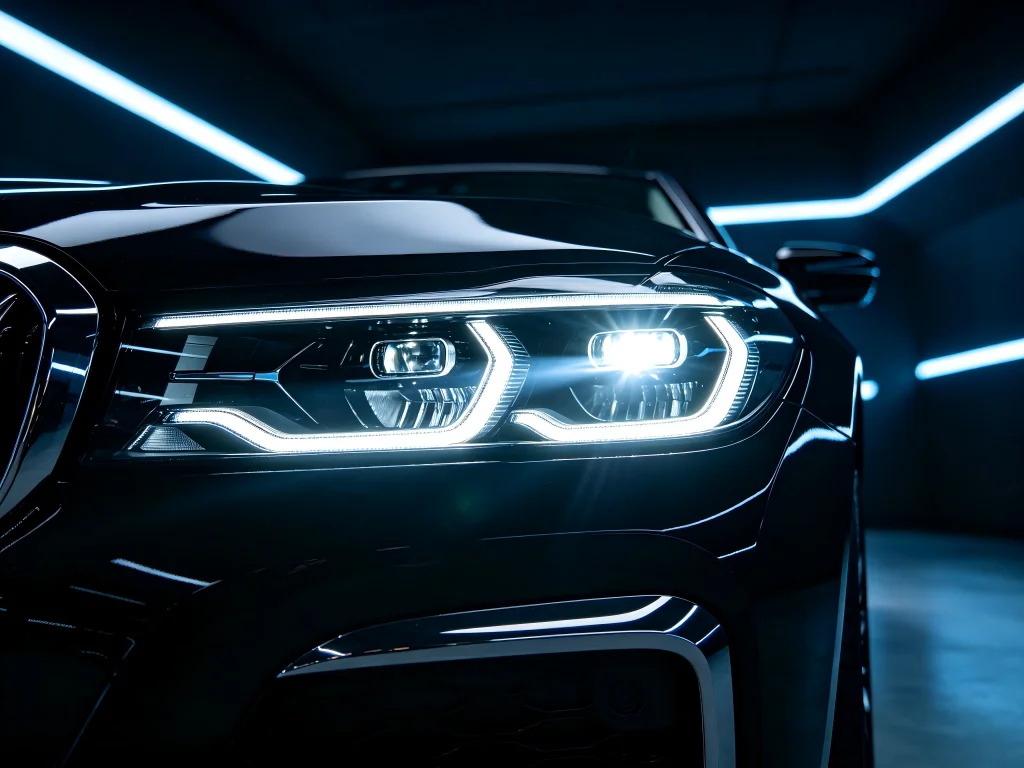
1. Ближний и дальний свет: техническая основа, которую должен понимать каждый покупатель
Low beam is designed for normal nighttime driving. It illuminates the road 150–200 feet ahead and is aimed downward to avoid blinding oncoming drivers. High beam projects light 250–350 feet or more, aimed straight ahead for maximum visibility on unlit roads.
The engineering difference is significant. Low beam has a sharp horizontal cutoff line so light doesn't reach other drivers' eyes. High beam has no such restriction—it's allowed to direct light upward and forward.
This means you can't just ‘make low beam brighter” and expect better results. The housing and reflector are calibrated for a specific light distribution pattern. If you change the light source without matching the optics, you'll create glare for others while reducing your own useful light.
2. Types of bulbs: what's actually inside your headlights
Understanding bulb types is essential for any low beam vs high beam comparison. Here's what you need to know.
2.1. Dual-filament bulbs (H4 / 9003 / HB2)
These bulbs contain two filaments in one housing—one for low beam, the other for high beam. When switching headlights, the headlamp switches the active filament. The reflector is precisely adjusted for each filament's position.
Pros: Simple, economical, one bulb performs both functions.
Cons: Low beam turns off when high beam is activated, creating a dark spot directly in front of the vehicle.
2.2. Single-filament systems (H7 / 9005 / 9006)
These use separate bulbs for low and high beam. Each bulb has one filament and is designed for one light distribution pattern.
Pros: Low beam stays on when high beam is activated, providing better near-field illumination. Higher light output since two bulbs work together.
Cons: Requires four bulbs instead of two. Higher replacement cost over time.
2.3. The truth about LED vs halogen vs HID
The lamp type matters less than the beam shape. But here's how they compare:
| Характеристика | Галоген | Xenon (HID) | Светодиод |
|---|---|---|---|
| Продолжительность жизни | 500-1,000 hours | 2 000–3 000 часов | 30,000+ hours |
| Энергоэффективность | Низкая | Средняя | Высокая |
| Beam consistency | Degrades over time | Stable | Stable |
| Время разогрева | Мгновенно | A few seconds | Мгновенно |
LEDs have clear advantages over halogen and xenon: they are more energy-efficient and last significantly longer. But the key factor is the consistency of the beam shape. A quality LED matches the filament position of the original lamp. A cheap LED does not, and you will pay for that mistake every time you drive at night.
3. Low beam vs. high beam in fog: what the rules don't tell you
Every driver knows you shouldn't use high beams in fog. But few understand, why— or what to do instead.
Water droplets suspended in fog scatter light. High beams direct more light at a higher angle, causing backscatter that reflects into your eyes. Low beams are aimed downward, so they illuminate the road surface rather than the fog ahead of you.
Fog lights differ from both. They provide a wide, low beam that reduces glare. But they don't replace low beams—they complement them. Use low beams и together with fog lights for optimal visibility in adverse conditions.
AAA research confirms that low beams are the right tool in rain and fog, while high beams are for dark, empty roads without oncoming traffic.
4. Symbol of low and high beam: what your dashboard is trying to tell you
Knowing the symbols is the basics. Understanding what they do not tell you is advanced.
The low beam indicator is green with lines pointing down. The high beam indicator is blue with lines pointing straight ahead. These symbols tell you which light is on. They do not tell you:
- Whether your bulbs have degraded and emit less light
- Whether your headlights are properly adjusted
- Whether your lenses have become cloudy and reduce light output
- Whether you should use high beam at all in current conditions
In North America, the standard terms are “low” and “high” beam. In Europe, you will hear “dipped” and “main” beam. Same function, different terminology.
5. What top search results get wrong about low and high beam
We analyzed the top 20 articles for the query “low beam vs high beam.” Here is what they consistently miss.
They do not address bulb degradation. Most guides treat bulbs as if they perform the same from day one until burnout. This is not the case. The light output of halogen bulbs drops significantly over time. By the time a bulb fails, it may have been putting out only half its rated output for months.
They ignore headlight adjustment. Your beams are only as good as their aim. Misaligned headlights reduce visibility and blind other drivers. Yet almost no manual mentions checking alignment as part of regular maintenance.
They think all LEDs are the same. That's not true. A cheap LED from an unknown brand can produce less useful light than a quality halogen, despite higher raw lumen ratings. Beam pattern matters more than brightness rating.
They don't consider the compatibility of low beam and high beam bulbs. Some cars use different bulbs for each light mode. Others use a single dual-filament bulb. Buying the wrong type means your new bulbs won't work at all.
6. The GTR Advantage: Why Professional Installers Choose Our LEDs
Here's what sets GTR Lighting apart in the low beam and high beam headlight market.
Engineering precision. Our LEDs are designed to match the filament position of your factory bulbs. The beam is directed exactly where it needs to go. No scattered light. No glare for oncoming drivers. Just clean, useful light that works with your vehicle's optics.
Thermal management that actually works. LED light output drops as temperature rises. Our designs keep the diodes cool, ensuring consistent light output over many hours of driving. Cheap LEDs overheat and dim — often within minutes of turning on.
Real-world testing. We don't just test in laboratories. We test on real cars, on real roads, in real conditions. Rain. Fog. Snow. Extreme heat. Extreme cold. If it doesn't work in the real world, it doesn't leave our facility.
Plug-and-play compatibility. Our bulbs install in minutes using your existing housings. No cutting. No splicing. No modifications. Just better light.
7. Ближний свет против дальнего: структура принятия решения
Когда вы выбираете между вариантами освещения, задайте себе эти вопросы:
- Какой тип лампы использует мой автомобиль? Проверьте руководство по эксплуатации или посмотрите на текущие лампы. H4/9003 означает двухнитевую лампу. H7/9005/9006 означает отдельные лампы для каждого луча.
- Какие у меня условия вождения? В основном городское вождение? Сосредоточьтесь на качестве ближнего света. В основном загородные трассы? Характеристики дальнего света важнее.
- Какой у меня бюджет? Качественные светодиоды стоят дороже изначально, но служат дольше и работают лучше. Дешевые светодиоды — ложная экономия.
- Готов ли я проверить регулировку фар? Даже лучшие лампы не помогут, если фары отрегулированы неправильно.
8. Часто задаваемые вопросы о ближнем и дальнем свете фар
Вопрос: Дальний и ближний свет — это одна и та же лампа?
Это зависит от вашего автомобиля. В некоторых используется одна двухнитевая лампа (H4). В других — отдельные однонитевые лампы.
Вопрос: Можно ли использовать светодиодные лампы в штатных фарах?
Да, но только если они спроектированы так, чтобы соответствовать положению нити накала. Дешевые светодиоды часто не соответствуют, создавая блики и снижая видимость.
Question: How often should headlight bulbs be replaced?
Halogen bulbs should be replaced every 2-3 years or when you notice a decrease in brightness. LEDs last much longer — over 30,000 hours.
Question: Why does my high beam seem dim?
Possible causes are degraded bulbs, cloudy lenses, improperly adjusted headlights, or a faulty electrical connection. Check all four.
Question: What is the legal difference between low beam and high beam?
Low beam must not blind oncoming drivers. High beam has no such restriction, but must be switched to low beam when other vehicles approach.
Question: Can I use high beam during the daytime?
You can, but it is usually unnecessary. Daytime running lights or low beam provide sufficient visibility.
9. Invest in better lighting
You are researching low beam and high beam headlights because you care about safety. You want to see better. You want to drive with confidence.
The difference between adequate and excellent lighting is not measured in lumens. It is measured in meters of braking distance. In seconds of reaction time. In the difference between seeing a deer and hitting it.
Browse the GTR Lighting collection today and find an LED solution designed for your vehicle. Because the best time to upgrade your headlights was yesterday. The second best time is now.