
選擇正確的H11頭燈燈泡,意味著要了解鹵素燈、基本LED和高端LED選項之間的真正差異。本指南將穿透行銷炒作,向您展示對於您的特定車輛和駕駛條件而言,真正重要的是什麼。.
基於我們多年的製造專業知識和廣泛的實驗室測試,我們創建了目前最全面的H11頭燈燈泡比較。您將了解為什麼有些燈泡在數週內就失效,而其他燈泡則能使用數年,如何在購買前識別危險的光束圖案,以及哪些功能確實能提供更好的夜間能見度。.
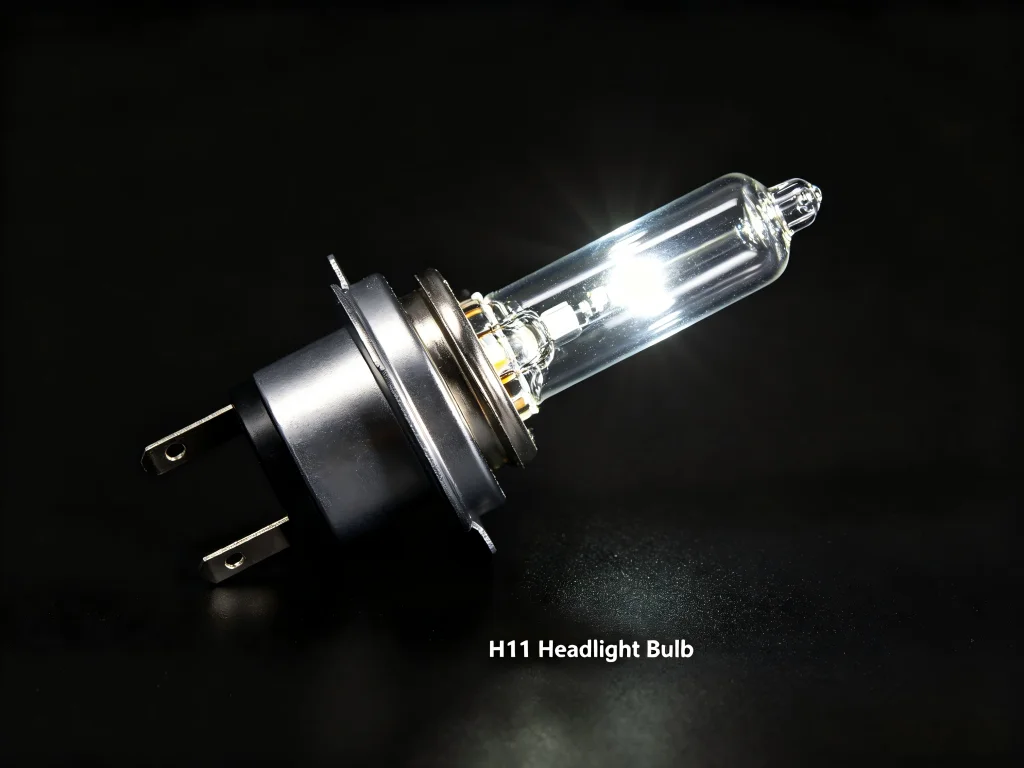
1. H11燈泡類型比較:購買前您需要知道的事
H11連接器標準涵蓋多種燈泡技術,每種技術都有不同的性能特徵、預期壽命和相容性考量。
特點鹵素H11基本LED H11高端LED H11光輸出(流明)~1,0003,000-5,0004,000-6,000+壽命(小時)~320-50015,000-25,00030,000-50,000+功率消耗(瓦)55W30-50W16-25W光束品質工廠基準通常不一致精確匹配CANbus相容是(工廠)需要外部解碼器整合解決方案色溫~3,000K(黃色)6,000-6,500K(藍白色)6,000K(純白色)
如表所示,高端LED H11頭燈燈泡選項在性能上明顯優於鹵素燈和經濟型LED替代品。然而,即使在高端類別中,光束品質和相容性也有很大差異。
一項行業分析指出,「一個好的LED H11產生3,000-6,000流明(相對於H9的2,100),持續30,000+小時(相對於320),並且比原廠H11鹵素燈消耗更少的功率[參考:37]。」好與偉大之間的差距通常取決於工程細節,而不是原始規格。.
2. 購買H11頭燈燈泡時最常見的錯誤:忽略光束圖案
大多數買家完全專注於流明輸出,而完全忽略光束圖案品質。一個更亮但聚焦不良的燈泡,其可用光線比一個中等亮度但光束幾何完美的燈泡更少。.
這就是為什麼這如此重要。您的頭燈外殼是一個光學系統,設計圍繞特定的光源位置和長度。鹵素燈泡從單一燈絲點360度發光。LED晶片是發射定向光的平面表面。如果LED晶片沒有精確定位在鹵素燈絲所在的位置,光束圖案就會變形。
光束幾何不良的結果從惱人到危險不等。暗點直接出現在您的行駛路徑中,使您在關鍵區域失明。光線散射到截止線以上,使對向駕駛者眩目。投射的圖案變得斑駁且不一致。
Tests show that cheap LED bulbs can produce beam patterns that are 'worse than the original halogen bulbs' [Ref: 38]. In extreme cases, reviewers report bulbs with 'no high beam/low beam, only constant high beam, and poor alignment. These are dangerous to other vehicles on the road [Ref: 39].'
High-end manufacturers solve this problem through precision engineering. They measure the exact filament position of the original H11 halogen bulb. They position the LED chips with micron-level precision to match that position. They test the beam pattern in actual headlight housings, not just on bench fixtures.
GTR uses authentic Philips Z ES ”CSP' style LED chips, which have a higher heat tolerance rating than standard alternatives [Ref: 40]. The positioning of these chips aims to replicate the appearance of a traditional filament, projecting a 'precise beam that provides you with higher visibility and a wider viewing angle [Ref: 41].'
3. CANbus Compatibility: Why Your Dashboard Might Be Lying to You
Modern vehicles use CANbus systems to monitor every electrical component, including your headlights. The system expects to see a specific electrical load from each bulb. When you install LED H11 headlight bulbs that consume less power than halogen bulbs, the computer interprets this as a burned-out bulb.
The result is the classic 'bulb failure' warning on your dashboard, even though your LEDs are working correctly. Some vehicles go further, causing the LEDs to flicker continuously or shut off completely after a few seconds of operation.
Popular HID and LED experts The Retrofit Source confirm that vehicles with sensitive CANbus systems may experience flickering or complete failure after installing LEDs, requiring additional components to resolve the issue [Ref: 42].
Economy bulb manufacturers completely ignore this issue, shipping products that work fine in bench tests but fail in real vehicles. They may mention 'CANbus ready' in marketing, but this often only means the bulb will light up, not that it won't produce errors.
High-end solutions handle this differently. Instead of adding external decoders (which add extra points of failure), they design the driver circuit to properly communicate with your vehicle's electrical system. This integrated approach eliminates flickering and error codes without bulky external components.
Trusted brand in automotive lighting, Philips, confirms that 'when upgrading fog light bulbs to LED, manufacturers recommend installing CANBus LED bulb adapters to prevent LED flickering/strobing and dashboard warning lights [Ref: 43].' However, the best solutions integrate this compatibility directly without the need for additional adapters.
For particularly sensitive systems, external anti-flicker decoders can solve the problem. These devices normalize voltage to the LED and stop flickering by ensuring a continuous power supply [Ref: 44]. However, even these solutions require proper installation and may add points of failure over time.
4. Heat Dissipation: The Hidden Factor Determining Lifespan
LED chips generate significant heat at their junction. If this heat is not efficiently removed, the chip will thermally throttle to prevent self-destruction. This reduces light output. Repeated thermal cycling eventually leads to complete chip failure.
This is why cooling technology matters more than almost any other specification when evaluating H11 headlight bulbs.
4.1. Active Cooling (Fans)
Fan cooling uses a small, high-speed fan to draw heat away from the LED chip. This method works well when implemented correctly. However, fans can fail. When the fan stops, the bulb overheats and dies quickly. Fans also generate noise, although high-end fans run quietly and are barely noticeable inside the vehicle.
Some manufacturers claim '10,000 RPM noiseless replaceable fans' with lifespans up to 30,000 hours [Reference: 45]. The challenge is that the fan itself is a moving part with its own failure rate. When the fan fails, the entire bulb becomes useless.
4.2. Passive Cooling (Heatsinks)
Passive cooling uses large metal heatsinks to radiate heat away from the LED chip. This method has no moving parts, meaning no possibility of mechanical failure. However, passive heatsinks require sufficient space within your headlight housing. In compact assemblies, passively cooled H11 headlight bulbs may not fit properly.
High-end passive solutions use 'aerospace-grade aluminum' heatsinks with optimized surface area for maximum heat dissipation without moving parts [Reference: 46].
4.3. Thermal Separation Technology
The most advanced method separates the LED chip from the driver circuit on different heat dissipation planes. This prevents heat generated by the driver components from affecting the LED chip, and vice versa.
Industry tests have confirmed that H11 headlight bulb solutions with thermal separation technology 'operate at lower temperatures than competitors of the same wattage [Reference: 47].' Lower operating temperatures mean more stable output and longer lifespan.
GTR's Ultra series utilizes a custom TST 7045 chip with this exact thermal separation architecture. The LED chip is located on a heat dissipation plane separate from the driver circuit, ensuring that heat generated by either component does not affect the other [Reference: 48].
5. Real User Evaluations of Premium vs. Budget H11 Headlight Bulb Options
Going beyond manufacturer claims, delving into actual user experiences reveals the true performance differences between options.
One user comparing multiple premium brands noted that while Diode Dynamics SL1 bulbs offer American manufacturing, customers have also successfully used 'GTR Lighting Ultra 2' with excellent results [Reference: 49]. Key takeaway? Brand reputation and engineering quality matter more than marketing claims.
A detailed comparison between GTR Lighting and Morimoto found that 'GTR Lighting offers competitive performance-oriented options, while Morimoto excels in high-end design and advanced features [Reference: 50].' The GTR Ultra 2 series, in particular, has been noted for its efficiency and lumen output, engineered for performance rather than design aesthetics.
Perhaps most compelling is the Toyota 4Runner owner who upgraded from Morimoto 2Stroke 2.0 to GTR Ultra 2.0 bulbs. Their assessment was that the GTR bulbs represented a 'significant improvement' over their previous high-end option [Reference: 51]. They estimated that the GTR bulbs provided approximately 60-70% of the total output of the Lexus GX460 factory OEM LEDs, which is excellent for an aftermarket upgrade.
Another user confirmed that installing GTR Ultra 2.0 H11 LED bulbs required 'no modifications' to their vehicle, with all components fitting within the factory dust caps [Reference: 52].
These practical experiences highlight how advanced engineering translates directly into better performance and easier installation.
6. Frequently Asked Questions About H11 Headlight Bulb Upgrades
6.1. Is H11 a low beam or high beam?
In most vehicles, H11 is primarily used as a low beam bulb. However, depending on your vehicle's configuration, H11 can also be used as a fog light bulb or daytime running light. Always consult your owner's manual to confirm the specific application.
One vehicle owner reported that the purchased H11 LED kit was correctly installed in their low beam, but 'the high beam's housing, mount, or electrical connector was different,' highlighting the importance of confirming the specific application before purchase [Reference: 53].
6.2. Can I replace H11 halogen bulbs with LED without modification?
Direct replacement is possible when the LED bulb meets your vehicle's physical dimensions and electrical requirements. However, 'fitting in' does not always mean 'functioning well and remaining legal [Reference: 54].' You need a proper beam pattern, adequate heat dissipation, and CANbus compatibility for error-free operation.
6.3. Why do my H11 LED bulbs flicker after installation?
Flickering usually indicates CANbus incompatibility or a polarity issue. If your vehicle's computer detects the lower power consumption of the LED, it may try to alert you by causing the bulb to pulse. First, try rotating the bulb connector 180 degrees, as polarity issues cause this problem in more than half of the cases [Reference: 55]. If this does not resolve the issue, you may need a CANbus decoder [Reference: 56].
6.4. How bright should a good H11 LED bulb be?
High-end H11 LED bulbs produce 3,000 to 6,000 lumens per bulb. This represents a 300-600% increase in light output compared to factory halogen bulbs while consuming significantly less power [Reference: 57]. However, the raw lumen number does not tell the whole story. Beam pattern quality determines how much light actually reaches the road.
6.5. Will H11 LED bulbs fit my specific vehicle?
Vehicle compatibility depends on the physical clearance within the lamp housing. Some vehicles have fully enclosed assemblies with rubber dust covers that require compact bulbs. Always check the depth of the housing before purchasing. Quality bulb manufacturers specify exact dimensions and provide vehicle fitment guides.
6.6. How long do H11 LED bulbs last compared to halogen bulbs?
High-end LED bulbs are rated for 30,000 to 50,000 hours of use. Standard halogen bulbs last approximately 320 to 500 hours. If you drive 2 hours at night each evening, LED bulbs can last over 40 years, while halogen bulbs need replacement every 6 to 8 months [Reference: 58].
However, these lifespan assumptions assume proper thermal management. Cheap LED bulbs with poor heat dissipation may fail within weeks. Thermal design determines lifespan more than any other factor.
6.7. Do H11 LED bulbs require special wiring?
Most H11 LED bulbs are designed as plug-and-play replacements that connect directly to the factory wiring. However, vehicles equipped with CANbus systems may require additional decoders to prevent error codes. High-end bulbs integrate this compatibility internally, eliminating the need for external components [Reference: 59].
One important note: if the LED bulb does not light up after installation, you may need to "reverse the male plug 180 degrees and try again," as polarity sensitivity is a common issue with LEDs [Reference: 60].
6.8. What color temperature should I choose for H11 LED bulbs?
6000K produces pure white light that simulates daylight, providing excellent contrast without being overly blue. 6500K leans slightly toward blue-white, an aesthetic some drivers prefer, but it may reduce contrast in wet conditions. Lower color temperatures around 5000K produce a warm white similar to high-end OEM LEDs.
A review of the GTR Ultra 2 bulbs notes that they provide "crisp 6000K white light that mimics daylight" without any blue or yellow tint, making them excellent for all-weather visibility [Reference: 61].
6.9. Will upgrading to LED affect my vehicle's warranty?
The Magnuson-Moss Warranty Act protects consumers from automatically voiding warranties after aftermarket modifications. However, if the LED upgrade directly causes damage to the vehicle's electrical system or lamp assembly, that specific repair may not be covered under warranty. Always keep your original bulbs for warranty service involving lights.
7. Making the Final H11 Headlight Bulb Decision
After examining the technical differences among halogen, basic LED, and high-end LED H11 headlight bulb options, the choice comes down to three factors: your budget, your driving conditions, and how much you value reliability.
For occasional nighttime driving in well-lit urban areas, halogen bulbs remain acceptable. Basic LEDs suit budget-conscious drivers who understand they are compromising on beam quality and lifespan. High-end LEDs offer the best overall value for anyone who frequently drives at night or in adverse weather.
The high-end category provides significantly better visibility, 30 times longer lifespan, lower power consumption, and includes engineering features that basic options completely ignore. Over the lifetime of the vehicle, the cost difference becomes negligible compared to the safety benefits and reduced hassle.
GTR Lighting spent nearly a decade developing H11 LED headlight bulb solutions [Reference: 62]. Our products use genuine Philips Z ES chips, employ thermal separation technology, and undergo extensive testing in actual vehicle lamp housings before market release. We never cut corners on heat dissipation, beam geometry, or CANbus compatibility.
If you are ready to experience true H11 headlight bulb engineering, click the link below to browse our full product line. Your nighttime driving experience will never be the same.