
Chọn đúng bóng đèn pha H11 có nghĩa là hiểu được sự khác biệt thực sự giữa halogen, LED cơ bản và LED cao cấp. Hướng dẫn này cắt giảm những lời quảng cáo thổi phồng để cho bạn thấy chính xác điều gì quan trọng đối với xe và điều kiện lái xe cụ thể của bạn.
Based on years of manufacturing experience and extensive laboratory testing, we have created the most comprehensive H11 headlight bulb comparison chart available. You will learn why some bulbs fail within weeks while others last for years, how to detect dangerous beam patterns before purchasing, and which features truly provide better night vision.
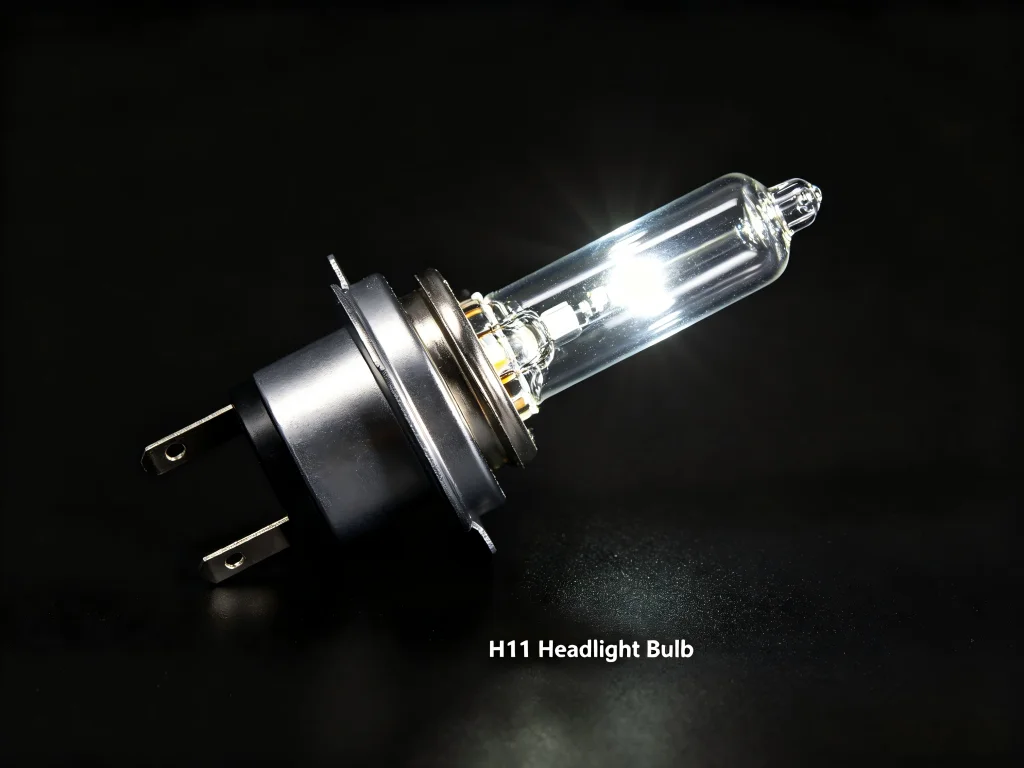
1. Comparing H11 bulb types: What you need to know before buying
The H11 connector standard encompasses various bulb technologies, each with distinct performance characteristics, lifespan, and compatibility considerations.
Feature | Halogen H11 | Basic LED H11 | Premium LED H11 | Luminous output (Lumens) | ~1,000 | 3,000-5,000 | 4,000-6,000+ | Lifespan (Hours) | ~320-500 | 15,000-25,000 | 30,000-50,000+ | Power consumption (Watts) | 55W | 30-50W | 16-25W | Beam quality | Factory base | Often inconsistent | Precise match | CANbus compatibility | Yes (factory) | Requires external decoder | Integrated solution | Color temperature | ~3,000K (yellow) | 6,000-6,500K (blue-white) | 6,000K (pure white)
As the table shows, premium H11 LED headlight bulb options offer significantly better performance than both halogen and cheap LED. However, beam quality and compatibility vary considerably even within the premium segment.
An industry analysis noted that “a good H11 LED produces 3,000-6,000 lumens (compared to 2,100 for H9), lasts over 30,000 hours (compared to 320), and consumes less power than standard H11 halogen [reference:37].’ The gap between good and excellent often lies in technical details rather than raw specifications.
2. Mistake #1 when buying H11 headlight bulbs: Ignoring beam pattern
Most buyers focus only on lumen output and completely overlook beam pattern quality. A brighter bulb with poor focus provides less useful light than a moderately bright bulb with a perfect beam shape.
Here is why this is crucial. Your headlight housing is an optical system designed around a specific light source position and length. Halogen bulbs emit 360 degrees from a single filament point. LED chips are flat surfaces that emit directional light. If the LED chip is not positioned exactly at the halogen filament location, the beam pattern will be distorted.
The results of poor beam shape can range from annoying to dangerous. Dark spots appear right in your path, blinding you in critical areas. Light scatters above the cut-off line, glaring at oncoming drivers. The projection becomes patchy and inconsistent.
Testing has shown that cheap LED bulbs can produce a beam pattern “worse than standard halogen[ref:38].” In severe cases, evaluators reported “no low beam, only high beam, and terrible alignment. These are a hazard to every other vehicle on the road[ref:39].”
Premium manufacturers address this issue through precision engineering. They measure the exact filament position of the original H11 halogen bulb. They position the LED chip with micron-level accuracy to match that position. They test the beam pattern in actual headlight housings, not just on bench fixtures.
GTR uses genuine Philips Z ES type “CSP” LED chips with a higher thermal resistance rating than standard types[ref:40]. These chips are positioned to replicate the traditional filament shape, producing “a precise beam that enhances visibility, with a wider field of view[ref:41].”
3. CANbus Compatibility: Why Your Dashboard Might Be Lying to You
Modern vehicles use CANbus systems to monitor every electrical component, including headlights. This system expects a specific electrical load from each bulb. When you install an H11 LED headlight bulb that consumes less power than halogen, the computer interprets that as a burnt-out bulb.
The result is the classic “bulb out” warning on your dashboard, even though your LED is working perfectly. Some cars go further, causing the LED to flicker constantly or shut off completely after a few seconds of operation.
Well-known LED and HID expert The Retrofit Source confirms that vehicles with sensitive CANbus systems may experience flickering or complete failure after LED installation, requiring additional components to resolve the issue[ref:42].
Cheap bulb manufacturers ignore this issue entirely, delivering products that work on the test bench but fail in real vehicles. They may mention “CANbus ready” in their marketing, but this often just means the bulb will light up, not that it will operate without errors.
Premium solutions approach this problem differently. Instead of adding external decoders that create additional failure points, they design the driver circuitry to communicate properly with the vehicle's electrical system. This integrated approach eliminates flickering and error codes without bulky external components.
Philips, a trusted name in automotive lighting, confirms that “when upgrading fog lights to LED, manufacturers recommend installing a CANbus LED bulb adapter to prevent flickering/strobing and dashboard warning lights[ref:43].” However, the best solutions integrate this compatibility directly, eliminating the need for additional adapters.
For vehicles with particularly sensitive systems, external anti-flicker decoders can solve the problem. These devices stabilize voltage for the LED and prevent flickering by ensuring a continuous power supply[ref:44]. However, even these solutions require proper installation and may add failure points over time.
4. Heat Dissipation: The Hidden Factor Determining Lifespan
LED chips generate significant heat at the junction. If that heat is not effectively removed, the chips will throttle themselves to avoid self-destruction. This reduces light output. Repeated thermal cycling eventually leads to complete chip failure.
This is why cooling technology matters more than almost any other specification when evaluating H11 headlight bulbs.
4.1. Active Cooling (Fan)
Fan-cooled bulbs use a small high-speed fan to draw heat away from the LED chip. This method works well when done correctly. However, the fan can fail. When the fan stops, the bulb overheats and dies quickly. The fan also creates noise, although premium fans run quietly enough to be inaudible in the cabin.
Some manufacturers claim “noiseless 10,000 RPM replacement fans” with lifespans up to 30,000 hours[reference:45]. The challenge is that the fan itself is a moving part with its own failure rate. When the fan fails, the entire bulb becomes useless.
4.2. Passive Cooling (Heatsink)
Passive cooling uses large metal heatsinks to dissipate heat away from the LED chip. This method has no moving parts, meaning nothing can mechanically fail. However, passive heatsinks require sufficient space inside your headlight housing. In tight assemblies, a passively cooled H11 bulb may not fit.
Premium passive solutions use “aerospace-grade aluminum” heatsinks with optimized surface area for maximum heat dissipation without moving parts[reference:46].
4.3. Thermal Separation Technology
The most advanced method separates the LED chip from the driver circuit on different thermal planes. This prevents heat from the driver components from affecting the LED chip and vice versa.
Industry testing has confirmed that thermal separation technology results in H11 bulbs that “run cooler than competitors with the same wattage[reference:47].” Cooler operation means more stable light output and significantly longer lifespan.
GTR's Ultra Series uses a custom TST 7045 chip with this precise thermal separation architecture. The LED chip sits on a separate thermal plane from the driver circuit, ensuring heat from one component does not affect the other[reference:48].
5. What Real Users Report About Premium vs. Budget H11 Bulb Options
Looking beyond manufacturer claims to real-world user experiences reveals the true performance differences between options.
One user comparing multiple premium brands noted that while Diode Dynamics SL1 bulbs are made in the USA, customers have successfully used “GTR Lighting Ultra 2’s” with excellent results[reference:49]. The key takeaway? Brand reputation and engineering quality matter more than marketing claims.
A detailed comparison between GTR Lighting and Morimoto showed that “GTR Lighting offers competitive performance-oriented options while Morimoto excels in premium design and advanced features[reference:50].” The GTR Ultra 2 Series was specifically noted for its efficiency and high lumen output, designed for performance rather than design aesthetics.
Perhaps most tellingly, a Toyota 4Runner owner upgraded from Morimoto 2Stroke 2.0 to GTR Ultra 2.0 bulbs. Their review stated that the GTR bulbs represented a “significant improvement” over their previous premium choice[reference:51]. They estimated the GTR bulbs provide about 60-70% of the total output of OEM LED headlights from a Lexus GX460, which is remarkable for an aftermarket upgrade.
Another user confirmed that installing GTR Ultra 2.0 H11 LED bulbs required no “modifications” to their vehicle, with everything fitting snugly under the factory dust caps[reference:52].
These real-world experiences highlight that premium engineering translates directly into better performance and easier installation.
6. Frequently Asked Questions About H11 Headlight Bulb Upgrades
6.1. Is H11 a low beam or high beam?
H11 is primarily used as a low beam headlight bulb in most vehicles. However, H11 can also function as a fog light or daytime running light depending on your vehicle's configuration. Always check your owner's manual for specific applications.
One vehicle owner reported that the H11 LED kit they purchased fit their low beams but “the high beams did not share the same body, bracket, or electrical connector,” emphasizing the importance of confirming the specific application before purchasing[reference:53].
6.2. Can I replace halogen H11 with LED without modification?
Direct replacement is possible when the LED bulb matches the physical size and electrical requirements of your vehicle. However, “fitting” does not always mean “working well and legally[reference:54].” You need proper beam pattern, adequate cooling, and CANbus compatibility for error-free operation.
6.3. Why is my H11 LED bulb flickering after installation?
Flickering usually indicates CANbus incompatibility or a polarity issue. If your vehicle's computer detects the lower power consumption of the LED, it may try to warn you by making the bulb flicker. Try rotating the bulb connector 180 degrees first, as polarity issues cause this problem more than half the time[reference:55]. If that doesn't resolve the issue, you may need a CANbus decoder[reference:56].
6.4. How bright should a good H11 LED bulb be?
Premium H11 LED bulbs produce between 3,000 and 6,000 lumens per bulb. This represents 300-600% more light output than factory halogens while consuming significantly less power[reference:57]. However, raw lumen numbers don't tell the whole story. Beam quality determines how much of that light actually reaches the road surface.
6.5. Will H11 LED bulbs fit my specific vehicle?
Vehicle compatibility depends on the physical space inside your headlight housing. Some vehicles have fully sealed headlight assemblies with rubber boots that require compact bulbs. Always check the depth of the housing before purchasing. Quality bulb manufacturers specify exact dimensions and provide installation guides for vehicles.
6.6. How long do H11 LED bulbs last compared to halogen?
Premium LED bulbs are rated to operate for 30,000-50,000 hours. Standard halogen bulbs last about 320-500 hours. With 2 hours of night driving per day, an LED bulb could last over 40 years, while halogens would need replacement every 6-8 months[reference:58].
However, this lifespan assumes proper thermal management. A cheap LED bulb with inadequate cooling can fail within weeks. Thermal design determines durability more than any other factor.
6.7. Do H11 LED bulbs require special wiring?
Most H11 LED bulbs are designed as direct replacements (plug-and-play), meaning they connect directly to the vehicle's wiring. However, vehicles with CANbus systems may require additional decoders to avoid error codes. Premium bulbs integrate this compatibility internally, eliminating external components [reference:59].
One important note: if your LED bulb does not light up after installation, you may need to “reverse the male connector 180 degrees and try again,” as polarity sensitivity is common with LEDs [reference:60].
6.8. What color temperature should I choose for H11 LED bulbs?
6000K produces pure white light that mimics daylight, providing excellent contrast without excessive blue tones. 6500K shifts slightly to blue-white, which some drivers prefer aesthetically but may reduce contrast in wet conditions. Lower temperatures around 5000K produce warm white light similar to premium OEM LEDs.
A review of GTR's Ultra 2 bulbs noted that they provide “sharp 6000K white light that mimics daylight” without any blue or yellow tints, making them ideal for all-weather visibility [reference:61].
6.9. Will upgrading to LED affect my vehicle's warranty?
The Magnuson-Moss Warranty Act protects consumers from automatic warranty denial after accessory modifications. However, if the LED upgrade directly causes damage to the vehicle's electrical system or headlight assembly, that specific repair may not be covered. Always keep your original bulbs for warranty claims related to the lighting system.
7. Making your final decision on H11 headlight bulbs
After reviewing the technical differences between halogen, basic LED, and premium LED H11 headlight bulb options, the choice comes down to three factors: your budget, your driving conditions, and how much you value reliability.
Halogen remains acceptable for occasional nighttime driving in well-lit urban areas. Basic LEDs suit budget-conscious drivers who understand they are accepting trade-offs in beam quality and lifespan. Premium LEDs represent the best overall value for anyone who regularly drives at night or in bad weather.
The premium category delivers significantly better visibility, lasts 30 times longer, consumes less power, and includes engineering features that budget options completely omit. Over the life of the vehicle, the cost difference becomes negligible compared to the safety benefits and reduced hassle.
GTR Lighting has spent nearly a decade developing H11 LED headlight bulb solutions [reference:62]. Our products use genuine Philips Z ES chips, incorporate heat separation technology, and undergo extensive testing in real housings before release. We do not cut corners on cooling, beam pattern, or CANbus compatibility.
If you are ready to experience proper H11 headlight bulb engineering, explore our full lineup at the link below. Your nighttime driving will never be the same.