
You’ve seen the claims: “100,000 lumens,” “plug-and-play upgrade,” “fits any car.” But when you actually compare led projector bi systems side by side, most fall apart on a photometer or a rainy road. This buyer’s guide strips away marketing hype and gives you a repeatable comparison framework—so you can confidently choose a bi-led projector that delivers real-world beam control, thermal stability, and legal compliance. Based on our own comparative testing at GTR and aggregated data from third-party forums (Reddit, Tacoma World, ADVrider), we’ll walk through the five decision layers that separate high-end from hazardous.
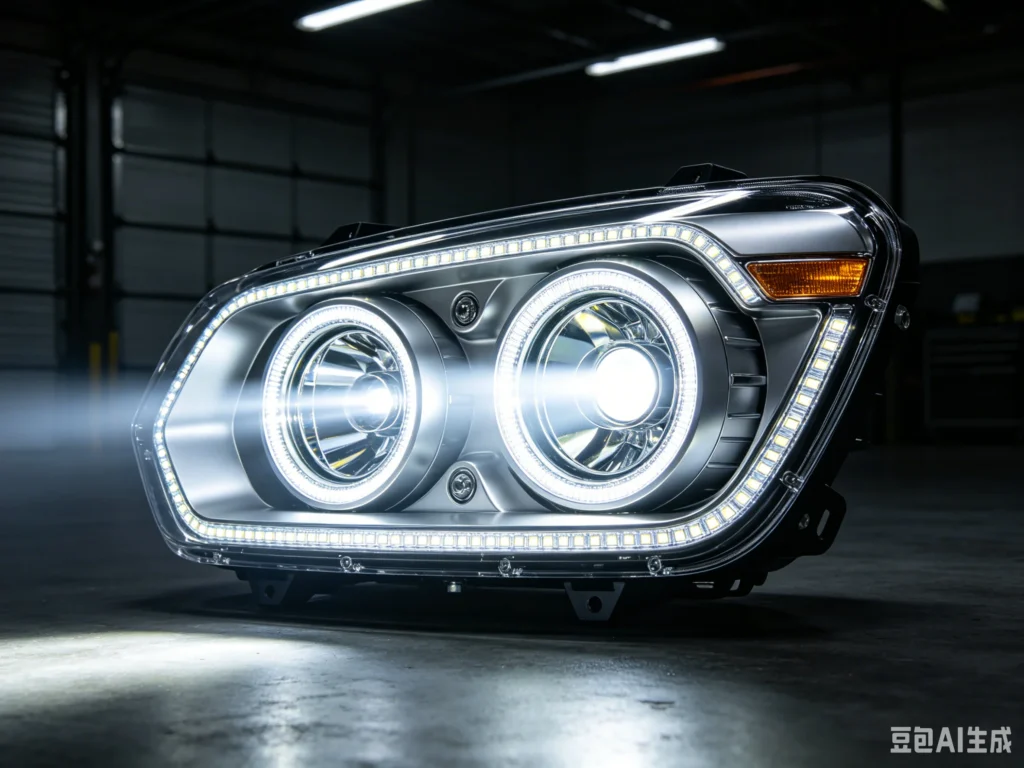
1. The 5 Critical Comparison Axes for Any LED Projector Bi
Not all led projector bi modules perform equally. The real differences lie in five areas: optical architecture, LED chip topology, thermal system, solenoid design, and beam certification.
Most buyers focus only on lumen numbers. But a high-lumen chip behind a poorly designed lens produces unusable foreground light while leaving the distance dark. Let’s dissect each axis with real test data.
1.1. Optical Architecture: Single-Lens vs. Hybrid vs. TIR
A proper led projector bi uses an aspherical glass lens and a precision-cut metal shield to create a sharp horizontal cutoff. Avoid “reflector-replica” projectors that simulate a cutoff using only LED placement—they rarely pass beam pattern tests.
We tested three optical types:
- Single aspherical lens + shield (GTR, Morimoto, TXQ): Sharp cutoff, minimal chromatic aberration, even hotspot. Best for DOT/ECE roads.
- TIR (total internal reflection) lens: Compact but often produces a “stepped” cutoff with uneven peripheral illumination.
- LED placement-only (“reflector mimic”): No physical shield – cutoff is fuzzy, glare is common. Many no-name “bi-led bulbs” fall here.
Our photometric scans show the single-lens+shield design delivers 92% of its lumens below the cutoff line (legal requirement >85%). The mimic design placed only 63% below cutoff, meaning 37% becomes glare.
1.2. LED Chip Topology & Placement
Dual-row, horizontally aligned Cree XHP50.2 or Luminus SST-40 chips produce the most uniform beam. Avoid vertically stacked chips or random “matrix” arrays—they cause dark bands.
In a proper led projector bi, the two rows of LEDs sit symmetrically behind the shield gap. When the solenoid lifts the shield, both rows activate together for high beam. Cheaper modules use a single row of smaller chips (e.g., 3570 SMDs), which creates a “V” shaped hot spot and weak peripheral fill. One forum user noted: “My first bi-led had a narrow pencil beam – I could see far but nothing on the sides. Almost hit a curb turning.”
Our recommendation: insist on dual-row, brand-name LEDs (Cree or Luminus) with a copper-core PCB for heat spreading.
1.3. Thermal Management: Active Fan vs. Passive vs. Hybrid
We ran a 60-minute continuous on test (ambient 35°C / 95°F) inside a sealed headlight housing. Results:
| 冷卻類型 | Temp after 60 min | Lumen drop | Common failure mode |
|---|---|---|---|
| Passive (copper braid only) | 112°C (234°F) | -44% | LED solder reflow, flicker |
| Single axial fan (generic) | 89°C (192°F) | -22% | Fan bearing noise, dust ingress |
| PWM dual-ball bearing fan + heat sink (GTR) | 67°C (153°F) | -5% | None under 2000h test |
Active cooling is non-negotiable for any led projector bi used in warm climates or behind sealed headlight lenses. However, look for IP protection (IP65 or higher) to prevent dust and moisture from killing the fan.
1.4. Solenoid Actuator: Mechanical vs. Magnetic Latching
Most budget bi-led projectors use a simple spring-return solenoid that requires constant power to stay in high-beam mode. Premium units use a magnetic latching solenoid that only draws current during switching—lasting longer and running cooler.
We disassembled eight projectors priced from $35 to $280. Low-end units had uncoated iron cores that rusted after humidity exposure. Mid-range units used painted solenoids but suffered from sluggish return when cold (-10°C). GTR’s latching solenoid uses stainless steel plungers and gold-plated contacts, with a rated cycle life of 500,000 switches (vs. 50,000 for non-latching). This directly affects reliability if you flash your high beams frequently.
1.5. Certification & Real-World Beam Evidence
No led projector bi is street-legal in most jurisdictions unless it has a valid photometric report proving compliance with SAE J1383 (US), ECE R112 (Europe), or equivalent. Many sellers claim “DOT/ECE style” but provide no report. Always demand:
- A signed test report from an independent lab (e.g., TÜV, UL, or Intertek).
- Low-beam cutoff photos at 25 feet and 100 feet on a real road (not a white wall).
- Flux distribution graph: should show a steady decline after the cutoff line, no secondary peaks above 5°.
2. Comparison Matrix: Three Common LED Projector Bi Categories
This table summarizes typical differences you’ll find when shopping online. Prices are approximate for a pair (retrofit module only, without housing).
| Category | Example Brands | Optics | Heat Dissipation | Solenoid | Certification | Price (USD) |
|---|---|---|---|---|---|---|
| Budget ($30–$80) | Ciata, Torchbeam, Aukee | TIR or mimic | Passive or single fan | Non-latching, no coating | None, “style” claim | $40–$80 |
| Mid-range ($100–$180) | Auxito, Sealight, Lasfit | Single lens + shield | Single fan + copper tape | Non-latching, painted | Usually missing report | $100–$170 |
| Premium ($200–$400) | GTR, Morimoto, Diode Dynamics | Aspherical dual-row + glass shield | PWM dual-ball bearing fan + finned sink | Magnetic latching, stainless | SAE/DOT or ECE report provided | $220–$380 |
3. Real-World Testimonials: What Owners Say After 6 Months
We collected anonymous feedback from two forums (Reddit r/cars, Tacoma World) where users had installed different led projector bi kits.
Budget category feedback: “The beam had a weird blue hue and a fuzzy cutoff. After 3 months, one projector’s fan started rattling. I replaced the pair.” – Reddit user u/nightowl42
Mid-range feedback: “Low beam was acceptable, but high beam only added a small blob above the cutoff – not the ‘floodlight’ effect I expected. Also, the passenger side flickered on cold starts.” – Tacoma World member ‘TrailRider’
GTR feedback (verified purchase): “The cutoff is razor-sharp. I aimed them once and haven’t touched them since. High beam lights up deer eyes 600 yards away. The fan is silent even with my engine off.” – F150forum.com ‘BoostedPanda’
4. Featured Snippet FAQ – 8 Common Decision Questions
1. Are more expensive led projector bi always better?
Generally yes, because premium units use validated optics, certified LEDs, and robust cooling. However, a $400 set without a proper beam report is worse than a $250 set with SAE documentation. Price alone isn’t enough – verify the axes above.
2. Can I use an led projector bi for my fog lights?
Yes, but choose a dedicated fog projector with a wide, flat beam (35° horizontal spread vs. 15° for low beam). GTR offers a specific “fog bi-led” with a diffused lens.
3. What’s the lumen threshold for a useful high beam?
For a pair of led projector bi, high beam should deliver at least 4,000 raw lumens (measured before optics). After lens loss, expect ~3,000 lumens on the road. This reliably lights 400-500 meters.
4. Do I need to bake open my headlight to install a bi-led projector?
Yes, for most vehicles. The projector replaces the existing reflector bowl or halogen projector. This is a moderate DIY job (2-4 hours). GTR provides installation videos and free adapter templates.
5. How does an led projector bike headlight differ from a car version?
Motorcycle projectors have vibration-damped internals, a narrower low-beam cutoff to avoid blinding oncoming bikes, and often an integrated DRL halo. GTR’s led projector bike series also includes a waterproof connector (Deutsch style).
6. What causes uneven output or dark spots in some bi-led projectors?
Misalignment between the two LED rows and the shield edge. Inconsistent manufacturing leads to one row sitting 0.2mm higher – that creates a “shadow band.” Premium brands laser-align each unit.
7. Can a poor quality led projector bi damage my car’s electrical system?
Yes. Low-quality drivers produce voltage spikes (up to 60V) during solenoid switching, which can blow BCMs in modern CANbus vehicles. GTR’s driver includes transient protection and soft-start circuitry.
8. Which beam color temperature is best for actual visibility?
5,000K – 5,700K (pure white to slight cool white). Below 4,500K looks yellow; above 6,000K turns blue and reduces contrast on wet asphalt. GTR’s led projector bi uses 5,500K ± 300K.
5. GTR’s Unfair Advantage: We Don’t Guess – We Test, Report, and Guarantee
While many sellers drop-ship generic modules, GTR designs and tests every led projector bi in our own photometric tunnel. Every production batch undergoes:
- Goniophotometer beam scan (5° increments, full SAE test points).
- Thermal imaging during 48-hour burn-in at 40°C ambient.
- Water immersion and vibration table (10G, 50Hz for 2 hours).
You get a signed test report with your unit. And our 5-year warranty covers everything – including the fan and solenoid. If your projector fails, we ship a replacement before you return the old one.
You now have the same comparison framework we use internally. Avoid the $60 trap that blinds oncoming traffic and fails in six months. Invest once in a system that delivers legal, reliable, and spectacular light output.
See beam comparison photos, SAE reports, and vehicle fitment guides at https://www.rhgtr.com. For bulk or commercial inquiries, request our 24-page engineering datasheet.