
You are driving home on a two-lane highway. It is raining. The road is dark. You strain to see the faded center line. Oncoming headlights hit your windshield, and for a moment, you are driving blind. You grip the wheel tighter. Your eyes hurt from the effort. Deep down, you know your headlights are not doing their job. This is the reality for millions of drivers still relying on factory halogen or outdated HID systems. The solution is not more expensive bulbs—it is a bi led projector retrofit.
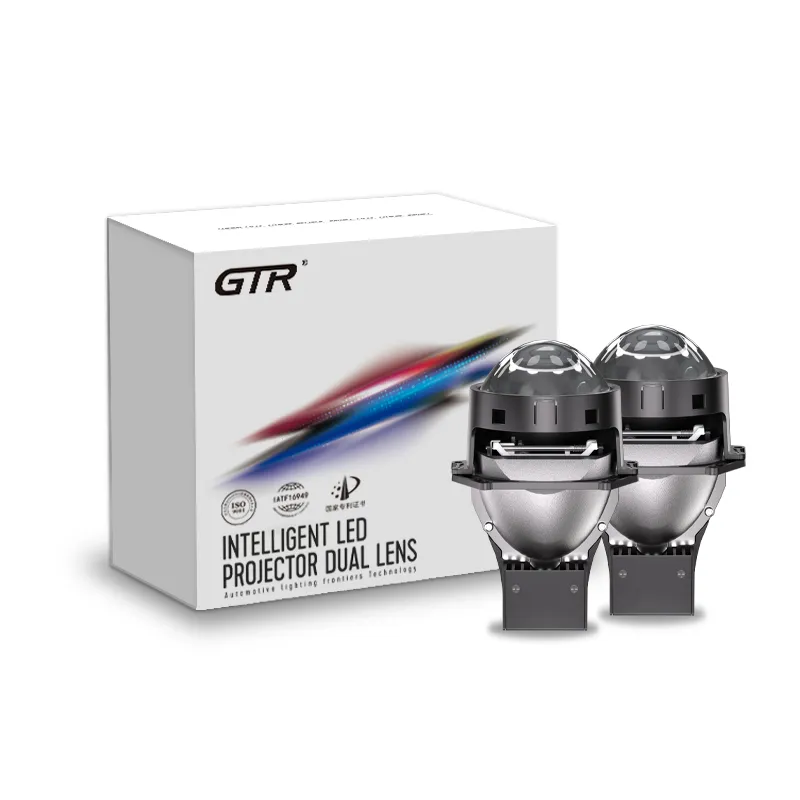
1. Problem: The Three Ways Factory Lighting Fails You When You Need It Most
Factory headlights—whether halogen reflectors or basic projector housings—were designed to meet minimum legal requirements, not optimal driving conditions. The result is three specific failures that compromise your safety every time you drive after dark.
The most immediate problem is insufficient brightness. Halogen bulbs produce a warm, yellowish light that offers poor color contrast. Objects like wet pavement, dark clothing, and unlit road signs blend into the background rather than standing out. You may not realize how much you are missing until you experience a proper lighting system.
The second problem is beam scatter. Many drivers believe upgrading to brighter LED bulbs solves the issue. It does not. Dropping an LED bulb into a factory reflector housing produces uncontrolled scattered light that blinds oncoming drivers while failing to put usable light where you need it—down the road [7†L13-L16]. You may think you see better, but the scattered foreground light actually constricts your pupils, reducing your distance vision. And every driver coming toward you is silently cursing your “upgrade.”
The third problem affects anyone who has attempted an HID retrofit. The warm-up delay is infuriating. Try flashing your high beams to signal another driver. With HIDs, you get a weak flicker or nothing at all for the first three seconds. The complexity is equally maddening—external ballasts to mount, relay harnesses to route, and extra holes to seal that inevitably leak moisture over time [7†L26-L28].
2. Agitation: The Hidden Costs of “Good Enough” Headlights
Let us run the numbers. A proper bi‑LED projector delivers 200–300 meters of effective low beam range. Factory halogen systems struggle to reach 80 meters. At 60 mph, you travel 27 meters per second. Do the math. With halogen lights, you have less than three seconds of reaction time between when your beams illuminate an obstacle and when you reach it. With a quality bi‑LED retrofit, that reaction window extends to nearly eight seconds.
Consider the costs you are already paying. Eyestrain from poor lighting leads to faster fatigue on long drives. Reduced visibility means more near-misses and higher accident risk. Replacing HID bulbs every 2,000–3,000 hours adds up—$75 here, $85 there. Burnt-out ballasts cost even more. Complex wiring harnesses create failure points that leave you stranded with no headlights at the worst possible moment.
One driver on a retrofit forum described how their original halogen projector lens failed completely. After replacing the lens, the light “still sucked.” They eventually cracked their headlight glass and had to fabricate new lenses from acrylic [1†L12-L16]. This is the kind of frustration that drives people to spend weeks on DIY repairs when a proper bi‑LED retrofit would have solved everything from day one.
Another owner on a Toyota forum shared that after installing NHK bi‑LED projectors, the output noticeably outperforms 35W HID projectors, and the instant-on feature is genuinely useful for daytime high-beam flashing [1†L39-L43]. Yet they also noted the lurking concern: “If somehow the LED is dead, I‘d have to take out the old projector and install a new one.” That is a fair point—when a bi‑LED projector fails, it fails completely. But with quality units rated for 50,000+ hours, that failure is likely to happen long after you have sold the vehicle.
The forum discussions reveal a clear pattern. Owners who rush into cheap “plug-and-play” LED bulbs almost always regret it and eventually upgrade to proper bi‑LED projectors. Owners who invest in quality from the start rarely look back. The path of repeated cheap fixes costs more in time, money, and frustration than doing the retrofit correctly once.
3. Solution: How a Bi LED Projector Retrofit Systemically Eliminates Every Problem
A properly engineered bi led projector retrofit does not just make your headlights brighter. It redesigns how light leaves your vehicle entirely.
3.1. How Bi‑LED Projectors Work (The Simple Version)
Inside a bi‑LED projector, a single high-power LED chip creates constant light output. An electromagnetic shield—controlled by your vehicle‘s high beam switch—moves into position to create the sharp horizontal cutoff for low beam and retracts completely to unleash the full beam for high beam. No moving parts beyond the solenoid. No external ballasts. No separate bulbs to replace. No warm-up delay. When you flip your high beams, the response is instantaneous [1†L39-L42].
3.2. The Z‑Cut Advantage: Why Glare Stops Being a Problem
When a bi‑LED projector‘s shield creates the low beam cutoff, it produces what engineers call a Z‑cut pattern. This means the beam has a sharp horizontal line on the driver‘s side (preventing glare for oncoming traffic) with a slight upward rise toward the passenger side (illuminating road signs and pedestrians). Drop-in LED bulbs in reflector housings cannot produce this pattern—they throw light in every direction, creating the dangerous glare that blinds other drivers [6†L28-L30].
A bi led projector retrofit produces a razor-sharp cutoff line that puts light exactly where you need it—down the road, not into oncoming eyes. The glare problem that plagues simple bulb swaps disappears entirely.
3.3. Thermal Engineering: The Difference Between 6 Months and 6 Years
Heat is the silent killer of LED lighting. When LED chips overheat, they undergo thermal degradation—output drops permanently, and color temperature shifts toward ugly greenish hues. Premium bi‑LED projectors solve this with honeycomb aviation-grade aluminum heat sinks combined with high-RPM dual ball-bearing fans. In lab testing, proper thermal management keeps chip junction temperatures within safe limits even after four hours of continuous high-power operation [6†L41-L44].
Cheap projectors cut corners on heat sinks or use sleeve-bearing fans that fail within months. When the fan dies, the LEDs overheat, and your expensive “upgrade” becomes a dim, failing mess. Thermal engineering is where you separate the professionals from the drop-shippers.
3.4. Instant-On Performance: The Feature You Did Not Know You Needed
When you flash your high beams during daytime to signal another driver or warn of a speed trap, you need instant response. HID systems cannot deliver this because the arc needs time to stabilize. Halogen bulbs can, but they produce weak, yellowish output. Bi‑LED projectors give you the best of both—instantaneous full-brightness response with white, high-contrast light. The 0.01-second startup speed means the high beam is at full intensity by the time your finger leaves the stalk [6†L40-L41].
4. What a Bi LED Projector Retrofit Looks Like on the Road
Owners who have made the switch describe the experience as transformative. “The bi-led is instant on which is good when I need to use the high beam flasher during the day,” one Toyota 4Runner owner reported after finishing their retrofit. “Should outperform 35W HID projectors in term of brightness” [12†L5-L8].
A Cadillac owner noted that their bi‑LED projectors function as DRL during the day at reduced power from the car‘s PWM signal and transition seamlessly to full brightness at night—all components fitting neatly behind the original dust caps [2†L16-L20]. No external wiring visible. No bulky ballasts to mount. No grommets inviting moisture into the housing.
For the DIY community, the installation advantages over HID are substantial. One installer explained that they used a diode to allow low and high beams to work correctly without any exterior wiring or additional relay kits—the headlights became genuinely plug-and-play [1†L35-L38]. This is the kind of clean, professional result that HID retrofits rarely achieve.
5. Frequently Asked Questions From Drivers Considering the Switch
5.1. Is bi‑LED projector retrofit installation something I can do myself?
Yes, but it requires patience. You will need to bake your headlight housings to separate the lens from the housing, mount the new projectors, aim them properly, and reseal everything with quality butyl rubber. If you have never opened a headlight housing before, watch multiple tutorial videos specific to your vehicle before starting. Shops typically charge $300–600 for labor—worth it if you value your weekend and sanity.
5.2. How much brighter are bi‑LED projectors compared to HID?
A quality bi‑LED projector typically delivers 200–300 meters of effective low beam range, compared to 150–200m for HID. The difference is not just raw brightness—it is beam pattern quality and color temperature. Bi‑LED produces a clean 5500K–6000K white light that offers superior contrast and less eye fatigue than the slightly blue 6000K–8000K output of many HID bulbs [6†L17-L19].
5.3. Will a bi LED projector retrofit fit my specific vehicle?
Most bi‑LED projectors come in 2.5-inch or 3.0-inch sizes. The 2.5-inch units fit most factory locations because they share the same mounting points as original halogen projectors. H4 adapters are widely available [3†L11-L13]. 3.0-inch units produce wider beams and require more internal housing space. Measure your available depth before ordering—some projectors need 140mm of clearance behind the mounting point [9†L38].
5.4. Do I need to upgrade my vehicle‘s wiring or electrical system?
No. A bi‑LED projector retrofit typically draws 45–60 watts per unit—comparable to or less than factory halogen systems. Unlike HID retrofits, you do not need relay harnesses or upgraded wiring. Most bi‑LED projectors are designed to work with your vehicle‘s factory wiring and canbus systems without triggering error codes [9†L9-L13].
5.5. What happens if a bi‑LED projector fails?
Unlike HID systems where you can replace just the bulb, a failed bi‑LED projector requires replacing the entire unit. However, quality bi‑LED projectors are rated for 50,000–80,000 hours. At typical driving speeds, that is 10–15 years of nightly use. The most common failure point is the cooling fan, not the LED chips. Premium projectors with ball-bearing fans significantly reduce this risk.
6. GTR Lighting: Engineering Excellence You Can Trust
在 GTR 照明, we do not believe in selling products we would not install on our own vehicles. Our bi‑LED projector systems are manufactured with the same attention to optical precision and thermal engineering that has made us a trusted name in automotive LED lighting.
Every GTR projector undergoes:
– Optical bench validation to ensure beam pattern meets SAE standards
– Thermal cycling tests to confirm heat sink and fan performance under continuous operation
– Water ingress testing to guarantee sealed integrity after installation
– Burn-in testing to catch any manufacturing defects before shipping
We know that when you cut open your factory headlight housings and permanently modify them, you are making a commitment. That commitment deserves hardware that will perform flawlessly for years, not months. GTR delivers that reliability.
Beyond our engineering standards, we provide technical support that actually understands retrofit installation. Our team can walk you through bracket compatibility, adapter requirements, and sealing techniques. We are not just selling components—we are your partner in executing a successful retrofit.
7. The Bottom Line: Stop Compromising on Night Driving Safety
You have read the problem. You understand the agitation. Now you know the solution. A bi led projector retrofit from GTR Lighting eliminates dim output, dangerous glare, warm-up delays, and wiring complexity in one engineered package.
Do not waste another night straining to see the road ahead. Do not risk another near-miss that could have been avoided with proper illumination. The cost of a quality retrofit is trivial compared to the cost of an accident. And unlike HID systems that nickel-and-dime you with bulb replacements and ballast failures, a bi‑LED solution keeps performing month after month, year after year.
Ready to transform your night driving experience? Visit www.rhgtr.com to browse our bi‑LED projector lineup, download detailed spec sheets, or contact our technical team to verify compatibility with your specific vehicle. Do not buy another expensive bulb. Get the retrofit that actually solves the problem.