
หากคุณกำลังอ่านข้อความนี้ แสดงว่าคุณอาจผ่านขั้นตอน “ไบ-คัลเลอร์ LED แพนเนลคืออะไร” มาแล้ว และกำลังอยู่ในขั้นตอนการตัดสินใจซื้อ คุณได้คัดเลือกโมเดลไว้สามหรือสี่รุ่น สเปกทั้งหมดดูเหมือนจะใกล้เคียงกัน: CRI 96+, 2700K–6500K, “ไม่มีการกะพริบ”, ตัวเครื่องอะลูมิเนียม แต่ความแตกต่างของราคาระหว่างตัวเลือกที่ถูกที่สุดและแพงที่สุดคือ $200 หรือมากกว่า คุณต้องการรู้ว่าเงินที่จ่ายไปนั้นไปอยู่ที่ไหน — และการจ่ายมากขึ้นนั้นทำให้คุณได้ไฟที่ดีขึ้นจริง ๆ หรือเพียงแค่เรื่องราวของแบรนด์ที่ดีกว่า
Drawing on years of experience manufacturing bi-color LED panels at GTR for rental companies, broadcast studios, and professional cinematographers, we will walk you through seven comparisons that truly indicate whether a panel will serve you well for five years or frustrate you within five months. This is not generic “look at the lumens” advice. This is the evaluation framework we use when competitors buy our panels to reverse-engineer them.
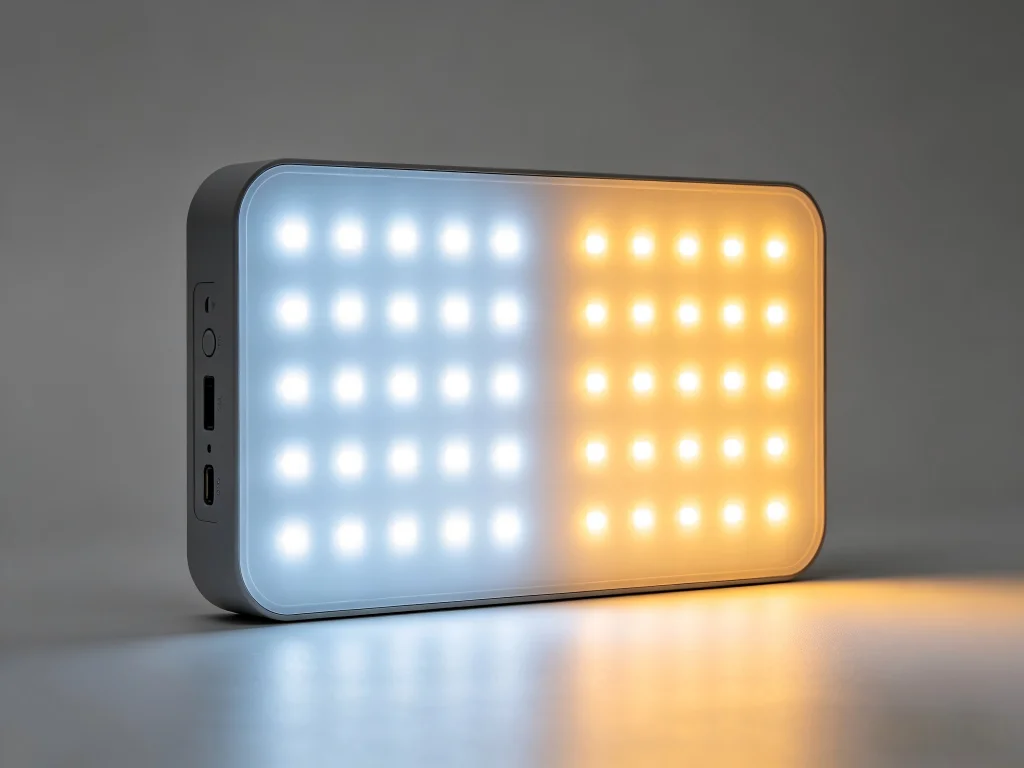
7. The Key Comparison: Edge-Lit vs. Direct-Lit Architecture
The fundamental architecture of a bi-color LED light panel — edge-lit or direct-lit — determines light softness, throw distance, heat, and serviceability. Most buyers overlook this choice entirely because both can produce a 60W panel with similar dimensions. In practice, edge-lit panels excel in soft light for tight spaces, while direct-lit dominates when you need intensity, consistent color mixing, and field repairability.
The difference is physical. Edge-lit panels place LED emitters only along the edges of the frame. A light guide plate — essentially a thick acrylic sheet with a light-diffusing pattern — spreads light from the edges across the panel surface. This creates a naturally diffused, soft, and minimal-thickness light source. Direct-lit panels place an array of LEDs across the entire back surface behind a diffusion layer.
The edge-lit approach yields a thin, lightweight panel that is gentle on faces at arm's length — ideal for desk streaming setups or cramped interview corners. But there are trade-offs. Because all light comes from the edges, output drops noticeably toward the center on larger panels. Our photometric mapping of a popular 12-inch edge-lit panel showed a 22% brightness falloff from edge to center. CCT also shifts toward the edges, as warm and cool LED dice placed along the edges mix unevenly along the long light guide path.
Direct-lit panels solve this by placing many LEDs — an alternating array of warm-white and cool-white emitters — behind the diffusion layer, mixing color at the source. This yields remarkably smooth CCT uniformity across the entire emitting surface. In our own direct-lit designs, we measure CCT variation of less than ±80K from corner to corner. Direct-lit also means that if an individual emitter fails, you can replace individual LED modules — edge-lit panels typically require replacing the entire light guide plate, making them more disposable than repairable.
| Evaluation Criteria | Edge-Lit Panels | Direct-Lit Panels |
|---|---|---|
| Natural Softness | Excellent — inherently soft due to light guide plate diffusion | Good — requires quality diffuser, but controllable with distance |
| Throw Distance | Poor — drops off rapidly beyond 1.5 meters | Strong — usable at 3–5 meters as a key light |
| CCT uniformity | Weak — edge-to-center differences are common | Excellent — ±80K achievable with proper LED binning |
| Serviceability | Low — replacing the light guide plate is complex and costly | High — modular LED panels can be replaced individually |
| การจัดการความร้อน | Heat concentrated at edges; thermal bottleneck | Even heat distribution across a larger back surface |
| Best use cases | Desk streaming, close-up aesthetics, tight spaces | Studio key light, on-location interviews, broadcast scenes |
Our recommendation: If you regularly work beyond two meters, a direct-lit panel is the safer professional choice. You can always soften a direct-lit panel with a diffuser, but you cannot make an edge-lit panel reach farther or mix CCT more evenly.
7. Key comparison: PWM Dimming Frequency — the real "flicker-free" benchmark
The PWM dimming frequency of bi-color panels is the most hidden spec in the lighting industry, but it determines whether your footage will work at high frame rates, whether interviewees will get eye strain during long interviews, and whether the camera's rolling shutter will create unsightly bands. Any panel with a PWM frequency below 20,000Hz is a risk when shooting above 60fps.
Most manufacturers advertise “flicker-free” without specifying what that means. In our tests, many panels claiming this feature operate at PWM frequencies between 600Hz and 1,200Hz. At 24fps with a 180-degree shutter, these frequencies mathematically avoid visible flicker — and nothing more. Crank your camera to 120fps for smooth slow-motion B-roll, and the interaction between the panel's PWM cycle and the sensor's rolling shutter will create dark bands moving across the frame. (Source).
The solution is simpler than manufacturers make it seem. A PWM frequency of 25,000Hz, well above the Nyquist threshold for any frame rate used in commercial video production, completely eliminates banding. It also reduces perceived flicker below the threshold that can cause eye strain for people in front of the camera during long shoots. Our GTR panels operate at 25kHz specifically because we saw too many cinematographers discover PWM banding for the first time in the editing suite, not on set where they could fix it.
- Ask manufacturers for the exact PWM frequency in hertz. If they answer “our panels are flicker-free,” ask again. Only a specific number is an acceptable answer.
- Test at the highest frame rate you plan to use before trusting any panel. Shoot at 240fps with a high shutter speed and review the footage on a large monitor. Visible banding in playback means a panel you can't rely on for slow-motion work.
- Be skeptical of “high-speed sync” claims for stills. Continuous LED panels and flash sync are different engineering challenges. A panel tuned for video PWM may still band with a mechanical shutter at 1/1000s.
7. Key Comparison: The CRI-TLCI Gap and Why It Betrays Your Footage
Buyers prioritize CRI because it's the biggest number printed on the box, but as manufacturers, we can tell you that CRI alone is misleading because it measures color rendering for the human eye, not for CMOS sensors with their own spectral sensitivity curves. TLCI (Television Lighting Consistency Index) was developed by the European Broadcasting Union specifically to predict how camera sensors will interpret a light source's spectrum. (Source).
We've measured competitor panels that achieve CRI 97 but TLCI 82, meaning the light looks flawless to the operator's eye while producing footage with a persistent green-magenta cast that requires secondary color correction to neutralize. This gap is worst at intermediate CCT settings like 3800K and 5000K, where mixed ambient light forces you to work. Budget panels achieve high CRI at 3200K and 5600K because those are the two points factories calibrate to. The rest of the range is spectrally unaddressed.
Our approach at GTR is to measure and publish TLCI alongside CRI at every major CCT point. We calibrate across 16 points with a reference spectrophotometer, and the compensation data lives in each panel's firmware. The TLCI values we publish are the minimum across the entire range, not the maximum. Panels claiming “TLCI 95+” but only at 5600K are not being honest with you. Demand the curve, not a cherry-picked number.
7. Key Comparison: Thermal Behavior at Full Power Over Time
Dual-color LED panels are heat-generating devices. LEDs convert only about 30–40% of electrical energy into light; the rest becomes heat that must be drawn away from the emitter to prevent efficiency loss, color shift, and accelerated degradation. How a panel handles continuous full-power operation separates professional gear from prosumer gear more clearly than any other factor.
Passive cooling, using finned aluminum heat sinks with no fans, is the gold standard. Passive designs are silent, immune to fan-bearing failure, and operate without pulling dust through the unit. But passive cooling requires substantial metal mass and careful heat-path design. Budget panels often cut corners here, using thinner extruded aluminum that pushes junction temperatures 30–40°C above ambient within an hour of full-power operation.
Why does this matter for your footage? Because LED phosphor efficiency drops as temperature rises. A panel that measures 5600K and 100% power when cold can drift to 5300K and 88% power after 90 minutes of continuous use if thermal management is inadequate. Our own testing of popular budget dual-color panels showed a 12% power drop and a 300K CCT shift over a two-hour session. GTR panels use a massive passive heat sink plus firmware-level thermal compensation—a feedback loop that adjusts drive current to maintain color as temperatures naturally rise—keeping both power and CCT within 2% of cold-start values indefinitely. (Source).
7. Key Comparison: Build Quality That Signals Lifespan
You can assess build quality in a dual-color panel before you even plug it in. We recommend buyers check four things by hand:
- Housing material and thickness. Plastic housings flex, transmit vibration, and crack at mounting points over time. Extruded or cast aluminum is the professional standard. Thicker walls—2mm or more—resist torque from accessories like softboxes and heavy barn doors. (Source).
- Connector type and safety. Locking Neutrik or 3-pin XLR power connectors prevent accidental disconnects during shoots. Barrel DC jacks without locking rings are the number one cause of on-set power interruptions we see reported. A light unplugging during a live broadcast is an amateur mistake caused by amateur connectors.
- Yoke and tilt mechanism. The yoke should lock firmly without sagging under accessory weight. Friction hinges that loosen after 50 adjustments are a sign of cost-engineered design. Look for ratcheting lock plates or lever-lock mechanisms that hold tension for years.
- Ingress Protection (IP) rating. IP20 means the panel is safe only for clean, dry studios. IP54—dust-protected and splash-proof—means you can shoot in warehouses, sandy locations, or light drizzle without special care. If your shoots take you beyond the soundstage, an IP rating is a practical necessity, not a luxury.
7. Key Comparison: Ecosystem Compatibility and Mounting
Dual-color panels that use proprietary dimmers, proprietary mounting plates, or non-standard power connectors lock you into a single manufacturer's ecosystem and limit your ability to expand or rent cross-system gear. The professional standard is V-mount or Gold-mount battery plates for location lighting, industry-standard Bowens or Profoto modifier mounts, and widely available DMX or Bluetooth control protocols.
Check that the panel is compatible with the control system you already use. DMX512 via XLR is the backbone of studio and broadcast lighting systems. Bluetooth apps are convenient for solo operators but introduce latency and pairing failures in environments with multiple devices. The most flexible panels have both, plus the ability to receive firmware updates that add support for control protocols over time — a feature that future-proofs your investment as wireless standards evolve.
7. Key Comparison: Warranty and the Company Behind It
Bi-color LED panels are a major investment for most creators. Warranty terms reveal more about a manufacturer's confidence in their product than any marketing copy. A 12-month warranty that says “send it back yourself and we'll take a look” shows the company expects failures and has priced them in. A 24- or 36-month warranty with prepaid return shipping and advance replacement indicates engineering built to withstand working conditions.
Equally important: what happens when you email support with a technical question. Before buying, send a pre-sales inquiry. Ask a specific technical question — such as PWM frequency or TLCI curve — and see how quickly you get a real answer from someone who understands the engineering. A response that takes five business days and reads like a copied spec sheet tells you everything you need to know about support quality when a panel fails mid-project.
At GTR, we stand behind our bi-color panels with a warranty that reflects professional engineering, and our support team includes engineers who can diagnose complex issues without routing you through three tiers of pre-written responses. Visit rhgtr.com to see all our product specifications and support documentation.
8. Quick Comparison of Bi-Color LED Panels
| Specification | Typical Budget Panel | Typical Mid-Range Panel | GTR Professional Panel |
|---|---|---|---|
| ช่วงอุณหภูมิสี | 3200K–5600K (factory-adjustable only) | 2700K–6500K | 2700K–6500K (16-point adjustable) |
| Minimum CRI / TLCI | CRI 96 / TLCI 80 | CRI 97 / TLCI 88 | CRI 96+ / TLCI 93+ ทั่วช่วง |
| ความถี่ PWM | 500–1200Hz | 2000–10000Hz | 25,000Hz |
| การออกแบบระบายความร้อน | พาสซีฟบาง / พัดลมขนาดเล็ก | พาสซีฟขนาดกลางหรือพัดลม | พาสซีฟขนาดใหญ่พิเศษ ชดเชยความร้อน |
| โครงสร้างตัวเครื่อง | พลาสติกหรืออะลูมิเนียมบาง | อะลูมิเนียม ความหนาปานกลาง | อะลูมิเนียมเกจหนา ปิดผนึก IP54 |
| Serviceability | ใช้แล้วทิ้ง | ตัวเลือกการซ่อมจำกัด | แผง LED แบบโมดูลาร์ ซ่อมบำรุงในสนามได้ |
| การรับประกัน | 12 เดือน | 12–24 เดือน | 24+ months replacement support |
9. FAQ about purchasing
9.1. How many bi-color LED panels do I need for basic interview lighting?
Standard three-point lighting uses a key light (your main bi-color panel), a fill light (often a smaller bi-color panel or reflector), and a backlight (could be a small bi-color unit). For single-person interviews, two quality panels with a reflector can produce excellent results. If you only shoot talking-head content at a fixed distance, start with one powerful direct panel as your key light and expand later.
9.2. Should I choose a bi-color panel or a daylight-only panel?
If you only shoot in daylight-balanced environments like outdoor sports or sunlit areas, a daylight-only panel gives higher lumens per watt because you're not splitting LED space between warm and cool emitters. But if you shoot in offices, venues, or mixed ambient light, a bi-color panel's ability to match existing color temperature saves you from gel hassle and the lumen loss caused by filtering. Most video professionals we supply choose bi-color panels for flexibility, even with a slight lumen penalty.
9.3. Can I use bi-color LED panels for still photography and video?
Yes, with one caveat: continuous LED panels lack the freezing power of flash for fast motion. For portraits, products, and stills where you control ambient light, bi-color panels offer a “what you see is what you get” preview that flash can't match. For sports or dance photography, use flash for motion-freezing capability.
9.4. Which bi-color panel size suits my work?
A 12-inch panel works well for head-and-shoulders framing at 1–1.5 meters, like desk streaming, beauty shots, or single-person interviews in tight spaces. Step up to a 1x2-foot panel when you need to light two people, cover a wider set, or place lights further away. Larger panels also naturally produce softer light because the source size relative to the subject increases, reducing harsh shadows without extra diffusion.
9.5. Do I need DMX if I only use one or two lights?
For a solo operator using one or two fixtures, a well-designed Bluetooth or wireless app provides sufficient control without DMX cabling complexity. However, if you plan to expand your lighting kit or rent your gear to productions using DMX consoles, DMX adds long-term flexibility at a small extra cost. We recommend choosing panels with both DMX and wireless control so you're not limited in future upgrades.
10. Make your next panel purchase your last for years
The bi-color LED panel market rewards careful comparison and punishes guesswork. Two panels with identical CRI claims and similar CCT ranges on spec sheets can perform completely differently in real-world sets. The difference lies in details manufacturers hope you won't ask about: PWM frequency, thermal stability, CCT consistency, and build quality that withstands years of transport and rigging.
We designed GTR bi-color panels to excel precisely in these invisible specifications because our customers — broadcast engineers, rental house managers, and working cinematographers — evaluate lights with light meters, waveform monitors, and total cost of ownership over years, not just Amazon star ratings. If this approach aligns with how you think about your equipment investment, we invite you to explore our full product range at rhgtr.com And contact our support team with the hardest technical questions you can think of. We answer those questions every day.
Compare the specifications of GTR dual-color LED panels and find the right one for your production →