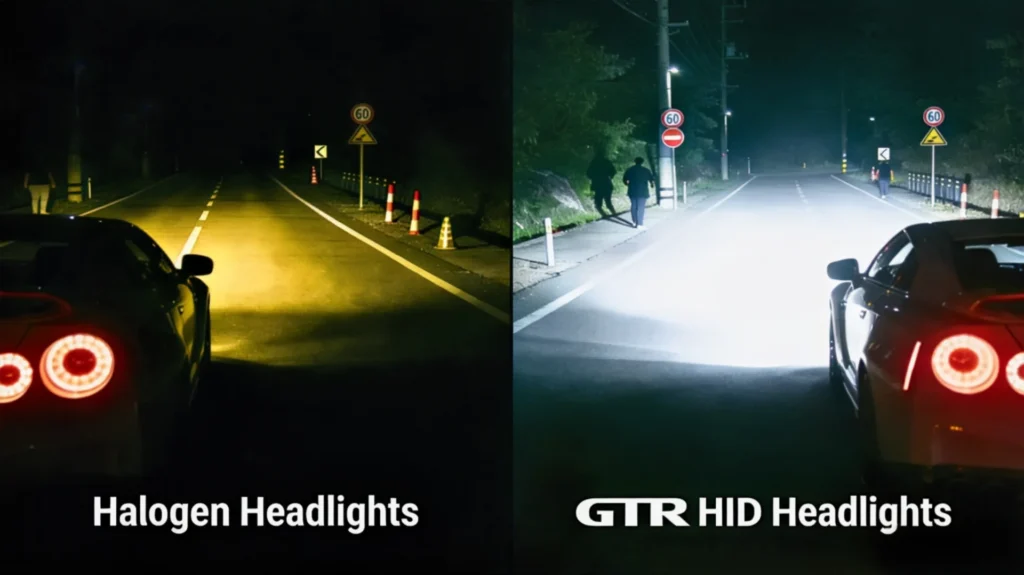
Choosing the right bi LED headlight projector lens retrofit kit requires understanding six critical factors: optical design, thermal management, lens size, beam pattern, certification compliance, and total cost of ownership.

The market for bi led headlight projector lens systems has exploded. Amazon alone lists over 2,000 options—from $35 drop-in bulbs claiming 100,000 lumens to $500 professional retrofit kits. Most claims are exaggerated. Some are outright fraudulent.

After evaluating dozens of bi led projector lens retrofit kit configurations in our GTR engineering lab, we have developed a systematic evaluation framework. Use this guide to separate marketing hype from genuine engineering.

The Complete Buyer’s Guide to Bi LED Headlight Projector Lenses (2026 Edition)

1. What Is a Bi-LED Projector Lens? (Technical Foundation)

A bi-beam LED projector lens (Bi-LED projector) is a headlamp optical system that uses one LED light source and one projector assembly to produce both low beam and high beam, switching via an internal solenoid-actuated cutoff shield.

Unlike single-beam projectors that require separate high-beam units, Bi-LED systems integrate both functions into one compact module. This saves space, reduces wiring complexity, and ensures consistent color temperature across both beam modes.

1.1. The Anatomy of a True Bi-LED Projector

When you disassemble a genuine bi led projector lens, here is what you will find inside:

  • LED chip(s): One or multiple high-intensity emitters mounted on a metal-core PCB
  • Reflector bowl: Precision-shaped elliptical reflector that captures and directs light toward the lens
  • Cutoff shield: Metal plate positioned between the reflector and lens that blocks upward light
  • Solenoid actuator: Electromagnetic coil that moves the shield when high beam is activated
  • Projection lens: Optical-grade glass (or plastic in cheap units) that focuses and distributes light
  • Heat dissipation system: Aluminum/copper heat sinks, cooling fans, or heat pipes
  • Driver module: Regulates voltage and current to prevent flickering and thermal runaway

As the Royalin-Lighting team explains: “The bi-led projector lens is almost the same as bi-xenon projector lens. In bi led lens, there do not need any other led bulbs. All components are integrated into one.”

The presence of a solenoid is your primary indicator of true Bi functionality. Look for an actuator and shutter linkage—that is the clearest clue.

2. Comparison #1: Bi-LED Projector vs. LED Bulb in Reflector Housing

This is the most common confusion point. Many drivers assume that installing LED bulbs in their existing reflector housings gives them “projector-like” performance. It does not.

2.1. Side-by-Side Comparison: Bi-LED Projector vs. Reflector + LED Bulb

Performance Metric Bi-LED Projector Lens LED Bulb in Reflector
Cutoff line sharpness Razor-sharp (DOT/SAE compliant) Blurry or absent
Glare for oncoming traffic Minimal (shield blocks upward light) High—frequent complaints from other drivers
Beam pattern uniformity Even, wide, predictable Uneven, with hot spots and dark zones
Distance throw (effective range) 300–500 feet (90–150 meters) 150–250 feet (45–75 meters)
Installation complexity Moderate (may require housing opening) Low (plug-and-play)
Legal compliance DOT-certified when properly installed Often illegal for road use in many regions

Why the huge difference? Reflector housings were engineered for halogen filaments that emit light omnidirectionally. LED chips emit directionally. As the CONPEX Group notes: “The core issue behind most reflector vs projector LED upgrade failures is optical mismatch. Halogen bulbs are 360-degree light sources. LEDs are directional.”

Even when installed with optimal orientation (LED chips at 3 o’clock and 9 o’clock), LED bulbs in reflectors cannot overcome this fundamental geometry mismatch. The reflector simply cannot reshape LED output the way a projector lens can.

3. Comparison #2: Bi-LED Projector vs. Bi-Xenon (HID) Projector

This comparison matters for drivers coming from older HID systems or deciding between technologies.

3.1. Detailed Feature Comparison

特點 Bi-LED Projector Bi-Xenon (HID) Projector
Startup time to full brightness 0.01 seconds (instant) 3–5 seconds (warm-up delay)
Lifespan (hours) 30,000–50,000+ 2,000–3,000
Power consumption 30–60W per unit 35–55W + ballast losses
Color temperature stability Consistent throughout life Shifts as bulb ages (color drift)
Moving parts Only the solenoid shield Solenoid shield + gas arc instability
Ballasts required No (integrated driver) Yes (external ballasts)
Vibration resistance Excellent (solid-state) Moderate (filament/arc sensitivity)
Upfront cost Higher ($200–500) Moderate ($80–250)

As the GZVAHID team summarizes: “Choose LED projector lenses if you want instant-on brightness, longer lifespan, better energy efficiency, and durability in tough conditions. Choose HID projector lenses if you seek very intense light at a somewhat lower upfront cost and don’t mind the ballast installation and warm-up time.”

For most daily drivers, Bi-LED is the superior long-term investment. The instant response time alone provides meaningful safety benefits—you see hazards the moment you switch to high beam, not three seconds later.

4. Comparison #3: 2.5-Inch vs. 3.0-Inch vs. 1.8-Inch Bi-LED Projectors

Selecting the correct lens diameter for your bi led headlight projector lens retrofit kit is arguably the most important fitment decision you will make—get this wrong and nothing else matters.

Lens size affects three things: physical fitment inside your headlight housing, beam width, and the style of cutoff line.

Practical guidance for each size:

  • 1.5–1.8 inch: Compact; ideal for motorcycles, fog lights, and vehicles with severely restricted housing depth. Beam width is narrower—acceptable for auxiliary lighting but not ideal as primary headlights.
  • 2.5 inch: The sweet spot for most passenger cars. Fits 95% of vehicles including Toyota, Honda, Mazda, Nissan, Hyundai, Kia, and most sedans/hatchbacks. Provides excellent width coverage (three full lanes) with strong distance throw.
  • 3.0 inch: Larger beam footprint; best for trucks (Ford F-series, RAM, Silverado), large SUVs, and vehicles with factory 3-inch projector housings. May require cutting or bracket modifications in smaller housings.

As LED-AKE notes: “Bigger projector lenses will easily fit in cars with large headlights. However, you can still install a smaller bi-led lens if you add a large shroud. Small projector lenses may be the only option for a car with small headlights.”

Our GTR engineering recommendation: measure your housing depth before ordering. A 2.5-inch projector typically requires 90–110mm of depth from mounting surface to the back of the housing. If you have less than 80mm, consider 1.8-inch options.

5. The Critical Evaluation Framework: 6 Factors That Determine Quality

Based on our years of manufacturing expertise, here is the exact checklist we use at GTR when qualifying bi led headlight projector lens systems:

5.1. Thermal Management Architecture

Heat is the number one cause of LED failure. LED chips convert over 60% of electrical energy into heat. Inadequate thermal management leads to “thermal runaway”—high temperatures exponentially accelerate lumen depreciation (dimming) and can catastrophically shorten the chip’s potential lifespan.

Look for: copper-core heat pipes, aviation-grade aluminum heat sinks, dual ball-bearing cooling fans (7,000+ RPM), and thermal interface materials between the chip and heat sink. Avoid: passive cooling only (no fans) on units over 30W, plastic housings that trap heat.

5.2. Optical Precision

The cutoff shield must be precision-stamped metal, not plastic, and firmly mounted to prevent vibration-induced misalignment. The projection lens should be optical-grade glass—plastic lenses yellow and warp under heat and UV exposure.

“The Bi-LED projector’s lens curvature, reflector geometry, and LED placement are calculated down to fractions of a millimeter. That level of optical engineering costs money.”

Test beam pattern before finalizing installation. Look for a flat, horizontal cutoff line with minimal color fringing (some blue hue at the cutoff edge is normal and desirable for contrast).

5.3. Solenoid Quality and Actuation Reliability

The solenoid actuator must operate reliably across temperature extremes (-30°C to 85°C) and survive hundreds of thousands of cycles. Low-quality solenoids can stick in high-beam mode (dangerous) or fail to engage at all.

Inspect the solenoid linkage. It should move freely without binding. Listen to the actuation—a clean “click” indicates proper mechanical engagement.

5.4. Wattage, Lumens, and Lux: Understanding Real Brightness

Manufacturers often inflate lumen claims. Use this guide to interpret specifications:

  • Actual wattage: 35–50W per unit is adequate for most applications. 60–80W indicates very high output but requires exceptional cooling. Beware of “120W” claims on $40 units—they are impossible without active cooling and premium components.
  • True lumens: Expect 3,000–5,000 raw lumens per unit from quality Bi-LED projectors. “20,000 lumens” claims typically measure both units combined and may include theoretical maximums, not sustained output.
  • Lux at 25 meters: This is the real-world metric that matters. Quality Bi-LED projectors deliver 8,000–15,000 lux at 25 meters.

“Lumen is a measure of the light output at the source, i.e., the LED, while Lux is a measure of how much light is cast onto a surface from the source. Lux is an important parameter because it factors distance and other factors that can limit how much light will be cast onto the road.”

5.5. Certification and Compliance

DOT (USA) or SAE compliance markings indicate the unit meets federal safety standards for beam pattern and glare control. However, “DOT-approved” does not guarantee plug-and-play legality—proper aiming and installation are still required.

ECE (European) certification uses different standards (R112 for LED headlamps). If you are outside North America, verify which standard applies in your jurisdiction.

5.6. Installation Method and Vehicle Compatibility

The two most common Bi-LED projector mounting types:

  • Threaded-shaft mount: Screws into the existing bulb socket opening using a locking nut. Non-destructive, reversible, fits most vehicles. This is what GTR uses for its 2.5-inch kits.
  • Bracket-mounted: Requires custom brackets or drilling/modification of the housing. More complex but may be necessary for certain vehicles or for quad-projector setups.

“Threaded-shaft style mount allows the projectors to be locked on their car headlight hardware. It can be mounted in H4/H7/9005/9006 headlights.” Always verify your bulb base type (H1, H4, H7, 9005, 9006, H13, etc.) and housing depth before ordering.

6. Real Customer Experiences: What Retrofit Forums Actually Say

We analyzed discussion threads across NSXPrime, FocusST, and other automotive forums to understand what real drivers experience with bi led headlight projector lens retrofits.

Positive experiences consistently mention:

  • “The focused usable light is probably 80% better. The beam pattern is much farther and wider vs. the factory projectors. The cutoff is crisp.”
  • “Users who have upgraded to Bi LED projector lenses report a significant improvement in their nighttime driving experience. The focused beam pattern of these lights illuminates the road more effectively, making it easier to see obstacles.”
  • “All in all, these are a phenomenal bang for the buck, and definitely worth buying.”

Negative experiences almost always trace to:

  • Cheap units with inadequate cooling that fail within months
  • Misaligned beam patterns causing glare complaints (aiming error, not product defect)
  • Incorrect size selection leading to fitment issues
  • Poor-quality cutoff shields that create uneven or non-existent cutoff lines

The pattern is clear: you get what you pay for. High-quality Bi-LED projectors from reputable manufacturers deliver transformative night driving experiences. Bottom-barrel knockoffs leave drivers frustrated.

7. Total Cost of Ownership Analysis

Let us compare a premium bi led projector lens retrofit kit against cheaper alternatives over a 5-year ownership period:

  • Bi-LED Projector (premium): $250–400 upfront, 50,000+ hour lifespan, zero bulb replacements over 5 years, integrated driver (no ballast to fail), consistent performance.
  • LED Bulbs in Reflector: $60–120 upfront, 12–18 month lifespan ($40–80 replacement annually = $200–400 over 5 years), ongoing glare risk, poor beam pattern, potential fines for non-compliance.
  • Bi-Xenon (HID) Projector: $120–250 upfront, 2,000–3,000 hour lifespan (requires bulb replacement every 2–3 years = $60–120 per replacement), ballasts may fail ($50–100 replacement), 3–5 second warm-up delay.

“Cheap LED bulbs frequently fail within 12–18 months. Replacing them every year turns a ‘cheap’ upgrade into a recurring expense. High-quality Bi-LED projectors are built to last 30,000+ hours—often the remaining life of the vehicle.”

When viewed over time, premium Bi-LED projectors are the more economical choice—not even counting the safety benefits and reduced maintenance hassle.

8. Frequently Asked Questions for B2B Buyers and Retail Customers

Q1: What is the difference between bi-LED and single-beam LED projectors?

Bi-LED uses a solenoid-actuated shield to provide both low and high beam from one unit. Single-beam provides only one function (usually low beam) and requires separate high-beam modules.

Q2: How can I identify a genuine Bi-LED projector vs. a fake?

Look for the solenoid actuator. “If it has a solenoid, it’s typically a bi-beam projector; if not, it’s usually single-beam.” Also verify the unit has both high and low beam wiring connections.

Q3: Are 3-inch Bi-LED projectors always better than 2.5-inch?

No. Size must match your housing. A 3-inch projector incorrectly installed in a housing designed for 2.5-inch will produce distorted beams and may not fit without cutting. Choose based on your specific vehicle, not general assumptions.

Q4: What is the ideal color temperature for Bi-LED projector lenses?

5500K to 6000K provides natural white light that balances visibility and eye comfort. Lower than 5000K appears yellowish (less modern). Higher than 6500K appears blue (fashion over function—reduces effective contrast).

Q5: How important is the reflector bowl material?

Metal bowls are preferable for durability. However, modern heat-resistant plastics can perform adequately with proper cooling. “The quality of plastic reflector bowls has improved with more heat-resistant material being used. A typical LED bulb also produces a lot less heat than a halogen or HID bulb.”

Q6: What does “non-destructive installation” actually mean?

It means the bi led projector lens retrofit kit mounts using the existing bulb socket opening, typically via a threaded shaft and locking nut. No cutting of the housing, no permanent modifications, and the installation is reversible.

Q7: Can I install Bi-LED projectors myself, or do I need a professional?

DIY installation is possible for mechanically inclined individuals. Expect 2–4 hours per side including removing the headlight assembly, opening the housing (some require baking to soften sealant), mounting the projector, resealing, and aiming. Professional installation costs $200–500 but guarantees proper alignment.

Q8: Will Bi-LED projectors trigger my vehicle’s CAN-bus error codes?

Some vehicles (especially European brands) monitor bulb resistance and may report errors with LED retrofits. Quality Bi-LED projectors include CAN-bus decoders or resistors to prevent this. Verify compatibility with your specific vehicle before purchasing.

Q9: How do I properly aim Bi-LED projector headlights after installation?

Park 25 feet from a wall on level ground. Mark the centerline of your vehicle and the height of your headlights on the wall. The top of the low-beam cutoff line should be 1–2 inches below the headlight centerline height. Adjust using factory adjusters until the pattern is level and symmetrical.

Q10: Are Bi-LED projector lenses legal in all 50 states?

When properly installed and aimed, DOT-compliant Bi-LED projectors are legal for road use. However, some states have additional restrictions on color temperature (often limiting to 6000K maximum) or aftermarket lighting modifications. Check your local Department of Motor Vehicles regulations before purchasing.

9. Why GTR Is Your Trusted Source for Bi-LED Projector Lenses

GTR has been engineering and manufacturing automotive LED lighting systems for over a decade. Our bi led headlight projector lens products are designed by former automotive OEM optical engineers and tested to exceed DOT, SAE, and ECE standards.

When you source from GTR, you get:

  • Factory-direct pricing: No middlemen markup. Competitive wholesale rates for B2B buyers.
  • Complete technical documentation: Installation guides, wiring diagrams, and aiming instructions included.
  • Global warranty support: 2-year manufacturer’s warranty on all bi led projector lens retrofit kit 產品。.
  • Bulk and custom options: OEM/ODM capabilities for businesses requiring private labeling or custom specifications.
  • Fast shipping from US/EU warehouses: Reduced lead times and import costs for international buyers.

Our best-selling 2.5-inch Bi-LED projector series delivers 20,000 lumens per pair, DOT-approved sharp cutoff lines, IP67 water resistance, and 50,000-hour rated lifespans—tested and verified in our ISO-certified manufacturing facility.

Ready to upgrade your vehicle lineup or secure reliable Bi-LED projector supply for your business? 參觀 https://www.ledcxr.com to browse our complete catalog. Contact our B2B sales team for volume pricing, customization options, and technical consultation.

For more technical resources, industry standards, and regulatory references, consult the SAE International lighting standards library or your local Department of Transportation lighting regulations.