
Choosing the right H7 LED headlight bulb is not about picking the highest lumen count or the cheapest price. Here is what actually matters — and how to avoid the mistakes most buyers make.
H7 halogen bulbs are among the most commonly used headlight bulbs in Europe and beyond, found in both cars and motorcycles. Unlike H4 bulbs with two filaments, H7 bulbs feature a single filament designed specifically for either low or high beam use. This single-purpose design can result in a better-focused beam pattern when the replacement bulb matches the original specifications.
But here is the problem: the H7 LED headlight bulb market is flooded with products that look identical on paper but perform radically differently in real-world conditions. This guide breaks down what separates a genuine upgrade from a disappointing purchase.
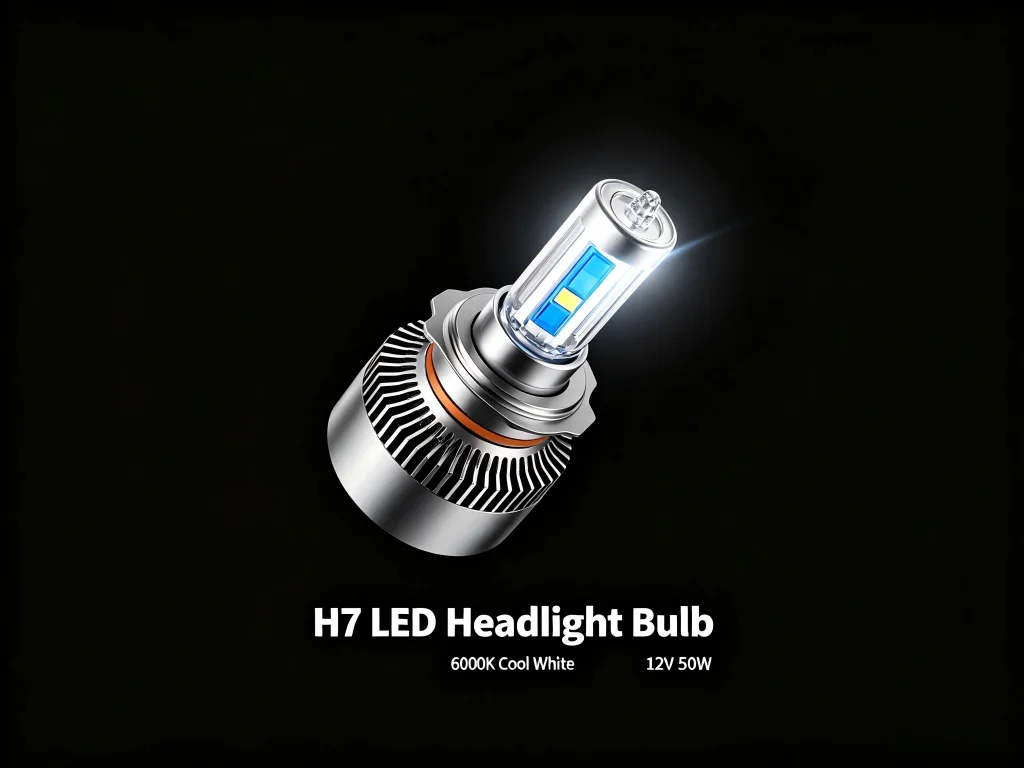
1. What Matters Most in an H7 LED Headlight Bulb
Five factors determine whether your H7 LED headlight bulb upgrade succeeds or fails: CANBUS compatibility, physical fitment, beam pattern accuracy, thermal management, and build quality.
La mayoría de los compradores se centra en el brillo y el precio. El comprador inteligente se centra en la compatibilidad y la ingeniería, porque el brillo no significa nada si la bombilla no funciona en tu vehículo.
1.1. Compatibilidad CANBUS: El factor decisivo
Modern vehicles use CANBUS (Controller Area Network) systems to monitor electrical components. When you replace a halogen bulb with an LED, the lower current draw often triggers a dashboard warning light.
Some manufacturers advertise “CANBUS error free” but deliver products that still cause errors. One Amazon reviewer noted: “It is saying CANBUS error free but it is not”. Another reported: “This item worked on my 2013 Mercedes Sprinter 906 then after three or four operations started to give a dashboard light-out error”.
The solution? Built-in CANBUS decoding that communicates properly with your vehicle’s computer. External resistors can work, but they generate significant heat — up to 50 watts of wasted energy that turns into heat inside your headlight housing.
For genuine CANBUS error-free operation, choose H7 LED headlight bulbs with integrated decoding rather than external resistor kits.
1.2. Ajuste físico: Diseño 1:1 vs. alternativas voluminosas
H7 headlight housings have limited space. The dust cover clearance is often just a few centimeters. Many LED bulbs use large heat sinks or external driver boxes that simply do not fit.
One Mercedes owner described the frustration: “To add to that the H7 adapters buyers must buy separately from a 3rd party vendor, were poor quality soft metal which bent easily and were impossible to install”.
The ideal H7 LED headlight bulb uses a 1:1 mini design that replicates the original halogen dimensions. The driver should be integrated into the bulb base, eliminating external boxes. Installation should take five minutes with no tools required.
As one satisfied customer noted: “Fitting these LED bulbs was simplicity itself, unplug the original bulbs and remove, fit LED bulb with a simple twist”.
1.3. Beam Pattern: Where Light Actually Goes
This is the most overlooked factor in H7 LED headlight bulb selection. The halogen filament sits at a precise position — 27.5mm from the base. If your LED chips are not in the exact same location, the beam pattern suffers.
Poor beam placement causes two problems: glare for oncoming traffic and dark spots in your own field of vision. You get the illusion of brightness — a bright foreground — but reduced distance visibility.
Quality H7 LED headlight bulbs position their chips to match the halogen filament exactly. In projector headlights, well-designed LEDs can outperform the original halogen entirely.
1.4. Gestión Térmica: El Asesino Silencioso del Rendimiento
LEDs generate heat at the semiconductor junction. If that heat is not efficiently dissipated, the LED degrades. Brightness drops. Color shifts. The bulb fails prematurely.
Look for H7 LED headlight bulbs with:
- Automotive-grade multi-core LED chips
- Efficient heat sink design (copper tubing or advanced aluminum)
- Reasonable power consumption (lower wattage typically means less heat)
- Active cooling where space permits
One reviewer noted the trade-off of passive cooling: “The only trade off being they are more susceptible to overheating if used for longer periods of time as they rely on passive heatsinks to cool down”.
1.5. Build Quality: You Get What You Pay For
The difference between a $20 H7 LED headlight bulb and a $80 set is not just marketing. It is materials, engineering, and quality control.
Cheap bulbs use:
- Single-core LED chips with poor light distribution
- Thin aluminum or steel mounting bases that bend
- Inadequate thermal design
- No CANBUS decoding
- No certification or warranty
Quality bulbs use automotive-grade materials, multi-core chips, proper thermal engineering, and come with meaningful warranties. One user described the difference: “Auxito is the real deal, not cheap Chinese junk”.
2. H7 LED Headlight Bulb Comparison: Key Specifications
| Característica | Budget Option | Mid-Range Option | Premium Option (GTR) |
|---|---|---|---|
| CANBUS Decoding | External resistor (adds heat) | Basic built-in decoder | Advanced built-in decoder |
| Fitment Design | Bulky, requires adapters | Compact, may need adapters | 1:1 mini, no adapters needed |
| Patrón del haz | Unpredictable, often poor | Decent, may have hot spots | Precision-engineered, OEM-like |
| Gestión térmica | Passive, inadequate | Basic active or passive | Advanced, automotive-grade |
| Lumens per Bulb | Claims 5,000-10,000 (unreliable) | 2,000-3,000 | 2,500 |
| Consumo de energía | 30-50W | 20-30W | 16W |
| Warranty | None or 30 days | 1 año | Industry-leading coverage |
3. Real-World Performance: What Reviews Actually Say
Reading between the lines of customer reviews reveals the truth about H7 LED headlight bulbs.
The Good: “Pin sharp flat cut-off with the correct dip beam kick up to the left and an instant increase in brightness, colour temperature and most importantly, greater range”.
The Bad: “I was disappointed the LED did not work on Jeep Cherokee 2014. I tried a few LED lights from different sellers. All the same results — It will light up then turn off after 2 minutes”.
The Ugly: “Item started to give dash error … the CANBUS correction has failed — I have no way of contacting the supplier to return them”.
The pattern is clear: compatibility issues are the number one complaint. A bulb that does not work with your vehicle is useless regardless of its specifications.
4. Instalación: qué esperar
A properly designed H7 LED headlight bulb should install in under 10 minutes per side. The process is straightforward:
- Remove the dust cover from the headlight housing
- Unplug the factory wiring from the halogen bulb
- Remove the halogen bulb (usually a quarter-turn counterclockwise)
- Insert the new LED bulb, aligning the tabs with the housing slots
- Twist clockwise until it locks in place
- Plug in the factory connector
- Replace the dust cover
If your installation requires adapters, external resistors, or modification to the dust cover, you have chosen the wrong bulb. Quality H7 LED headlight bulbs are truly plug and play.
5. Legal Considerations: Is It Road Legal?
This is a critical question that many buyers ignore. In many countries, LED bulbs are not street legal when used in halogen headlight housings. The concern is beam pattern differences that may cause glare.
Top brands like Osram and Philips address these issues with quality design and testing. Some of their LED models have ECE/E-mark approval for road use in certain vehicles. Always check:
- ECE certification for UK/EU legality
- Local regulations in your country or state
- Whether your specific vehicle model is approved for LED conversion
For off-road or show use, restrictions may not apply. But for daily driving, legal compliance matters.
6. Frequently asked questions about H7 LED headlight bulbs
What Is the Difference Between H7 and H4 Bulbs?
H7 bulbs have a single filament and are used for either high beam or low beam individually. H4 bulbs have two filaments in one unit and handle both functions.
Can I use H7 LED headlight bulbs in any car?
Most vehicles with H7 halogen fittings can accept LED replacements, but compatibility depends on the vehicle’s electrical system and headlight housing design. Always verify fitment for your specific make and model.
Why do I need CANBUS-compatible H7 LED headlight bulbs?
Modern vehicles monitor bulb status through the CANBUS system. LEDs draw less current than halogens, which can trigger dashboard errors. CANBUS-compatible bulbs have built-in decoding to prevent this.
¿Más lúmenes siempre es mejor?
Not necessarily. A bulb that claims 30,000 lumens but cannot sustain that output due to heat limitations is worse than a 2,500-lumen bulb that maintains consistent brightness. Focus on real-world performance, not inflated numbers.
Do H7 LED headlight bulbs last longer than halogens?
Yes. Quality LEDs can last 30,000-50,000 hours compared to 500-1,000 hours for halogens. However, poor thermal management can significantly reduce LED lifespan.
What does 6000K mean for H7 LED headlight bulbs?
6000K refers to color temperature. It produces crisp white light that mimics daylight, improving visibility and reducing eye strain. Higher numbers (6500K+) shift toward blue; lower numbers (4300K) shift toward yellow.
Can I install H7 LED headlight bulbs myself?
Yes, with a 1:1 mini design that matches the original halogen dimensions. Installation typically takes 5-10 minutes per side with no special tools required.
Are Halfords H7 LED headlight bulbs any good?
Halfords offers H7 LED options for off-road and interior use. However, road-legal use may be restricted, and compatibility varies by vehicle. Always check product specifications carefully.
7. Tomando su decisión final
Choosing an H7 LED headlight bulb comes down to matching the right engineering to your specific vehicle. Do not fall for marketing hype. Look for:
- Built-in CANBUS decoding (not external resistors)
- 1:1 mini design with integrated driver
- Precision chip placement matching halogen filament position
- Efficient thermal management with reasonable power consumption
- Automotive-grade materials and meaningful warranty
GTR H7 LED headlight bulbs meet every criterion above. At just 16 watts, our CSP Mini series delivers 2,500 lumens per bulb — two to three times brighter than halogen — with advanced thermal management that ensures consistent performance. The built-in CANBUS decoder eliminates errors and flicker without external resistors. The 1:1 mini design fits perfectly in tight European headlight housings.
Your headlights are not just an accessory. They are a critical safety system. Choose the H7 LED headlight bulb that actually works.
Explore GTR H7 LED Headlight Bulbs — Engineered to Fit. Built to Last.