
Entra en cualquier tienda de autopartes o navega por Amazon, y te enfrentarás a cientos de opciones de bombillas LED H7 que van desde reemplazos halógenos de $10 hasta kits de conversión LED de $200. Cada una afirma ser la más brillante, la más duradera o la más fácil de instalar. Aquí está la verdad: la mayoría de las reseñas de bombillas LED H7 son promociones pagadas o escritas por personas que instalaron la bombilla ayer y no tienen idea de si seguirá funcionando el próximo mes.
This guide cuts through the noise. Based on our years of manufacturing experience and analysis of thousands of real user experiences, we'll show you exactly how to evaluate an H7 LED bulb — and why most drivers end up buying the wrong one.
1. Understanding the H7 LED headlight bulb landscape
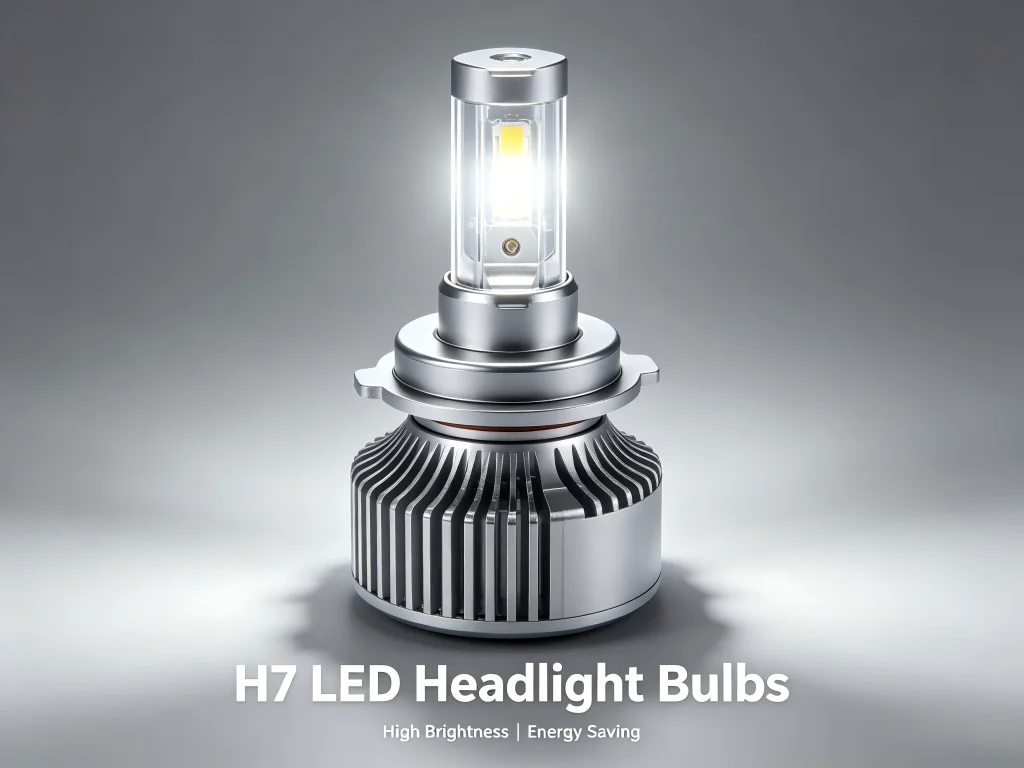
Before diving into the selection criteria, let's clarify what an H7 headlight bulb really is. The H7 is a single-filament bulb with a PX26d base and two exposed blade terminals. Unlike H4 bulbs that handle both high and low beams in one unit, H7 bulbs are designed for a single function — either low beam or high beam. Most vehicles use H7 for low beams, with a separate bulb type for high beams.
Your H7 LED headlight bulb options fall into three categories:
| Característica | Halogen H7 | LED H7 | HID (Xenon) H7 |
|---|---|---|---|
| Lumens | ~1,200-1,550 | 3,000-6,000+ | 3,000-5,000+ |
| Vida útil | 300-500 hours | 30,000-50,000 hours | 2,000-3,000 hours |
| Temperatura de color | 3,200K-3,500K | 5,000K-6,500K | 4,300K-6,000K |
| Luminous efficiency | 15-25 lm/W | 100-120+ lm/W | 80-100 lm/W |
| Tiempo de calentamiento | 0.1-0.2 seconds | Instantaneous | 3-5 seconds |
| Instalación | Direct replacement | Plug and play (with CANBUS) | Requires ballast, wiring |
| Cost (per pair) | $10-$40 | $40-$150 | $50-$150 |
The case for upgrading from halogen to H7 LED is compelling: more light, longer lifespan, lower energy consumption, and instant full brightness. But not all LED bulbs offer these benefits. The difference between an excellent LED and a terrible one comes down to design, not marketing.
2. The five critical factors that separate quality H7 LED bulbs from junk
2.1. CANBUS compatibility: The decisive factor
CANBUS compatibility is the most common complaint we see in H7 LED headlight bulb reviews. Your vehicle's computer monitors electrical loads. When you install an LED that draws less power than the factory halogen, the computer thinks the bulb is burned out. The result is flickering, error warnings, or bulbs that refuse to work altogether.
Some manufacturers advertise “CANBUS error-free” but deliver products that still cause errors. An Amazon reviewer noted: “It says it's CANBUS error-free but it's not.” Another reported: “This item worked in my 2013 Mercedes Sprinter 906, but after three or four operations it started giving a light-out error on the dashboard.”.
External resistor kits can work, but they generate significant heat — up to 50 watts of wasted energy converted into heat inside the headlight housing. This additional heat degrades the LED chips and shortens their lifespan.
The solution is built-in CANBUS decoding that communicates correctly with your vehicle's computer. GTR H7 LED bulbs feature advanced built-in decoding that eliminates dashboard errors without external resistors.
2.2. Physical fit: 1:1 design vs. bulky alternatives
H7 headlight housings have limited space. The dust cap clearance is often only a few centimeters. Many LED bulbs use large heat sinks or external control boxes that simply don't fit.
One Mercedes owner described the frustration: “Furthermore, the H7 adapters that buyers must purchase separately from a third-party supplier were made of poor-quality soft metal that bent easily and were impossible to install.”.
The ideal H7 LED bulb uses a mini 1:1 design that replicates the original halogen dimensions. The driver should be integrated into the bulb base, eliminating external boxes. Installation should take five minutes without tools. As one satisfied customer noted: “Installing these LED bulbs was very straightforward, I unplugged the original bulbs and removed them, then installed the LED bulb with a simple twist.”.
2.3. Beam pattern precision: Where the light actually goes
This is the most overlooked factor in h7 LED bulb selection — and the most important for safety. The halogen filament in an H7 bulb sits at a precise position — 27.5 mm from the base. If your LED chips aren't in the same exact location, the beam pattern is affected.
Poor beam placement causes two problems: glare for oncoming traffic and dark spots in your own field of vision. You get the illusion of brightness — a bright foreground — but reduced visibility at distance. One driver reported that his h7 LED bulbs were “really dim in my headlight projector housing, making it difficult to drive at night.”.
Quality h7 LED headlight bulbs position their chips to match the halogen filament exactly. The best designs feature 360-degree adjustable collars that allow you to rotate the LED array to match your specific headlight housing.
2.4. Thermal Management: The Silent Performance Killer
LEDs generate heat. Heat degrades LED chips. Degraded LEDs produce less light. This is simple physics, yet many manufacturers treat thermal management as an afterthought.
Most h7 LED projector units overheat after twenty minutes of high beam use, causing the LEDs to thermally throttle from thousands of lumens down to just hundreds. You may not notice the gradual dimming, but the reduced visibility creates a real safety hazard.
Advanced thermal solutions include vapor chambers, high-RPM fans, and optimized heatsink designs. GTR uses a vapor chamber combined with a 8,000 RPM bearingless fan, keeping junction temperatures below 85°C even in 40°C ambient conditions.
2.5. Honest Specifications vs. Marketing Exaggeration
Manufacturers love to advertise astronomical lumen numbers. “50,000 lumens!” “100,000 lumens!” Here's the engineering reality: a single H7 LED bulb physically cannot produce 50,000 raw lumens with current consumer-grade technology. These numbers are calculated per set, measured at the LED chip before optics, or simply fabricated.
What matters is usable lumens — light that actually reaches the road in a focused beam. A perfectly focused bulb at 4,000 lumens will outperform a scattered beam at 10,000 lumens every time.
GTR publishes verifiable numbers. Our Ultra 3.0 produces 4,700 raw lumens per bulb — a real figure that translates to exceptional road illumination when properly focused. We don't play the inflated lumen game because honest specifications build trust.
3. Comparing the Giants: Big Brands vs. Generic Market Bulbs vs. GTR
| Métrica | Big Brand (Philips/Osram) | Generic Market Bulbs | GTR Professional Series |
|---|---|---|---|
| Brightness Gain | +150% – 200% | Unreliable / Inflated Claims | +300% – 500% |
| CANBUS Decoding | Basic built-in decoder | External resistor (adds heat) | Advanced built-in decoder |
| Beam adjustment | Fixed or limited | Often none | 360° adjustable collar |
| Gestión térmica | Standard heat sink | Inadequate/cheap fan | Vapor chamber + 8,000 RPM bearingless fan |
| Temperatura de color | Varies | Often harsh 6500K | Premium 5500K (OEM Lexus/Audi specification) |
| Build quality | Bueno | Poor / inconsistent | Premium aerospace grade |
| Reliability | Reliable | High failure rate | Exceptionally reliable |
While brands like Philips and Osram offer reliability, specialized manufacturers like GTR provide higher lumen density and custom adjustments for B2B and enthusiast markets. GTR offers the “sweet spot” of extreme brightness without the reliability issues of unbranded units.
4. H7 LED bulbs for projector headlights: what you need to know
If you are using H7 LED bulbs for projector headlights, the stakes are even higher. Projector housings are designed for precise optical focusing, and they will ruthlessly expose any design flaws in your LED bulb.
Older double-sided LED bulbs show a “V-shaped dark spot at the 6 o'clock position” when used in projector housings. The result is a visible dark area right in the middle of your beam pattern, exactly where you need light the most.
True active dual-chip Bi-LED projectors, the ones GTR uses, feature two physically separated LED chips. Low beam uses the lower chip with a fixed precision cut-off shield. High beam activates the upper chip while keeping the lower chip on. Total output increases from 100 to 150 percent. No moving parts. Instant switching. This is the gold standard.
5. Costly mistakes most buyers make with H7 LED headlight bulbs
- Chasing inflated lumen numbers. Ignore marketing claims. Look for verifiable specifications from manufacturers that publish real numbers.
- Ignorar el patrón de haz. A bulb that scatters light is worse than a halogen one. Look for adjustable collars that allow you to match your housing.
- Bypassing CANBUS compatibility. Dashboard errors and flickering are not acceptable. Choose bulbs with built-in decoding.
- Choosing the wrong color temperature. 6500K looks cold but reduces contrast in adverse weather conditions. 5500K provides better visibility.
- Ignoring thermal management. Heat degrades LEDs. Choose bulbs with proven cooling systems.
6. Frequently asked questions about H7 LED headlight bulbs
6.1. Are H7 LED bulbs legal for road use?
Replacement LED bulbs are often not legal for road use in many jurisdictions because halogen headlight units were not designed for LED light sources. However, some countries and regions have specific regulations. Always check local laws before upgrading.
6.2. Will H7 LED bulbs work with my projector headlights?
Yes, but only with properly designed bulbs that position the LED chips in the exact location of the halogen filament. Poorly designed bulbs create dark spots and glare. GTR bulbs feature adjustable 360-degree collars for optimal positioning in projector housings.
6.3. How do I know if my car uses H7 bulbs?
Consult the owner's manual, look at the bulb base designation printed on your current bulbs, or use an online vehicle compatibility tool. H7 is common in European and Asian vehicles from BMW, Volkswagen, Audi, Mercedes-Benz, Ford, and Hyundai.
6.4. Do H7 LED bulbs require special wiring?
Quality H7 LED bulbs with built-in drivers do not require special wiring: they plug directly into the factory harness. However, some vehicles may require CANBUS decoders if the bulbs do not have built-in compatibility.
6.5. ¿Cuál es la diferencia entre las bombillas H7 y H4?
H7 es una bombilla de haz único con un filamento, diseñada para luz de cruce o luz de carretera. H4 es una bombilla de doble haz con dos filamentos que proporciona funciones de luz alta y baja en una sola bombilla. No son intercambiables.
6.6. ¿Cuánto más brillantes son las bombillas LED H7 que las halógenas?
Las bombillas LED H7 de calidad producen de 3,000 a 6,000+ lúmenes en comparación con 1,200 a 1,550 lúmenes para halógenas: un aumento de 2x a 4x en la salida total de luz. Sin embargo, el enfoque del patrón de haz importa tanto como los lúmenes brutos.
7. Tome la decisión correcta para su seguridad y tranquilidad
Sus faros no son un accesorio: son un sistema de seguridad crítico. Elegir la bombilla de faro LED h7 incorrecta puede comprometer su visibilidad, molestar a otros conductores y dejarlo varado con un tablero lleno de códigos de error.
GTR ha pasado años diseñando soluciones que realmente funcionan: bombillas que ofrecen un brillo excepcional, patrones de haz perfectos y un rendimiento confiable noche tras noche. Nuestras bombillas LED h7 son confiadas por conductores que se niegan a comprometer la seguridad o la calidad.
Visita https://www.rhgtr.com hoy para explorar nuestra gama completa de bombillas de faro LED H7 y experimentar la diferencia que hace la ingeniería genuina.